History
Avignon, the century the popes ruled from France
For most of the fourteenth century the Catholic Church was run not from Rome but from a fortress on the Rhône, and Provence has never quite stopped benefiting from the palace, the wine and the roads the popes left behind.
By Arthur Penhallow26 September 20264 min read
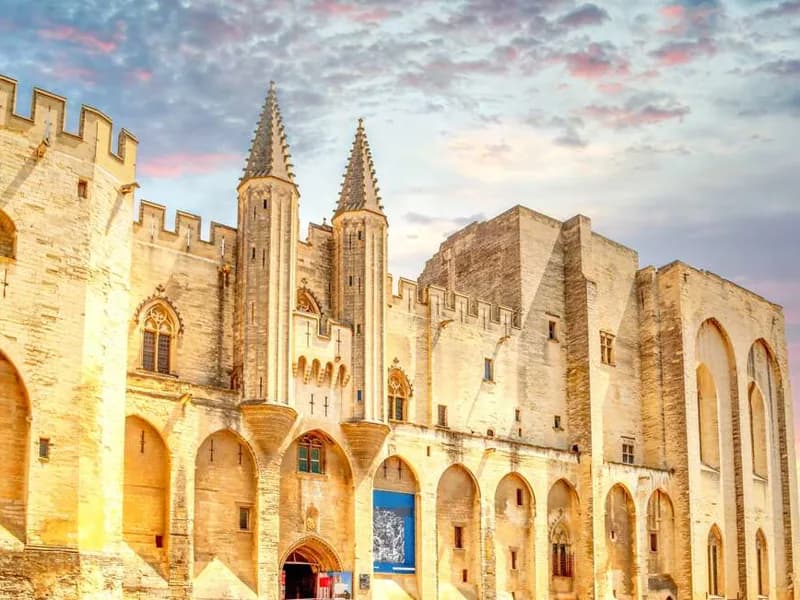
Avignon's Palais des Papes is, by area, the largest Gothic palace in Europe, a fact that surprises most visitors who assume the popes' grandest buildings must all stand in Rome. For sixty-seven years, between 1309 and 1376, they did not. Seven successive popes, all of them French, governed the Catholic Church from this fortified palace on the Rhône, in a period contemporaries and later historians alike took to calling, with a certain amount of relish, the Babylonian Captivity of the papacy, after the biblical exile of the Israelites.
An election that never quite left France
The move began with Clement V, elected pope in 1305 and, as a former Archbishop of Bordeaux, disinclined to relocate to a Rome then riven by feuding noble families and periodic violence against the papal court. He settled instead in Avignon, at the time not strictly part of France but of the adjoining Kingdom of Arles, and his successors, all French cardinals elected largely by a French-dominated College of Cardinals, saw no urgent reason to move back. Each pope expanded the palace in turn, adding towers, chapels and fortifications until the complex became less a religious residence than a small self-contained city, capable of housing the entire papal court and administration and of withstanding a siege if it came to that.
The arrangement ended messily. Pope Gregory XI finally returned the papacy to Rome in 1377, under pressure from figures including Catherine of Siena, but his death shortly afterwards triggered a disputed election and, within a year, a rival pope was installed back in Avignon, beginning the Western Schism, a period of close to forty years in which two, and at times three, rival popes each claimed legitimacy from competing seats. The schism was resolved only in 1417, and Avignon's brief period as the centre of Western Christianity ended with it, though the city remained papal territory, administered directly by Rome, for a further four centuries until it was formally annexed by revolutionary France in 1791.
The bridge that stopped halfway
Just outside the palace walls stands the ruin most visitors already know before they arrive, even if they do not immediately recognise it: the Pont Saint-Bénézet, the broken bridge celebrated in the French nursery rhyme "Sur le pont d'Avignon". Built in the twelfth century and rebuilt repeatedly after flood damage over the centuries that followed, the bridge originally crossed the full width of the Rhône; repeated flooding eventually proved too costly to keep repairing, and the town gave up maintaining it in the seventeenth century, leaving four of its original twenty-two arches standing, reaching partway across the river and stopping, rather abruptly, in open water.
The vineyards the popes left behind
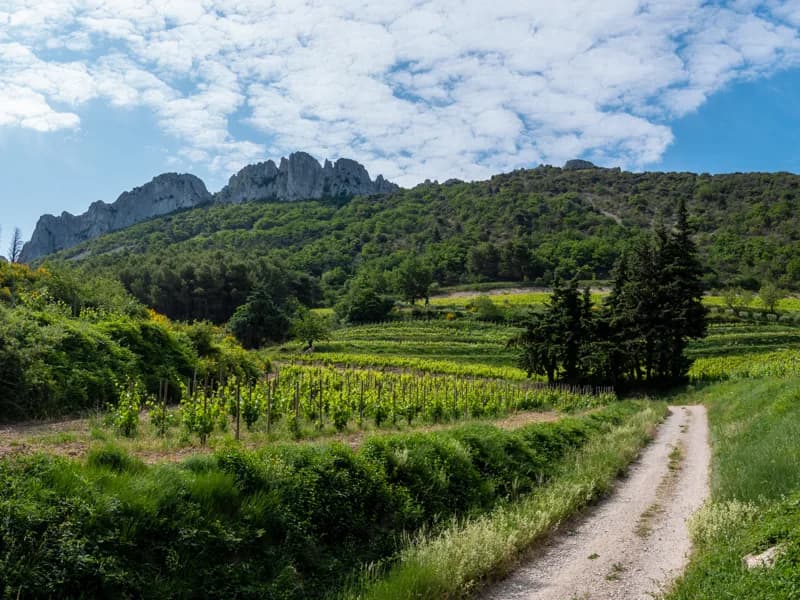
The papal court's presence for the better part of a century left a lasting mark on the surrounding countryside as well as the town. Vineyards around the village of Châteauneuf-du-Pape, a short distance upriver, were developed and favoured specifically to supply the papal cellars, and the village's name, meaning simply the pope's new castle, still advertises the connection on every bottle. The wider landscape of Provence beyond Avignon, lavender fields, hill villages built from pale local stone and Roman ruins considerably older than the popes, has drawn walkers and cyclists for a different reason entirely, though most routes through the region still pass, sooner or later, beneath the palace walls.
Walking or cycling to Avignon
Explore Worldwide's Walking in Provence, seven nights, spends its final days approaching Avignon on foot through the villages and abbeys of the Vaucluse, taking in Gordes and the Roman ruins at Vaison-la-Romaine along the way.
Cycle Provence covers similar ground at a faster pace, riding between Avignon, Châteauneuf-du-Pape and the market towns of the Vaucluse on quiet country roads that were, in most cases, already old when the popes first arrived.
An hour or two inside the Palais des Papes is enough to sense the scale of what was built here in under a century; the broken bridge, visible from almost anywhere in the old town, is a rather more honest monument to how much of the past simply washes away.
By Arthur Penhallow, the name Atlas & Passage’s editorial team writes under. Prices and dates in the trips below come from the operators and can change.