Wildlife
Belize, the barrier reef and the jungle behind it
Belize is a small country with two great wild places: the longest barrier reef in the Americas just offshore, and a forested interior where jaguars are protected and Maya temples rise out of the trees.
By Walter Pellow2 November 20264 min read
Belize is easy to overlook on a map: a narrow strip of coast and forest between Mexico, Guatemala and the Caribbean, a little larger than Wales and with a population of a few hundred thousand. It is the only country in Central America where English is the official language, a legacy of its past as British Honduras. What it has in abundance is nature. Offshore lies the Belize Barrier Reef, the largest in the Americas and second only to Australia's Great Barrier Reef in size. Inland, much of the country is still forested, and a remarkable proportion of it is protected.
The reef and the cayes
The reef runs for around three hundred kilometres along the coast, a few kilometres to a few tens of kilometres offshore, enclosing a shallow lagoon scattered with small islands, the cayes. Charles Darwin, who never saw it, is often quoted as having called it the most remarkable reef in the West Indies, on the strength of reports from naval surveyors. It is a UNESCO World Heritage Site, along with the three atolls further out to sea and the Great Blue Hole, a deep, almost perfectly round marine sinkhole that has become one of the country's best known images.
The Great Blue Hole lies out on Lighthouse Reef, one of the three atolls, a near-circle of dark water about three hundred metres across, set in the pale turquoise of the shallows. It is a sinkhole that formed on dry land during an ice age, when the sea was far lower, and was flooded as the ice melted. Jacques Cousteau brought it to wide attention when he explored it in the early 1970s, and it is now one of the best-known dive sites in the world, though its deep walls are a dive for the experienced.
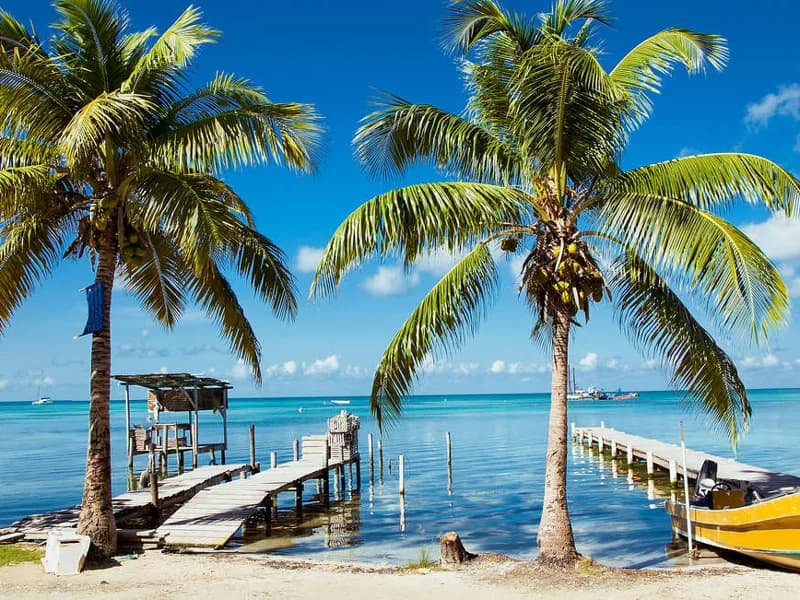
For most visitors the reef means snorkelling. Inside the lagoon the water is shallow, clear and warm, and the coral is home to rays, turtles, nurse sharks and a great variety of fish. Caye Caulker, in the north, is a small, low-key island of sandy streets and wooden houses, whose motto, Go Slow, is painted on signs all over it. Laughing Bird Caye, off the southern coast near Placencia, is a tiny island within a marine national park, named after the laughing gulls that once nested there.
A remarkable proportion of the country is protected.
The jungle behind the coast
Away from the coast, the forest takes over. Cockscomb Basin Wildlife Sanctuary, in the south, was set up in the 1980s as the world's first reserve dedicated to protecting jaguars. Seeing one is rare, since they are shy and mostly active at night, but their tracks are often found on the trails, and the reserve's forest, rivers and waterfalls are worth walking for their own sake. Its mountains rise to the jagged ridge that gave Cockscomb its name.
In the north, Crooked Tree Wildlife Sanctuary is a network of lagoons and wetlands that becomes one of the best places for birds in Central America in the dry season, when the water levels drop and herons, egrets, kingfishers and the huge jabiru stork gather to feed.
The Maya lived here too, in large numbers, and their cities are scattered through the forest. Altun Ha, near the coast north of Belize City, is a compact site of plazas and temples, where a large carved jade head of the sun god was found, the largest known Maya jade carving. Xunantunich, in the west near San Ignacio, stands on a ridge above the Mopan River, reached by a little hand-cranked ferry, and its main pyramid, El Castillo, is one of the tallest buildings in the country. Across the border in Guatemala, a short drive away, is Tikal, the greatest of all.
The trips
Explore Worldwide's Discover Belize, twelve nights, covers both halves of the country. It starts in Belize City and visits Altun Ha and Crooked Tree, travels south to Placencia, Laughing Bird Caye and the Cockscomb Basin, then west to San Ignacio and Xunantunich, crosses into Guatemala for Tikal and Flores, and ends on Caye Caulker. Its departures run from October to April.
Explore's Contrasts of Mexico + Yucatán Peninsula, twenty nights, is a long journey through central and southern Mexico, Oaxaca and the Chiapas highlands that continues into Guatemala and Belize and adds the Yucatán.
The dry season, from roughly December to May, is the best time for the reef and for walking in the forest; it is also when the birds gather at Crooked Tree. The wet season brings heavier rain and, later in the year, the risk of hurricanes. Belize is a small place, but it is not one to rush: the reef rewards a few days, and the jungle more.
By Walter Pellow, the name Atlas & Passage’s editorial team writes under. Prices and dates in the trips below come from the operators and can change.