History
Tikal, the Maya city above the Petén forest
For centuries Tikal was one of the great cities of the Maya world. Now its temples rise out of the rainforest of northern Guatemala, and from the top of the tallest you look out over a sea of trees.
By Walter Pellow2 November 20264 min read
From the top of Temple IV, the view is mostly trees. The rainforest of the Petén runs unbroken to the horizon, a rolling green canopy alive with the calls of birds and the roar of howler monkeys, and out of it, here and there, rise the stone roof-combs of other temples, like the masts of ships in a green sea. That is Tikal now. A thousand years ago, the view would have been of a city.
Tikal was one of the largest and most powerful cities of the Classic Maya, the civilisation that flourished in the lowlands of what are now Guatemala, Belize and southern Mexico from about AD 250 to 900. At its height it held tens of thousands of people, with palaces, ball courts, causeways, reservoirs and the great stepped temples that are its emblem, and its kings fought long wars with their rivals, above all the city of Calakmul to the north.
The Great Plaza
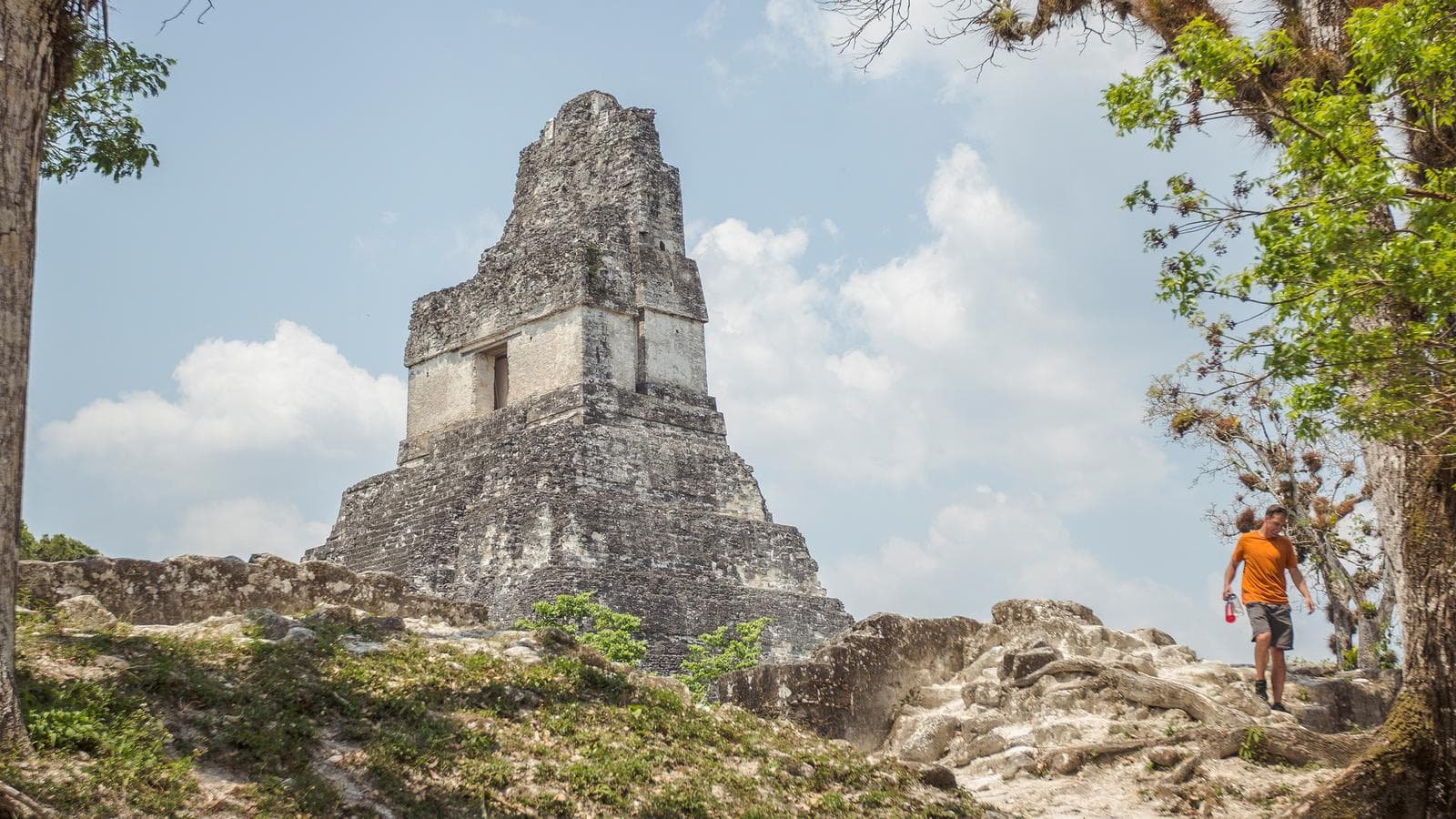
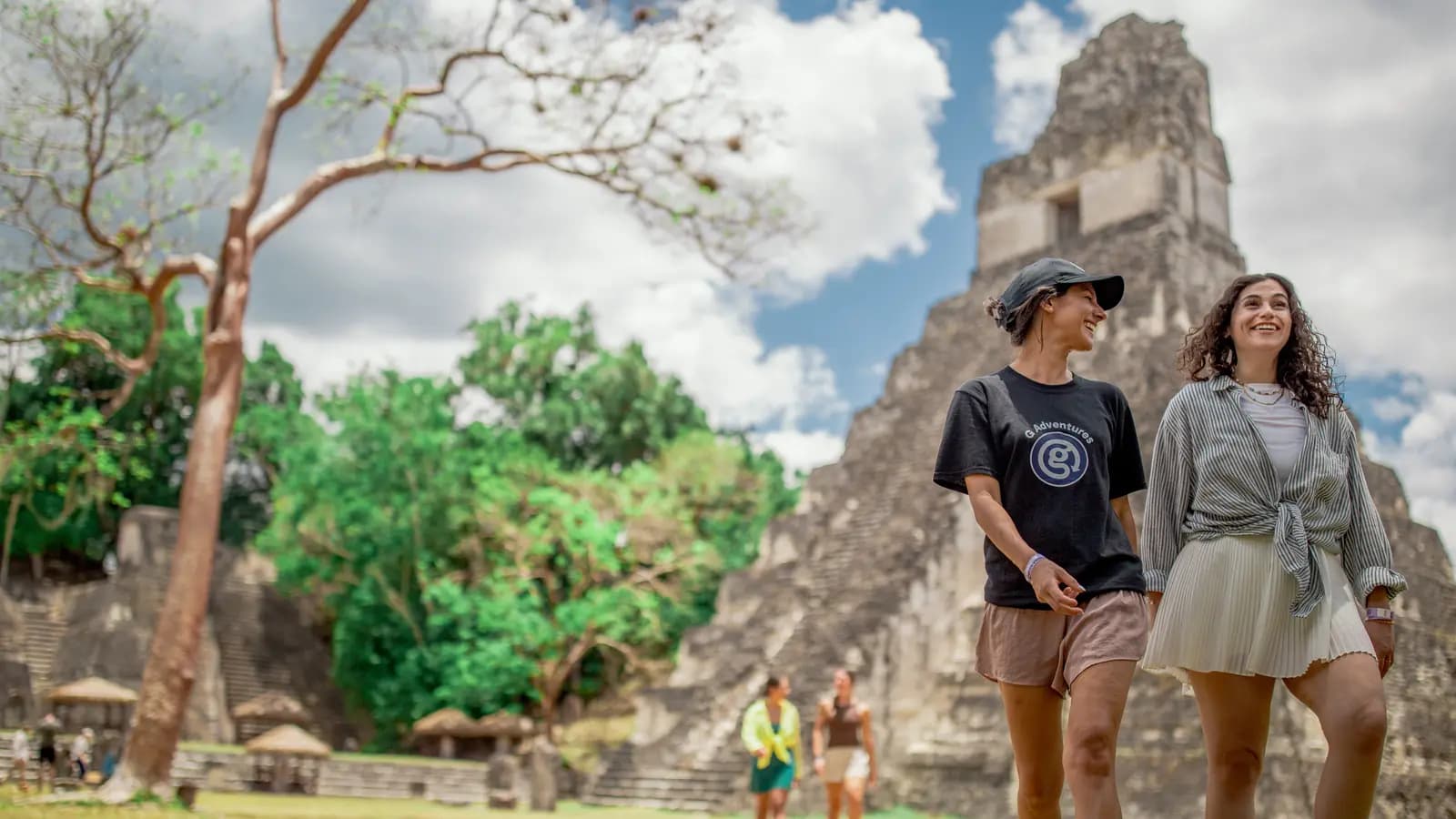
The heart of the site is the Great Plaza, an open space of grass and stone framed by two temples facing one another across it. To the east stands Temple I, the Temple of the Great Jaguar, rising in nine steep tiers to a small shrine and a carved roof-comb, about 47 metres above the plaza. It was built as the tomb of one of Tikal's greatest rulers, Jasaw Chan K'awiil I, who died in the 730s and whose reign restored the city's fortunes after a long eclipse. Opposite stands Temple II, a little lower, sometimes said to be dedicated to his wife.
On the north side of the plaza is the North Acropolis, a jumble of temples built one on top of another over many centuries, and on the south side the Central Acropolis, a maze of palace rooms and courtyards. Stelae, carved stone slabs recording the deeds and dates of kings, stand in rows in front of them.
Out of the forest rise the roof-combs of other temples, like the masts of ships in a green sea.
The forest and the fall
Then, in the ninth century, Tikal declined, as did the other cities of the southern lowlands. Building stopped, the population drained away, and by the end of the tenth century the city was largely abandoned to the forest. Why is still debated: drought, war, overpopulation and the exhaustion of the land are all part of the answer. The forest took the city back so thoroughly that it was not widely known to the outside world until an expedition reached it in the mid-nineteenth century.
Today the ruins lie inside Tikal National Park, a World Heritage Site for both its archaeology and its forest. Spider and howler monkeys, coatis, toucans and the brilliantly coloured ocellated turkey are common sights, and the walk between the temples is half the pleasure. Temple IV, the tallest structure on the site, is the one with the view: from its top, the roof-combs of Temples I, II and III rise above the canopy. Film buffs may recognise the scene from the first Star Wars film, which used it for the rebel base.
The usual advice is to go early, for the cooler air, the wildlife and the morning mist lifting off the trees, and to take water, a hat and good shoes. The steps are steep, and the site is large.
Tours that go there
Tikal is reached from Flores, a small island town on Lake Petén Itzá, and most tours of Guatemala end or begin there. G Adventures' eight-night Highlights of Guatemala combines Tikal and Flores with Antigua, Lake Atitlán and Panajachel, Chichicastenango, Semuc Champey and Lanquin. It departs in January, February, March, November and December.
Explore's fourteen-night Guatemala - Land of the Maya goes deeper into the Maya world: from Guatemala City to Copan, across the border in Honduras, and Quirigua, then Puerto Barrios, Livingston and the Rio Dulce, Flores and Tikal, Sayaxche, the Candelaria Caves, Coban and Lanquín. It departs in January, February, March, October and November.
For a shorter trip, G Adventures' eight-night Classic Belize & Tikal combines San Ignacio in western Belize and the Caribbean island of Caye Caulker with a crossing into Guatemala for Tikal. It departs in June, November and December.
Whichever you choose, give Tikal a full day if you can, and be at the top of Temple IV at least once. The forest is the reason the city is so moving. It is also the reason it was lost.
By Walter Pellow, the name Atlas & Passage’s editorial team writes under. Prices and dates in the trips below come from the operators and can change.