Journeys
Lake Atitlán, the lake ringed by volcanoes and Maya villages
Lake Atitlán fills a volcanic crater in the Guatemalan highlands, with three volcanoes on its southern shore and Maya towns all the way round. The way to see it is by boat, in the morning.
By Walter Pellow2 November 20264 min read
When Aldous Huxley came through Guatemala in the 1930s, he compared Lake Atitlán with Lake Como, and decided that Atitlán was Como with the addition of several immense volcanoes. It was meant as praise, and travellers have quoted the idea ever since, because it is hard to improve on. The lake is long and deep and blue, its shores rise steeply to a ring of green hills, and along its southern side stand three volcanic cones: San Pedro, Tolimán and Atitlán itself, the highest, at over 3,500 metres.
The lake lies in a caldera, the hollow left when an enormous eruption about 84,000 years ago emptied the magma chamber beneath and the ground collapsed into the space. The three volcanoes grew afterwards, inside and at the edge of the crater. On a clear morning, with their reflections in the water, it is hard to believe such a calm place has so violent a history.
The villages round the shore
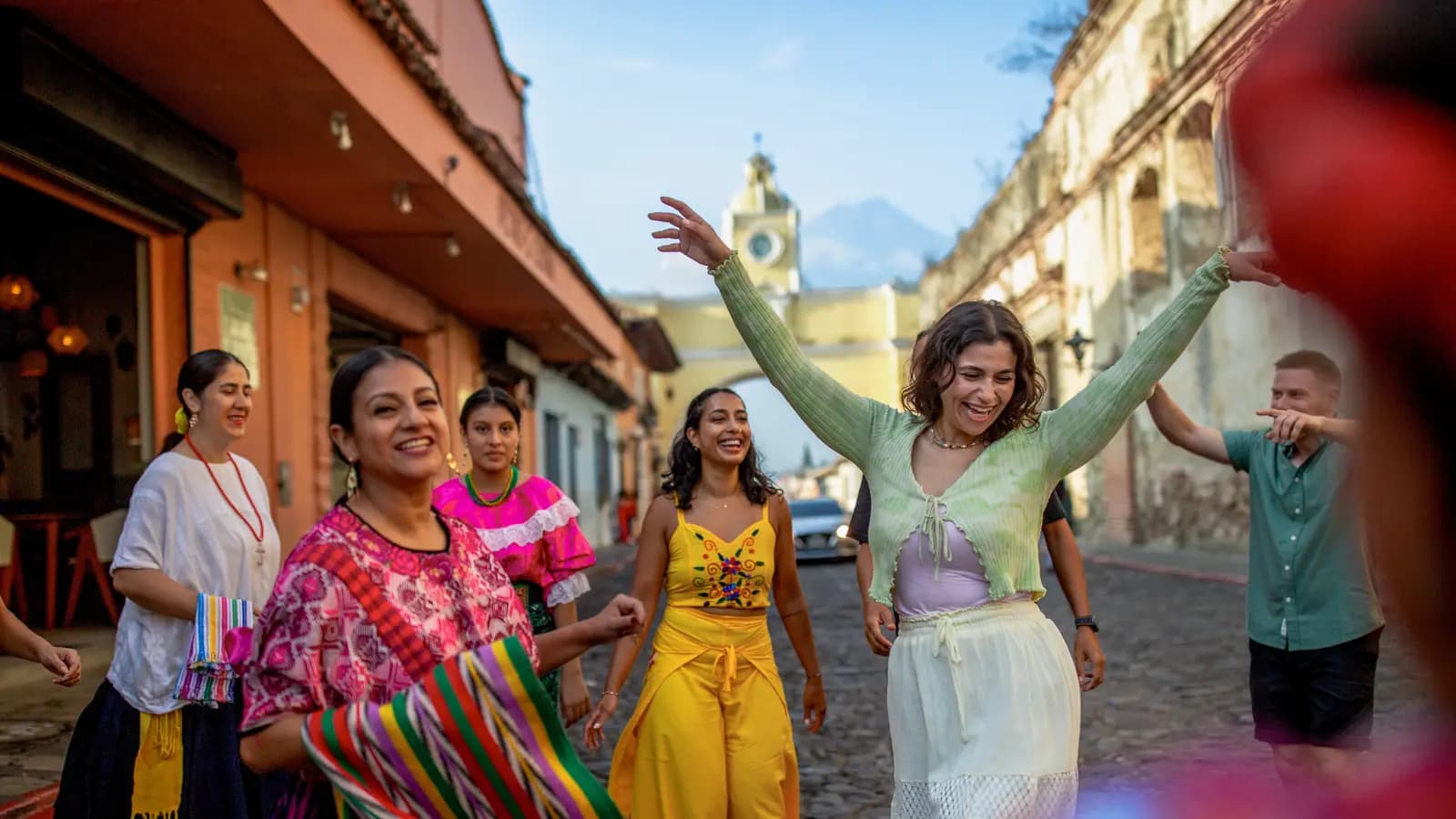
What sets Atitlán apart from its Italian rival is the people. The towns and villages around the lake are Maya, of the Kaqchikel and Tz'utujil peoples, and many keep their own languages, their own dress and their own markets. Each has a character of its own, and the traditional women's blouse, the huipil, is woven in patterns and colours that differ from one town to the next, so that a practised eye can often tell where its wearer comes from.
Panajachel, on the northern shore, is the gateway: the road from the highlands comes down to it in hairpins, and it is the place most visitors stay, with a long main street, a lakefront and the main jetties. Across the water, Santiago Atitlán, a large Tz'utujil town, sits in a bay between the volcanoes, and is known for its market, its old church and its devotion to Maximón, a folk saint of cigars and offerings whose image moves from house to house each year. San Juan La Laguna, on the western shore, has turned its weaving into a way of life for visitors as well as residents: cooperatives of women dye cotton with plants and weave it on backstrap looms, and are happy to show how it is done. San Pedro La Laguna, next door, is the lake's backpacker town, cheerful and a little ramshackle.
On a clear morning, it is hard to believe such a calm place has so violent a history.
Crossing the water
Roads round the lake are few and slow, so the lake is crossed by lanchas, the small open boats that run between the villages like buses. The rule of thumb is to cross in the morning. Around midday the wind known as the xocomil often gets up, and the afternoon water can be choppy enough to make the ride a wet one. Mornings are also when the volcanoes are most often clear of cloud, and when the light on the lake is softest.
The dry season, from about November to April, is the best time for clear views; in the rainy months the clouds tend to gather on the volcanoes by late morning.
Tours that stop there
Most tours of Guatemala give the lake a night or two between Antigua and the highlands. G Adventures' eight-night Highlights of Guatemala goes from Antigua to Lake Atitlán and Panajachel, the market town of Chichicastenango, Semuc Champey and Lanquin, and Flores and Tikal in the north. It departs in January, February, March, November and December. Chichicastenango, in the hills above the lake, holds one of Guatemala's best-known markets on Thursdays and Sundays, when the steps of its church of Santo Tomás fill with incense and flower sellers.
G Adventures' eight-night Solo-ish Guatemala, for people travelling on their own, follows a similar line, from Antigua to Lake Atitlán and Panajachel, then Tikal and Flores, Finca Paraíso and the Rio Dulce. It departs in January, February, March and December.
For a longer journey, G Adventures' fifteen-night Basic Central America: Mexico & Guatemala includes the weaving village of San Juan La Laguna on the lake as well as Antigua Guatemala and Tikal, then crosses into Belize for San Ignacio and Caye Caulker and ends on Mexico's Caribbean coast at Playa del Carmen. It departs in January, February, November and December.
However you come, try to be on the water early on your first morning, before the wind and the clouds. That is the view Huxley meant.
By Walter Pellow, the name Atlas & Passage’s editorial team writes under. Prices and dates in the trips below come from the operators and can change.