Journeys
Buenos Aires, and the falls that outdo Niagara
A city built by European immigration and a waterfall system spread wide enough to make Niagara look modest sit at opposite ends of the same overland route north from Argentina's capital.
By Arthur Penhallow26 September 20264 min read
Buenos Aires grew, over the late nineteenth and early twentieth centuries, into one of the great immigrant cities of the Americas, its population swelled overwhelmingly by arrivals from Italy and Spain, a wave large enough that a substantial share of Argentines today trace at least part of their ancestry to Italian immigration alone. The city's character still carries that history plainly: an Italian inflection in the local Spanish, an architecture that borrows freely from Paris and Madrid, and a culture of café life and late dinners that would not feel entirely foreign in either.
Tango, and where it actually started
Tango developed in the working-class port neighbourhoods of Buenos Aires and Montevideo in the late nineteenth century, in dockside bars and dance halls that brought together European immigrants, Argentine and Uruguayan criollos, and Afro-descendant communities whose musical traditions fed into the new form. It began as music and dance considered disreputable by the city's upper classes, and it was, somewhat improbably, a wave of enthusiasm for the dance in Paris in the years before the First World War that sent it back across the Atlantic with a respectability it had not previously enjoyed at home. La Boca, the old dockside neighbourhood where much of this history unfolded, remains one of the city's most visited quarters, its Caminito street lined with brightly painted corrugated-metal houses, a style said locally to trace back to dockworkers repurposing leftover ship paint on their own homes.
North to a waterfall wider than Niagara
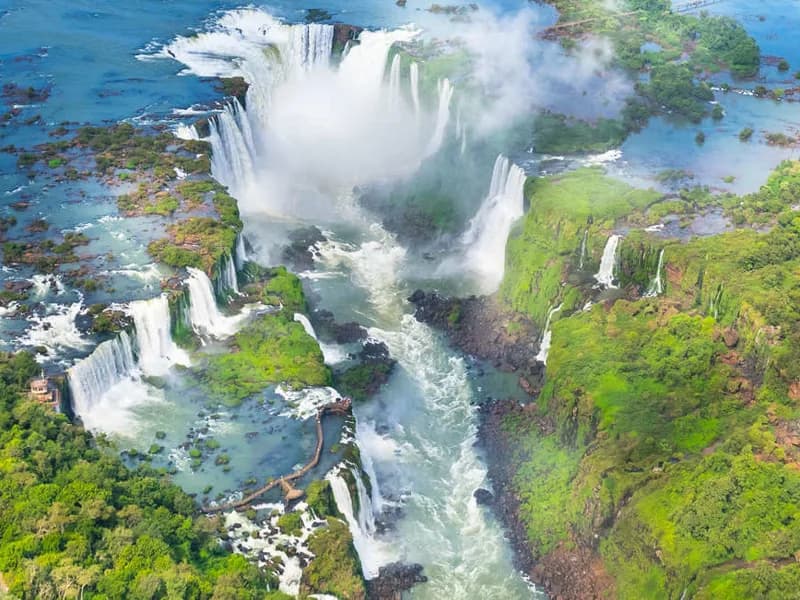
Several routes north from Buenos Aires lead eventually to Iguazu Falls, on the border with Brazil, where the Iguazu River drops over a horseshoe-shaped system of roughly two hundred and seventy separate cascades spread across more than two and a half kilometres, considerably wider, taken as a whole, than Niagara Falls. The most dramatic single section, the Garganta del Diablo, or Devil's Throat, is a U-shaped chasm where several of the largest falls converge into a single roaring drop, generating enough spray to be visible, and audible, from some distance before the viewing platforms bring it properly into sight.
A horseshoe-shaped system of roughly two hundred and seventy separate cascades, considerably wider, taken as a whole, than Niagara Falls.
A border shared, and a forest either side of it
Iguazu sits within a substantial stretch of subtropical Atlantic Forest, protected as national parks on both the Argentine and Brazilian sides of the border, home to a range of wildlife considerably harder to find than the falls themselves: toucans, capuchin monkeys and, in the forest's less visited corners, jaguar, though sightings of the last are rare enough that no honest guide would ever promise one. The Argentine side of the falls generally offers closer, more immersive walkways directly over and alongside the cascades, while the Brazilian side is usually credited with the better single panoramic view across the whole system.
Fitting the two together
Because Buenos Aires and Iguazu sit a considerable distance apart, most itineraries connect them by internal flight rather than road, treating the trip as two distinct chapters, a capital built on European immigration and tango, and a natural wonder shared with Brazil, rather than a single continuous journey.
Back in the capital, the Recoleta Cemetery offers an unexpected counterpart to the city's immigrant energy: a walled necropolis of elaborate mausoleums, built from the nineteenth century onward by Buenos Aires's wealthiest families in a competing array of European architectural styles, laid out on streets narrow enough to feel like a miniature city rather than a graveyard. Eva Perón, the political figure whose life remains one of the most discussed in twentieth-century Argentine history, is buried here, in a comparatively modest family vault that draws a steady stream of visitors regardless of the elaborate company surrounding it.
Much of Buenos Aires operates on a later rhythm than most European cities, dinner reservations that would count as late in London arriving as perfectly ordinary here, and cafés that stay busy well into the evening. It is not a city built for an early, rushed sightseeing schedule, and itineraries that build in slower mornings, a coffee before the day's plans begin rather than straight into a full schedule, tend to suit its character rather better than one built purely around a checklist of sights. Spring and autumn, March to May and September to November, suit both halves of the trip well, avoiding the sharpest humidity of the Iguazu summer and the coldest snaps of a Buenos Aires winter.
By Arthur Penhallow, the name Atlas & Passage’s editorial team writes under. Prices and dates in the trips below come from the operators and can change.