History
Chichén Itzá, and the shadow serpent of the equinox
Twice a year, late in the afternoon, a line of triangles of light runs down the steps of the great pyramid at Chichén Itzá and joins a stone serpent's head at the bottom. Whether the builders meant it is still argued over. The pyramid is remarkable either way.
By Walter Pellow2 November 20264 min read
Every year around the spring and autumn equinoxes, crowds gather on the grass in front of the great pyramid at Chichén Itzá and wait for the late afternoon. As the sun drops, the stepped edge of the pyramid's north-west corner casts a row of triangular shadows onto the side of the northern staircase. The triangles of light between them form a wavy line that seems to run down the steps, and at the bottom of the staircase it meets a carved stone serpent's head. For a while, the snake appears to be moving.
The pyramid is dedicated to Kukulcán, the feathered serpent, and it is hard to resist the idea that the Maya designed the building to produce exactly this effect. Some archaeologists think they did; others point out that the effect lasts for several days either side of the equinox and that it may be a happy accident of a building aligned to the sun for other reasons. What is not in doubt is that the Maya were careful astronomers, and that the pyramid is full of numbers.
The pyramid that is also a calendar
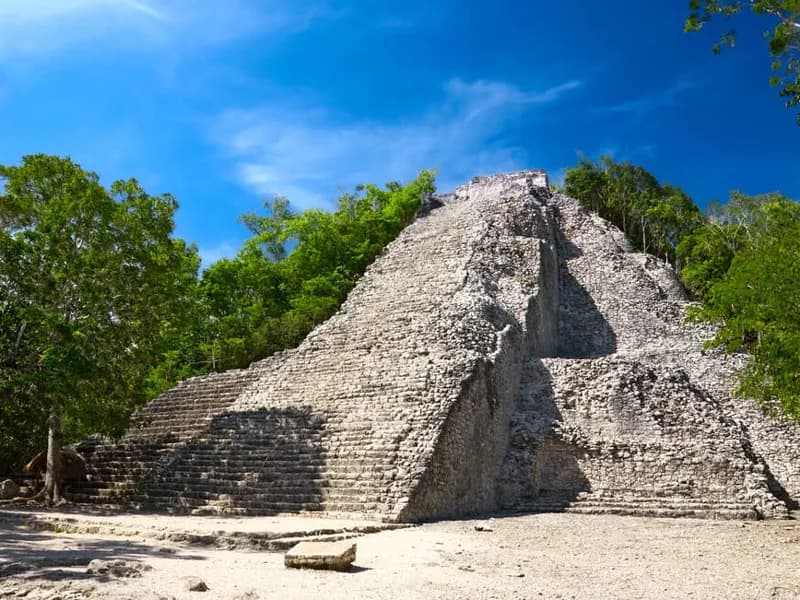
The building the Spanish called El Castillo, the castle, is a square stepped pyramid with a staircase on each side and a small temple on top. The count of the steps is usually given as ninety-one on each of the four stairways, which with the platform at the top makes three hundred and sixty-five, the days of the solar year. Each face is divided into terraces and panels whose numbers have been read as the months of the Maya calendar. It is a building designed, at least in part, to keep time.
It is also a building with another building inside it. In the 1930s, excavators tunnelled into the pyramid and found an older, smaller pyramid beneath, complete with a temple containing a red-painted stone jaguar throne and a reclining chacmool figure. The Maya often built over their temples in this way, encasing the old structure in a new one.
The count of the steps on the four stairways, with the platform at the top, makes three hundred and sixty-five.
A city, not a monument
Chichén Itzá was one of the great cities of the Maya world in the centuries before the Spanish arrived, at its height roughly between the ninth and twelfth centuries. It is unusual among Maya sites for the mixture of styles in its buildings, some in the traditional Maya manner and others showing strong influence from central Mexico, which has fed a long debate about who exactly built it and how.
The pyramid is only part of it. The site's ball court is the largest known in Mesoamerica, a long walled field with stone rings set high on the walls through which players are thought to have propelled a heavy rubber ball without using their hands. Carvings along its walls show a decapitation, a reminder that the game had a ritual meaning that went well beyond sport. Nearby are the Temple of the Warriors, surrounded by rows of carved columns, and the curious round building called El Caracol, the snail, which is generally thought to have been an observatory.
North of the main plaza, a raised causeway leads to the Sacred Cenote, a large natural sinkhole with sheer sides. The Yucatán has no rivers on its surface, and its people depended on these openings into the water table. The Sacred Cenote was a place of offerings: divers and dredgers have brought up jade, gold, pottery and human bones from its depths.
Seeing it, and when
Chichén Itzá is busy, as one of the most visited archaeological sites in Mexico, and the large tour groups from the coast arrive mid-morning. It is at its best early, before the heat and the crowds build, and on the equinox itself the site is crowded from noon. Visitors are no longer allowed to climb the pyramid.
Explore Worldwide's Best of Mexico's Yucatán Peninsula, seven nights, takes in Chichén Itzá along with the other Maya sites of Cobá and Uxmal, the colonial towns of Valladolid, Izamal and Mérida, the Ik Kil cenote and the flamingo lagoons of Celestún, starting from Playa del Carmen. Its departures fall in spring and early winter, from March to May and in November and December.
Explore's Cycle Mexico: The Yucatán Peninsula, eight nights, covers the region by bicycle from Cancún and Isla Mujeres, with Chichén Itzá, Mérida, Izamal, Valladolid and Río Lagartos among its stops. The peninsula is flat, which helps.
For a longer first visit to the country, Explore's Upgraded Highlights of Mexico, eleven nights, combines Mexico City, Puebla and Oaxaca with Chichén Itzá, Valladolid, Cobá and the Caribbean coast at Playa del Carmen and Cozumel.
The equinox effect is famous, but it is not the reason to go. The reason is the city itself: the scale of the plaza, the precision of the pyramid, and the dark water of the cenote at the end of the causeway, which tells you more about how the Maya lived on this dry limestone shelf than anything else on the site.
By Walter Pellow, the name Atlas & Passage’s editorial team writes under. Prices and dates in the trips below come from the operators and can change.