Seasons
Christmas in Costa Rica, at the start of the dry season
In Costa Rica, Christmas comes as the rains give way on the Pacific side. The country spends December outdoors, with tamales, lights, horses and the long school holiday.
By Walter Pellow2 November 20264 min read
A British Christmas is a matter of drawn curtains and the lights on by four. In Costa Rica the season turns the other way. December is when the rains ease on the Pacific side of the country, the skies over the Central Valley clear, and Costa Ricans head outdoors for the best part of a month. The school year ends, families go to the beach, and the capital spends its evenings watching parades.
It is a good moment to arrive, and a busy one. The dry season on the Pacific slope usually runs from about December to April, and December is its beginning: the forests are still green from the rains, the rivers are full and the roads are drying out. The Caribbean side keeps its own, less tidy, pattern of weather, and can be wet at almost any time of year.
Tamales, lights and horses
Christmas in Costa Rica is a family affair before it is anything else, and the food that marks it is the tamal: maize dough with pork or chicken, rice and vegetables, wrapped in banana leaves and boiled. Making them is a household job, often for several generations at once, and a stack of parcels tied in pairs turns up on doorsteps all through December. Most homes also set up a portal, a nativity scene, sometimes modest and sometimes taking over a room.
The capital, San José, has its own calendar. The Festival de la Luz, the festival of light, is a night-time parade of bands and illuminations through the city in December; in 2026 it is set for Saturday 12 December, with a new route and, this year, large balloons instead of the traditional floats. Then, on 26 December, comes the Tope, a parade of horses and riders through the centre of San José. Around the turn of the year the fiestas at Zapote, on the edge of the city, add bullfighting of the Costa Rican kind, in which nobody harms the bull and a crowd of volunteers runs about the ring trying not to be harmed by it.
None of this is laid on for visitors, and most of it happens in the Central Valley, which tours tend to pass through on the first and last days. But it sets the mood of the month, which is cheerful and on holiday.
December is when the rains ease, and the whole country seems to go outdoors.
The volcano, the cloud forest and the coast
Most first trips to Costa Rica follow the same shape, because the country's best-known places sit in a convenient loop. The Arenal volcano, a near-perfect cone above the town of La Fortuna, is the first stop for most. It has been quiet since 2010 after four decades of activity, and around it are hot springs fed by the volcano's heat, hanging bridges through the forest and the lake behind the dam. In December the cloud often lifts from the summit in the mornings, which is the best chance of seeing the whole cone.
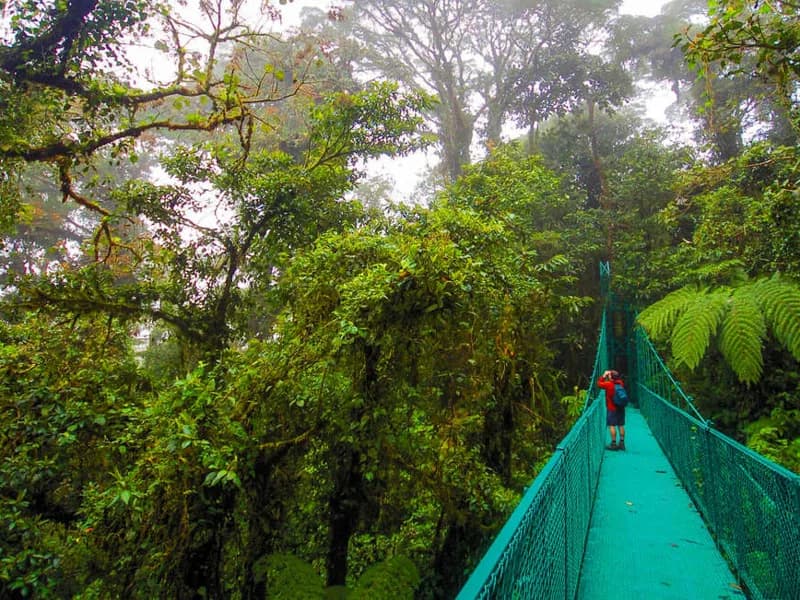
Monteverde, up in the hills to the west, is the cloud forest: a forest that lives in the clouds blown up from the Caribbean side, its trees covered in mosses, orchids and bromeliads. The bird everyone hopes for here is the resplendent quetzal, which is easiest to find in its nesting season, in the first half of the year. In December the cloud forest is cool and often misty, and that is rather the point of it.
Then the coast. Manuel Antonio, on the Pacific, is a small national park and a much-visited one: a headland of forest and white-sand coves where monkeys, sloths and iguanas live within sight of the beach. It is busy at Christmas, because Costa Ricans are on holiday too, and an early start is worth it.
Tours that go there
Explore's seven-night Highlights of Costa Rica follows that loop: San José, La Fortuna and the Arenal National Park, Monteverde, then down to the Pacific by way of the Rio Tarcoles bridge and the Carara Biological Reserve to Manuel Antonio and its national park. It departs in every month of the year, December included.
The nine-night Highlights of Costa Rica + Beach Extension takes the same route with time added on the coast at Manuel Antonio, and a visit to the Doka Estate at the start; it also departs in every month.
For longer, Explore's thirteen-night Upgraded - Costa Rica Wildlife reaches the parts the shorter tours miss: the Irazu volcano and the Turrialba valley, Tortuguero on the Caribbean side, Arenal and La Fortuna, Monteverde, then south to Dominical, the Osa Peninsula and Corcovado National Park. Its departure months include December, January, February and March.
If you go over Christmas itself, book early, because December is the start of the high season and Costa Ricans travel too. And take a light jumper for Monteverde: the dry season on the coast does not mean warm nights in the cloud forest.
By Walter Pellow, the name Atlas & Passage’s editorial team writes under. Prices and dates in the trips below come from the operators and can change.