History
Fes, Meknes and the Rome that got there first
Morocco's imperial cities are usually told as a story that begins with Fes in the eighth century. A short drive from Meknes, a set of Roman ruins insists the story actually starts rather earlier.
By Arthur Penhallow26 September 20264 min read
Most accounts of Morocco's imperial cities begin with Fes, founded at the end of the eighth century and built up over the following centuries into one of the great centres of Islamic learning and craft in North Africa. It is a reasonable place to start, but not, strictly, the true beginning. A few kilometres from Meknes, in open farmland, stand the ruins of Volubilis, a Roman provincial capital that was already old, and already abandoned, by the time Fes existed at all.
A Roman city at the empire's edge
Volubilis began as a Berber and Carthaginian settlement before becoming the administrative centre of the Roman province of Mauretania Tingitana from the first century AD, a position that made it wealthy on the trade of olive oil, grain and wild animals destined for the arenas of Rome. What survives is substantial for a site this far from the empire's core: a triumphal arch, a basilica, the outlines of villas, and a set of mosaic floors, remarkably intact after nearly two thousand years, depicting scenes from Greek mythology with a level of craftsmanship that suggests the town's merchants had money and were not shy about spending it on decoration. The Romans withdrew from the area in the late third century, and the town continued in local hands for several more centuries before being largely abandoned once Fes, a short distance away, became the region's new centre of gravity in the eighth and ninth centuries.
Fes, built for learning as much as for rule
Fes itself was founded in stages by the Idrisid dynasty, and by 859 it was home to the University of al-Qarawiyyin, founded by Fatima al-Fihri and widely recognised as one of the oldest continuously operating institutions of higher learning in the world. The old medina, Fes el Bali, grew up around it as a dense maze of workshops and houses, largely unchanged in layout since the medieval period and still, by most measures, one of the largest car-free urban areas anywhere. Its tanneries, dyeing hides in stone vats using methods that have barely changed in centuries, are among the oldest working examples of the trade still in operation.
A Roman provincial capital that was already old, and already abandoned, by the time Fes existed at all.
Meknes, and a sultan who built at speed
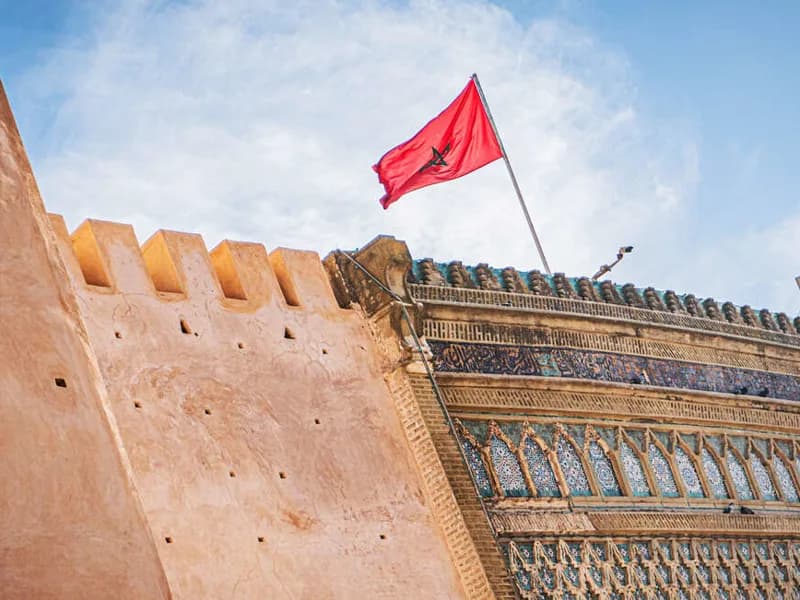
Meknes, the third city on this route, owes its grandest architecture to a single reign: Sultan Moulay Ismail, who ruled from 1672 to 1727 and set about turning Meknes into an imperial capital to rival Fes and Marrakech, with vast granaries, stables reputedly built to hold thousands of horses, and city walls running for many kilometres. The scale of the ambition outlasted the sultan's own dynasty's use of the city as a capital, but the walls, gates and granaries remain, on a scale that still surprises visitors more used to the tighter, older streets of Fes.
Three cities, three different kinds of power
Taken together, the three sites tell a fairly clear story about how power was expressed in this part of North Africa over two thousand years: Roman administrative order at Volubilis, religious and scholarly prestige at Fes, and sheer imperial scale at Meknes. None of the three cancels the others out, which is part of what makes the route rewarding; each city answers a different question about what a capital was for.
Chefchaouen, a coda rather than a capital
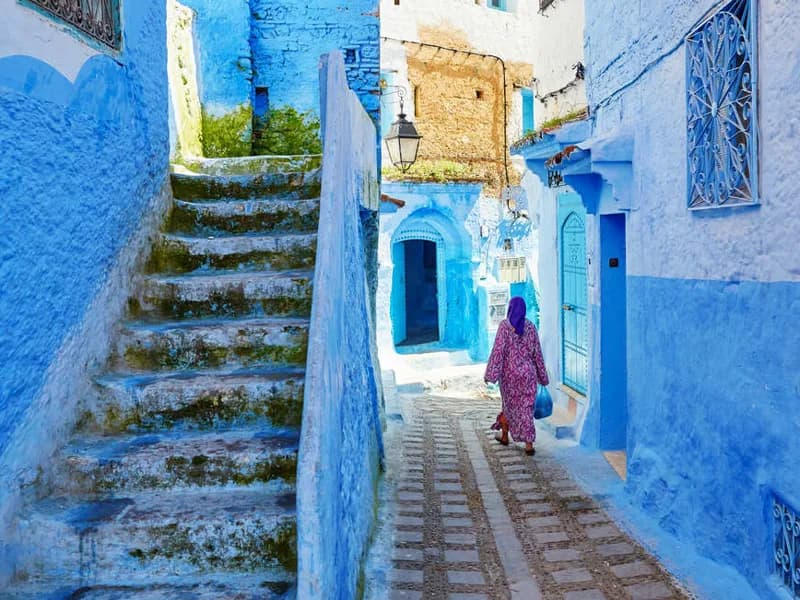
Several itineraries that link the imperial cities also detour north to Chefchaouen, in the Rif Mountains, a town with no real claim to the same political history as Fes or Meknes but a distinctive character of its own: narrow lanes painted in shades of blue, a tradition whose exact origin is disputed but which has become the town's defining feature regardless. It sits outside the imperial story proper, a mountain town rather than a seat of dynastic power, but its inclusion on this route offers a useful contrast: after three cities built to project authority, a smaller town that simply grew the way it grew.
The best months for this circuit are spring and autumn, when the inland cities are warm rather than uncomfortably hot and Volubilis's open, largely unshaded ruins are still pleasant to walk around at midday. Winter is workable too, cool enough at altitude in Chefchaouen and the Rif to need a coat in the evenings, but generally spared the summer crowds that build steadily through Fes and Marrakech from June onward.
By Arthur Penhallow, the name Atlas & Passage’s editorial team writes under. Prices and dates in the trips below come from the operators and can change.