Walking
Kilimanjaro, and choosing a route up it
Kilimanjaro is the highest mountain in Africa and the highest free-standing mountain in the world, and it can be climbed without ropes or technical skill. That does not make it easy. The route you choose, and the days you allow, make more difference than fitness.
By Walter Pellow2 November 20264 min read
Kilimanjaro rises out of the plains of northern Tanzania, close to the border with Kenya, a great volcanic massif that dominates the landscape for miles around. Its highest summit, Uhuru Peak on the crater rim of Kibo, the youngest of its three volcanic cones, stands at 5,895 metres. It is the highest mountain in Africa and one of the Seven Summits, the highest peaks of each continent, and unlike most of them it can be climbed by walkers with no mountaineering experience.
Every year, tens of thousands of people try. A good number do not reach the top, and the main reason is not lack of fitness but the altitude.
The altitude
At Kilimanjaro's summit, the air holds roughly half as much oxygen as at sea level. The body can adjust, but it takes time, and the higher you go, the slower the adjustment. Climbing too fast brings altitude sickness: headaches, nausea, sleeplessness and, in its serious forms, a build-up of fluid in the lungs or brain that can be fatal. The only reliable cure is to go down.
This is why the choice of route matters. The shortest routes reach the summit in five days, which gives the body little chance to adapt. Longer routes, of seven or eight days, allow a gentler ascent, often climbing high during the day and sleeping lower, which greatly improves the chances of success and makes the climb more enjoyable.
The route you choose, and the days you allow, make more difference than fitness.
The routes
There are several established routes up the mountain, each with its own character.
The Lemosho route approaches from the west. It is one of the longer routes and is often considered one of the most beautiful, starting in remote rainforest at the Londorossi gate and crossing the high Shira Plateau, an ancient collapsed crater, before joining the southern circuit beneath the glaciers of Kibo. It passes the Lava Tower, a volcanic plug at about 4,600 metres where climbers often climb high and then descend to sleep, and the Barranco Wall, a steep rock face that looks daunting but is a scramble rather than a climb. The summit attempt usually starts from Barafu Camp around midnight, to reach the crater rim at dawn.
The Rongai route comes from the north, near the Kenyan border. It is drier than the southern routes, since the northern side of the mountain receives less rain, and generally quieter. It passes Mawenzi Tarn, beneath the jagged second peak of Mawenzi, and the final ascent is made from Kibo Hut. Climbers usually descend on the other side of the mountain, by the Marangu route, past the Horombo and Mandara huts.
From rainforest to ice
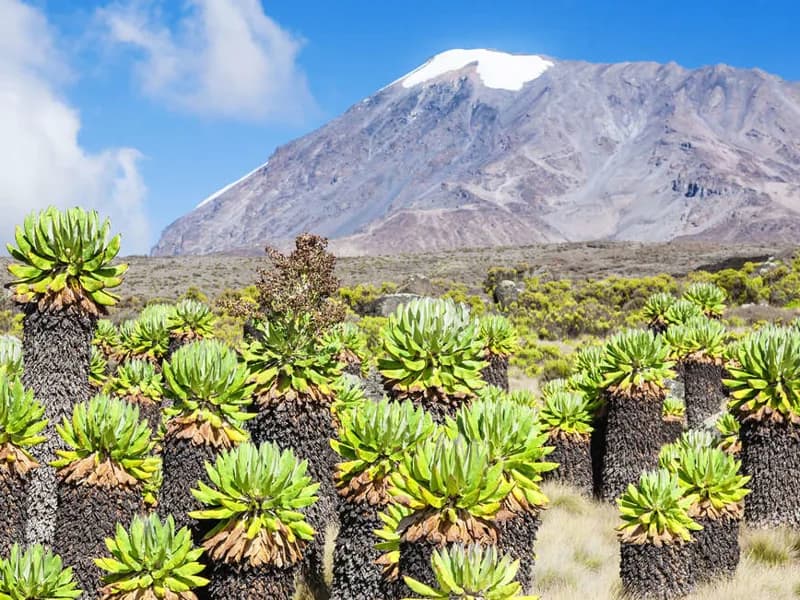
One of the pleasures of climbing Kilimanjaro is the way the landscape changes as you climb, like walking from the equator to the poles in a week. The lower slopes are farmland and dense montane rainforest, home to colobus monkeys. Above that comes heath and moorland, with giant groundsels and lobelias, strange plants that grow only on the high mountains of East Africa. Then an alpine desert of rock and scree, and finally the summit zone of snow and ice, with the remains of the glaciers that have been shrinking fast over the last century.
The treks
Explore Worldwide's Kilimanjaro: Lemosho Trek, nine nights, starts in Moshi and climbs by the Lemosho route from the Londorossi gate, through Big Tree Camp, the Shira Ridge and Shira camps, the Lava Tower, the Barranco valley and wall, the Karanga valley and Barafu Camp. Explore's Kilimanjaro: Lemosho Trek + Safari Extension, twelve nights, follows the same route and adds a safari.
Explore's Kilimanjaro: Rongai Trek, eight nights, climbs from the north, by way of Simba Camp, Second Cave and Kikelewa camps, Mawenzi Tarn Hut and Kibo Hut, descending past Horombo and Mandara huts, and includes a visit to the Momella Lakes in Arusha National Park.
The best seasons for the climb are the drier months, from January to early March and from June to October. The long rains of April and May make the trails muddy and the summit cloudy. Whichever route you choose, go slowly: the Swahili phrase pole pole, slowly slowly, is the advice every guide gives, and it is the best advice there is.
By Walter Pellow, the name Atlas & Passage’s editorial team writes under. Prices and dates in the trips below come from the operators and can change.