Journeys
Madagascar's Route Nationale 7, from the highlands to Isalo
The RN7 runs south from Antananarivo through rice terraces, craft towns and rainforest to the sandstone canyons of Isalo. It is Madagascar's classic road trip, and the changes of landscape along it are the point.
By Walter Pellow2 November 20263 min read
In a country where many roads are tracks and some tracks are rivers, the Route Nationale 7 is something of a celebrity. It leaves Antananarivo, the capital, and runs south through the central highlands, down the escarpment and out across the dry grasslands of the south-west to the coast at Toliara. Most journeys through Madagascar follow at least part of it, because it passes so many of the island's best places in one line: hill towns, craft villages, rainforest, wine country, a community lemur reserve and, near the end, the sandstone massif of Isalo.
It is a slow road. It winds, it climbs, it is shared with zebu carts, bicycles and taxi-brousses, the crowded minibuses that carry so many of Madagascar's travellers, and it takes several days to drive properly. That is no hardship. The changes of landscape are the reason to go.
The highlands
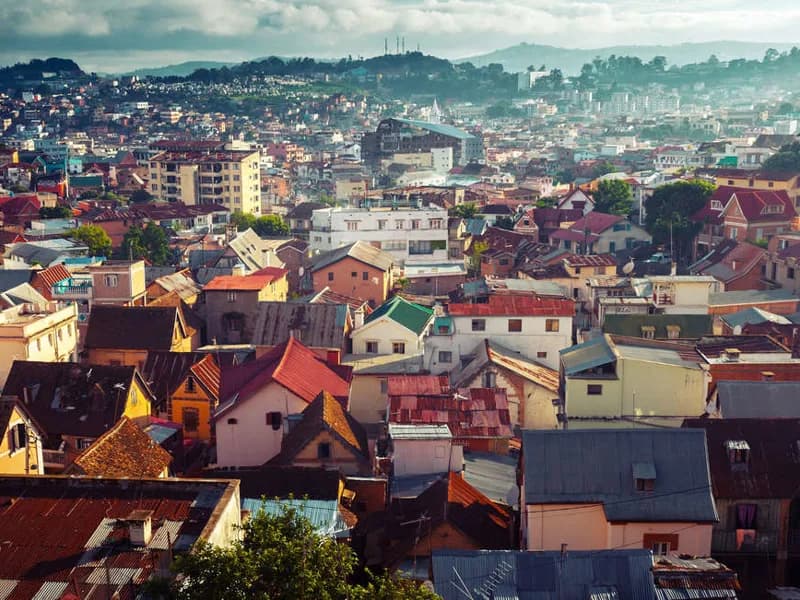
South of the capital, the road climbs into the highlands, a country of red earth, terraced rice fields and brick farmhouses with steep thatched or tiled roofs. It is cooler up here than visitors expect, and the light is sharp.
Antsirabe is the first town of size, a spa town that grew up around its hot springs, with wide avenues and a fleet of pousse-pousse, the rickshaws pulled on foot that are a famous sight of the town. Nearby, Lake Tritriva lies in an old volcanic crater, deep green and still, ringed by cliffs.
Further on, Ambositra is the centre of Zafimaniry woodcarving, the carving of the highland people whose craft is on UNESCO's list of intangible heritage, and its workshops sell boxes, panels and marquetry made from the island's woods.
Down to the rainforest
Then the road drops east to Ranomafana, where the rainforest of the eastern escarpment comes almost to the tarmac. The national park here is a fine place to see lemurs, among them the golden bamboo lemur, and many journeys stop for a night or two to walk its steep, damp trails.
Back on the plateau, Fianarantsoa is the old capital of the southern highlands, with a hilltop old town of churches and wooden balconies. South of it is Ambalavao, known for its weekly zebu market, where the cattle of the south are bought and sold, and for its paper, made by hand from bark, with dried flowers pressed into it.
A little further on, the Anja reserve is a small forest at the foot of granite cliffs, run by the local community, and home to ring-tailed lemurs, the striped-tailed lemur everyone knows from pictures. They are relaxed with visitors, and the community uses the reserve's income for the villages around it.
Isalo
Beyond Anja the land opens up. The highlands give way to a high, dry grassland, almost empty, crossed by long straight stretches of road. Then, near the small town of Ranohira, the Isalo massif appears: a long ridge of sandstone eroded into canyons, domes, pillars and flat-topped mesas, red and gold in the evening light.
Isalo National Park was created in 1962. Its sandstone, laid down by ancient rivers, has been carved by water and wind into deep gorges, and in some of them, out of sight of the dry country above, there are clear streams, ferns, palms and natural pools for swimming. The walks run through the canyons to these pools and up onto the ridges, and ring-tailed lemurs and sifakas live in the gorges.
Beyond Isalo, the road goes on through Zombitse National Park, a patch of dry forest known for its birds, and on to the coast at Toliara and the beaches of Ifaty.
The trips
Explore's fourteen-night Madagascar Wilderness Trek drives the whole road, and walks in its parks. From Antananarivo it goes to Antsirabe and Ambositra, Ranomafana National Park and Fianarantsoa, Ambalavao and the Anja Reserve, the mountains of Andringitra National Park and Isalo National Park, then Toliara and Ifaty, with Zombitse National Park in its list. It departs in April, September, October and November.
Explore's fourteen-night Madagascar: The Lost Continent begins with a detour east to Andasibe and the Analamazoatra Reserve, then follows the RN7 south by way of Antsirabe, Lake Tritriva, Ambositra, Ranomafana National Park, Fianarantsoa and the Anja Community Reserve to Ranohira, Isalo National Park and Zombitse National Park. It departs from April to November.
Drive the road slowly, and stop often. Its pleasures are the ones in between: a market in a highland town, a rice terrace in the late light, children waving from a village, and the first sight of Isalo's red walls rising out of the grassland.
By Walter Pellow, the name Atlas & Passage’s editorial team writes under. Prices and dates in the trips below come from the operators and can change.