History
Sarajevo, the city of four faiths
In the old heart of Sarajevo a mosque, an Orthodox church, a Catholic cathedral and a synagogue stand within a few hundred metres of one another. The city has been called the Jerusalem of Europe, and its history explains both the name and the scars.
By Walter Pellow2 November 20266 min read
Stand in the old town of Sarajevo at midday and you may hear, at almost the same moment, the call to prayer from a minaret and the bells of a church. It is the sound people remember. Within a few hundred metres of one another, in the narrow valley of the Miljacka, stand the city's great Ottoman mosque, its old Orthodox church, its Catholic cathedral and its oldest synagogue. Sarajevo has sometimes been called the Jerusalem of Europe for that reason, and walking between them takes a few minutes.
Its oldest quarter, Baščaršija, is the Ottoman-era old town, a bazaar of low shops, coffee houses and lanes paved with stone. At its centre is the Gazi Husrev-beg Mosque, completed in the 1530s and described as the largest Ottoman-era mosque in Bosnia and Herzegovina. A short walk away is the Old Orthodox Church, dedicated to the Archangels Michael and Gabriel, one of the oldest places of worship in the city. The Old Synagogue, dating from the sixteenth century, stands close by. And on the street called Ferhadija, where the Ottoman town turns into the Austro-Hungarian one, is the Catholic Cathedral of the Sacred Heart, built in neo-Gothic style in 1889.
A book that survived everything
The most remarkable object in Sarajevo is a book. The Sarajevo Haggadah is an illuminated Jewish manuscript, made in Barcelona around 1350, which somehow found its way across the Mediterranean to Bosnia and was sold to the National Museum of Bosnia and Herzegovina in 1894. Its survival since has been a matter of luck and courage. In wartime it has been hidden; one well-known account has it concealed by the museum's director in a mosque in a village on Mount Bjelašnica, where the imam hid it beneath the threshold. It is on display in the museum today, a Jewish book kept safe by Muslims in a city where Christians worship nearby, which is about as good a summary of Sarajevo as anyone could write.
A Jewish book kept safe by Muslims in a city where Christians worship nearby.
The bridge, the siege and the mountain
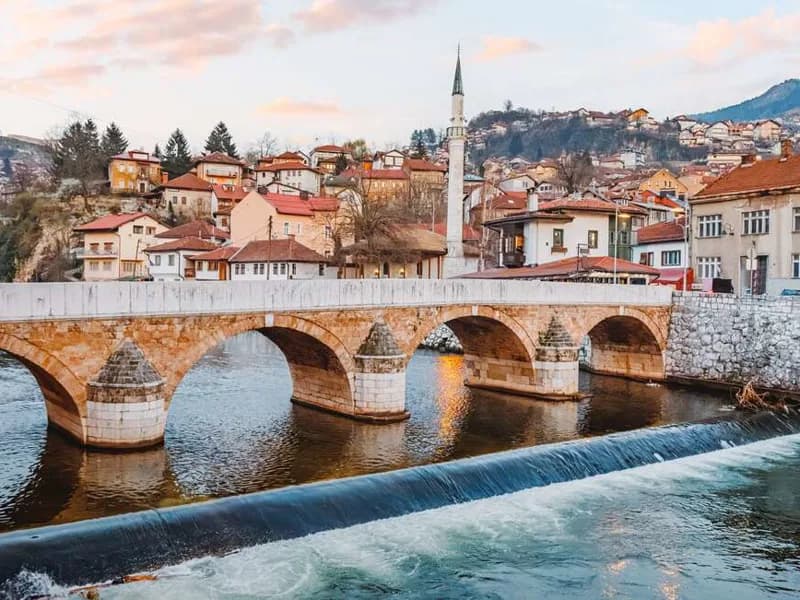
Sarajevo has a habit of appearing in the history books at terrible moments. On 28 June 1914, by the Latin Bridge over the Miljacka, Gavrilo Princip shot Archduke Franz Ferdinand of Austria and his wife Sophie, and the chain of events that followed led to the First World War. The bridge is a modest arch, and it is an odd place to stand.
Seventy years later, in 1984, Sarajevo hosted the Winter Olympics, and the mountains around the city became briefly famous for something cheerful. On Mount Trebević, above the city, the bobsleigh and luge track was built for the Games. Less than a decade later, those same mountains were held by the forces besieging the city. The siege of Sarajevo lasted 1,425 days, and it is often described as the longest siege of a capital city in modern warfare. The bobsleigh run, used by the besiegers as a firing position, is now derelict and covered in graffiti, and it has become a strange and popular walk, reached by cable car from the city.
The siege is not hidden in Sarajevo. You see its traces in the walls, and the city's museums record it plainly. Visitors tend to come away moved by how much of the old life of the place has survived it: the coffee, the bazaar, the evening walk along Ferhadija.
Into the mountains
The hills around Sarajevo are as much part of it as the old town. The mountains that hosted the Olympics have villages that seem to belong to another century. The best known is Lukomir, on Bjelašnica, often called the highest village in Bosnia and Herzegovina at close to 1,500 metres, where the stone houses have roofs of wooden shingles and families from the settlements below return each summer.
Explore Worldwide's eight-night Walking the Balkans – Bosnia, Serbia & Montenegro begins in exactly this country. Its places include Sarajevo, Lukomir and Mount Trebević, and then Mitrovac, Tara National Park, Sjenica and the Uvac Nature Reserve in Serbia, and Pljevlja, Žabljak, Durmitor National Park and Lake Jablan in Montenegro. It has departures in May, June, September and October.
Travelsphere's twelve-night Balkan Highlights is a broader tour of Croatia, Serbia and Bosnia and Herzegovina, with Sarajevo, Mostar, Višegrad and Medugorje among its places, as well as Split, Zadar, Zagreb, Novi Sad and Belgrade.
Explore Worldwide's fifteen-night Balkans Rail Adventure also reaches Sarajevo, on a long journey from Ljubljana and Lake Bled to Belgrade and Novi Sad, with Mostar, Dubrovnik and Kotor along the way. It has departures in May, June, August and September.
Whichever way you come, give Sarajevo at least one long evening in Baščaršija. Sit with a small cup of Bosnian coffee, listen for the call to prayer and the bells, and watch the city go by.
By Walter Pellow, the name Atlas & Passage’s editorial team writes under. Prices and dates in the trips below come from the operators and can change.