Journeys
Sri Lanka by bike, through the Cultural Triangle
Between Anuradhapura, Polonnaruwa and Kandy lies a flat, dry country of reservoirs, paddy fields and ancient ruins, crossed by quiet roads. It is some of the most rewarding cycling in Asia, with a rock fortress and a lake of elephants along the way.
By Walter Pellow20 October 20264 min read
Sri Lanka's Cultural Triangle is the name given to the area between three of its historic capitals: Anuradhapura in the north, Polonnaruwa in the east, and Kandy in the south, at the edge of the hills. Within it lie most of the island's great ancient monuments, including five of its World Heritage Sites. The land is part of the dry zone, flat or gently rolling, dotted with ancient reservoirs and paddy fields and scrubby forest, crossed by small roads between villages. For a cyclist, it is ideal: no great climbs, plenty to see, and the chance to stop at a roadside stall for a king coconut whenever the heat demands it.
Sigiriya and Dambulla
Sigiriya is the most dramatic sight in the triangle. A great column of red rock rises some two hundred metres from the plain. In the fifth century AD, according to the chronicles, King Kashyapa built a palace on its summit, approached through water gardens and up a staircase that passed between the paws of a giant brick lion. The paws survive at the base of the final climb. Halfway up, in a sheltered gallery, are paintings of graceful, bare-breasted women, and beside them a polished wall covered in centuries-old graffiti left by visitors who wrote poems about them. The climb to the top is steep and exposed, and it is best done in the early morning.
Dambulla, nearby, has a complex of cave temples set into a great rock outcrop, their walls and ceilings covered in paintings and filled with statues of the Buddha. The caves have been used as a place of worship for more than two thousand years.
Polonnaruwa and the reservoirs
Polonnaruwa became the capital after the fall of Anuradhapura in the eleventh century. Under King Parakramabahu I in the twelfth century, it was a magnificent city. Its ruins of palaces, council halls, stupas and temples are spread over a large area, ideal for exploring by bike. Its masterpiece is the Gal Vihara, four great images of the Buddha carved from a single granite rock face, among them a reclining Buddha some fourteen metres long.
The king is remembered too for his reservoirs. The vast Parakrama Samudra, the "sea of Parakrama", still stores water for the paddy fields around the city. The chronicles attribute to him the saying that not one drop of rain should be allowed to flow into the sea without first serving man. The reservoirs of the dry zone draw wildlife as well as farmers. At Minneriya and Kaudulla, in the dry months of the middle of the year, large herds of wild elephants gather on the grassy shores of the shrinking reservoirs.
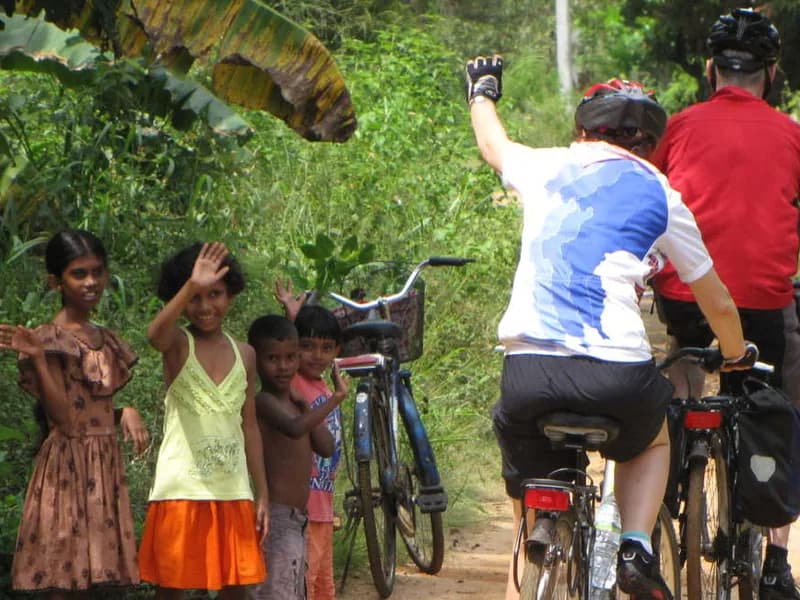
Between the great sites, the small things make a cycling trip. There are the village temples with their white stupas and bodhi trees, the stalls selling curd and treacle by the roadside, and the waves from children on their way to school. There are the water buffalo in the tanks, and the shrines to the god Ganesha at crossroads. A bicycle lets you stop for all of them, and on the quieter roads you will often have the countryside almost to yourself.
Riding it
The heat is the main challenge. Most riding is best done in the early morning, with a rest through the hottest hours. The roads in the dry zone are mostly quiet, but the main roads can be busy with buses, which drive fast and expect cyclists to give way. Elephants occasionally wander onto rural roads around dusk, and should always be given a wide berth.
Explore Worldwide's Cycle Sri Lanka, thirteen nights, combines the triangle with the hills. Its places include Negombo, Dambulla, Sigiriya, Minneriya, Polonnaruwa and the Parakrama reservoir, Kandy, Matale and Nuwara Eliya, the waterfalls of Ramboda and Bambarakanda, and Udawalawe National Park.
Explore Worldwide's Active Sri Lanka, thirteen nights, includes the west coast at Nainamadama and Chilaw, Wilpattu National Park, Anuradhapura and Mihintale, Habarana, Giritale, Sigiriya, Polonnaruwa and the walking country of the Knuckles range and the Matale valley.
The triangle is in the dry zone, which is driest from about May to September, and also pleasant from January to April. Whenever you ride, start early, drink plenty and save the climb up Sigiriya for the cool of the morning.
By Walter Pellow, the name Atlas & Passage’s editorial team writes under. Prices and dates in the trips below come from the operators and can change.