Slow travel
The Algarve coast the golf courses don't reach
Most of what the Algarve is known for sits on its calmer, south-facing shore. The western and eastern edges, cliffs that take the full Atlantic swell and a lagoon reachable only by boat, are a slower and considerably quieter version of the same coast.
By Arthur Penhallow26 September 20263 min read
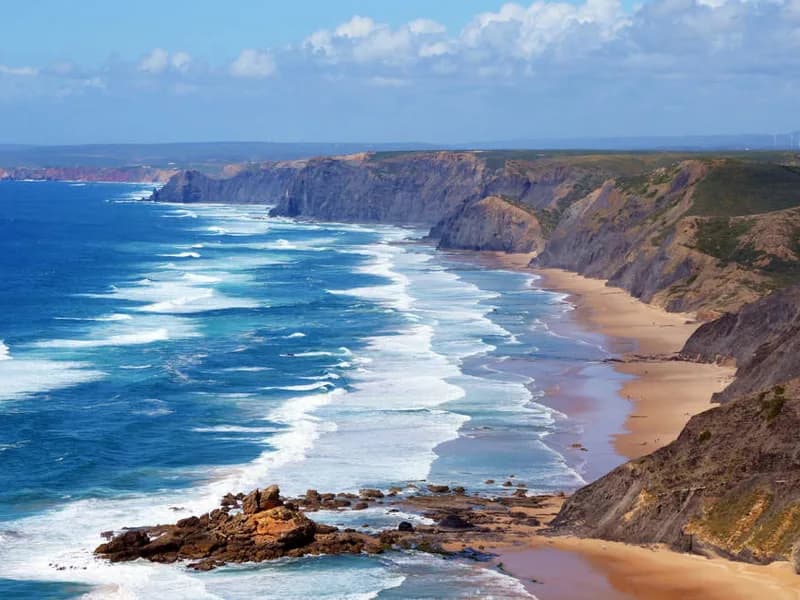
The Romans called Cabo de São Vicente, the headland at the Algarve's south-western tip, the Promontorium Sacrum: the Sacred Promontory, believed at the time to mark the westernmost edge of the known world, the point where the sun went into the sea each evening and, with it, whatever lay beyond human reckoning. It is a serious claim for a piece of coastline to have carried for two thousand years, and standing on the cliffs today, watching Atlantic swell break against rock with nothing but ocean visible to the horizon, it is not difficult to see how the idea took hold.
This stretch of coast, the Costa Vicentina, is a different Algarve entirely from the resort towns further east, and it rewards a different pace. Most of the region's golf courses, marinas and package hotels sit on the calmer, south-facing shore between Faro and Lagos; the coastline that faces the open Atlantic directly, to the west, and the lagoon behind the barrier islands to the east, have mostly been left alone.
A fortress on the edge of the map
A short walk from the headland stands the fortress of Sagres, built to guard this strategically exposed corner of the coast and long associated, in popular tradition, with Prince Henry the Navigator, the fifteenth-century patron of Portugal's early voyages of exploration. Quite how much formal "school of navigation" activity actually took place here, as opposed to being attached to the site by later storytellers keen to give Henry a fitting headquarters, is genuinely disputed among historians. What is not in dispute is the position itself: a fortified promontory looking directly out over the sea lanes that Portuguese ships would soon be using to reshape the map.
Walking routes along this coast, part of the wider Rota Vicentina network, follow clifftop paths through pine and scrub, past small fishing coves that have changed little since long before the resorts arrived, with the Atlantic doing most of the talking.
It is not difficult to see how the idea took hold.
A lagoon you reach by boat
The other quiet Algarve lies at the opposite end of the region, in the east. The Ria Formosa is a lagoon system sheltered behind a chain of barrier islands and sandbars, home to flamingos, purple herons and one of the most important wetland habitats on Portugal's coast. Several of the barrier islands, Culatra and the smaller island of Farol among them, support small fishing communities that are reachable only by boat, with no bridge and, on Culatra, no cars beyond a handful of service vehicles. Life on the islands still runs largely to the tides and the fishing seasons rather than to a resort calendar, and the short crossing from the mainland is usually enough on its own to make the point that this is a different Algarve from the one on the postcards. Walking routes along the mainland shore, through the market town of Tavira and the salt pans that supply much of the region, connect the lagoon with a version of the coast built around tide tables rather than tee times.
Getting between the two
The two quiet ends of the Algarve are separated by the busier resort coast in between, which most walking and cycling itineraries route around or through briskly rather than lingering in. Explore's cycling route down from Lisbon reaches the Algarve by way of the Atlantic coast towns of Comporta and Vila Nova de Milfontes before finishing at Sagres itself, a week's ride that treats the wild west coast as the destination rather than a detour from the beaches, and arrives at the Promontorium Sacrum on two wheels rather than by car.
Both ends of the Algarve ask more of a visitor than the resort coast does, a boat crossing here, a longer clifftop walk there, and both pay that patience back with a version of the region that has mostly kept its own pace.
By Arthur Penhallow, the name Atlas & Passage’s editorial team writes under. Prices and dates in the trips below come from the operators and can change.