Walking
The Bucegi and the Transylvanian Alps on foot
South of Braşov, the Carpathians rise into the Transylvanian Alps, a range of limestone plateaus, gorges and high ridges where shepherds still bring their flocks up for the summer and bears are more common than walkers.
By Walter Pellow2 November 20264 min read
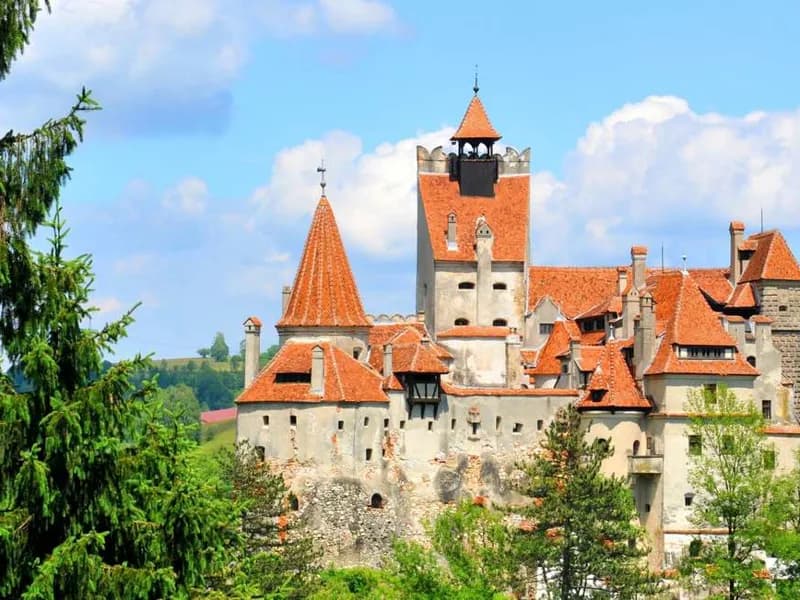
The Carpathians curve across Romania in a great bow, and at the southern end of the bend they rise into a higher, steeper range, the Southern Carpathians, which Romanians have long called the Transylvanian Alps. They form the old boundary between Transylvania to the north and Wallachia to the south, and the passes through them, guarded by castles such as Bran, were for centuries the main routes between the two.
This is some of the wildest country in Europe. The forests here hold the largest population of brown bears in the European Union, along with wolves and lynx. The high meadows are still grazed in summer by sheep and cattle, driven up from the villages by shepherds who live in simple huts, the stâne, and make cheese in the old way. For a walker, it is a landscape of real wilderness, but one with well-marked paths and a network of mountain huts.
The Bucegi
The Bucegi mountains rise steeply above the resort town of Sinaia in the Prahova valley. Their eastern face is a wall of cliffs, but on top they open into a broad, high plateau, rolling grassland at around two thousand metres, scattered with strange rock formations carved by the wind. The most famous are the Babele, the old women, a group of mushroom-shaped rocks, and the Sphinx, a rock that, from the right angle, looks remarkably like a human face.
Cable cars climb from Sinaia and Buşteni onto the plateau, but the real pleasure is walking across it, between its rocks, ridges and huts. On the plateau's highest point, Omu peak, at about 2,500 metres, stands one of the highest mountain huts in the country, a stone refuge that has sheltered walkers for well over a century. The Padina hut lies in a high valley in the middle of the range, near the Ialomiţa Cave, a deep limestone cave with a small monastery built at its entrance. From the plateau, on a clear day, the views stretch across the Carpathians and down to the plains of Wallachia.
Piatra Craiului
West of Bran, across the valley, rises Piatra Craiului, the King's Stone, a single long ridge of limestone about twenty-five kilometres long, sharp and narrow, which is one of the most spectacular walks in Romania. It is protected as a national park, and its flowers are famous, among them the Piatra Craiului pink, found nowhere else.
Its approach from the town of Zărneşti is through the Zărneşti Gorge, a narrow, steep-sided canyon between limestone walls, popular with climbers. Beyond it, the Curmătura hut sits in a saddle beneath the ridge, a classic base for walking.
Between the two ranges lie the villages of the Bran pass, such as Moieciu, where farmhouses are scattered across green hills, and hay is still cut by hand and stacked on wooden poles.
Sinaia, the starting point for the Bucegi, takes its name from a monastery founded at the end of the seventeenth century by a nobleman who had made the pilgrimage to Mount Sinai. The town grew into the summer retreat of the Romanian royal family, who built Peleş Castle in the forest above it, and it is still a pleasant mountain resort, busy with walkers in summer and skiers in winter.
The walking and cycling holidays
Explore Worldwide's Walking Romania: Transylvanian Alps Trek, seven nights, crosses both ranges. Its route runs from Bucharest and Sinaia through the Bucegi mountains, the Padina mountain hut and the Ialomiţa Cave to Moieciu and Bran Castle, and on to the Piatra Craiului mountains, the Curmătura hut and the Zărneşti Gorge. It runs from May to September.
Explore's Cycle Romania, eight nights, covers the countryside around the mountains by bicycle, from Bran and Moieciu through the villages at the foot of the Făgăraş mountains, the highest in Romania, to Sibiu and the Hârtibaciu valley.
The walking season runs from late spring to early autumn. June brings the flowers and the shepherds moving up to the high pastures; September is often the clearest month. Bears are shy and generally avoid people, but they are a real presence here, and it is sensible to walk with a guide who knows the mountains.
By Walter Pellow, the name Atlas & Passage’s editorial team writes under. Prices and dates in the trips below come from the operators and can change.