History
The Nile, and the temples built to face it
Ancient Egypt organised itself around a river that flooded on schedule and flowed the "wrong" way. Its temples were built facing the water that made them possible, and a cruise still reads them in the order they were meant to be seen.
By Arthur Penhallow26 September 20264 min read
The Nile flows north, which confused enough early European visitors that "upriver" and "south" needed separate words in their accounts. Ancient Egyptians had no such confusion: they knew perfectly well which way their river ran, and built an entire civilisation along its banks accordingly, oriented around a flood cycle so reliable that it structured the calendar, the economy and, in large part, the religion. Before the Aswan High Dam tamed it in the twentieth century, the Nile flooded every year with clockwork regularity, depositing the silt that made intensive farming possible in an otherwise desert landscape.
A river dividing the living from the dead
Because the sun rose in the east and set in the west, ancient Egyptian belief generally placed the world of the living, the temples, palaces and towns, on the Nile's east bank, and the world of the dead on the west, where the sun disappeared each evening. Luxor, ancient Thebes, follows this pattern precisely: the vast temple complex at Karnak, the largest religious building ever constructed in the ancient world, sits on the east bank alongside Luxor Temple, once connected to it by an avenue lined with sphinxes. Across the river, the Valley of the Kings holds the rock-cut tombs of pharaohs from the New Kingdom, chosen for burial there partly because the site's pyramid-shaped peak echoed, in miniature, the pyramids of an earlier age, and partly because a hidden valley was rather harder for robbers to find than a monument built in plain sight.
Tombs found, and temples nearly lost
The Valley of the Kings produced the twentieth century's most famous archaeological discovery when Howard Carter located the largely intact tomb of Tutankhamun in 1922, after years of searching a valley many believed had already given up its secrets. Further south, near Aswan, a different kind of drama played out decades later: the construction of the Aswan High Dam threatened to submerge several major monuments beneath the rising waters of Lake Nasser, prompting an international UNESCO campaign in the 1960s to dismantle and relocate them, stone by numbered stone, to higher ground. The temples of Abu Simbel, carved originally into a cliff face for Ramesses II, were cut apart and reassembled on an artificial hill nearby; the temple of Philae, dedicated to the goddess Isis, was moved to the nearby island of Agilkia, landscaped afterwards to resemble its original setting as closely as possible.
A river that flooded on schedule and flowed the wrong way.
The temples in between
Between Luxor and Aswan, the river passes two further temples that reward the stop as much as the headline sites do. Kom Ombo is unusual in being a double temple, its design perfectly symmetrical and dedicated jointly to two gods, the crocodile-headed Sobek and the falcon-headed Horus, with matching entrances, halls and sanctuaries running side by side. Edfu holds one of the best-preserved temples anywhere in Egypt, largely because it was buried under desert sand for centuries after the ancient religion it served fell out of practice, which shielded its carved reliefs and roofed halls from the weathering that affected more exposed sites.
A calendar built around the flood
The ancient Egyptian year was itself organised around the Nile's behaviour, divided into three seasons tied directly to the flood: a season of inundation, when the fields lay underwater and the silt was deposited; a season of growth once the water receded and crops were sown; and a season of harvest before the cycle began again. Religious festivals, farming schedules and even the timing of major construction work were set against this rhythm, since a labour force freed from the fields during the flood months could, for part of the year, be redirected towards building the very temples and tombs that lined the riverbanks.
Reading the river as it was meant to be read
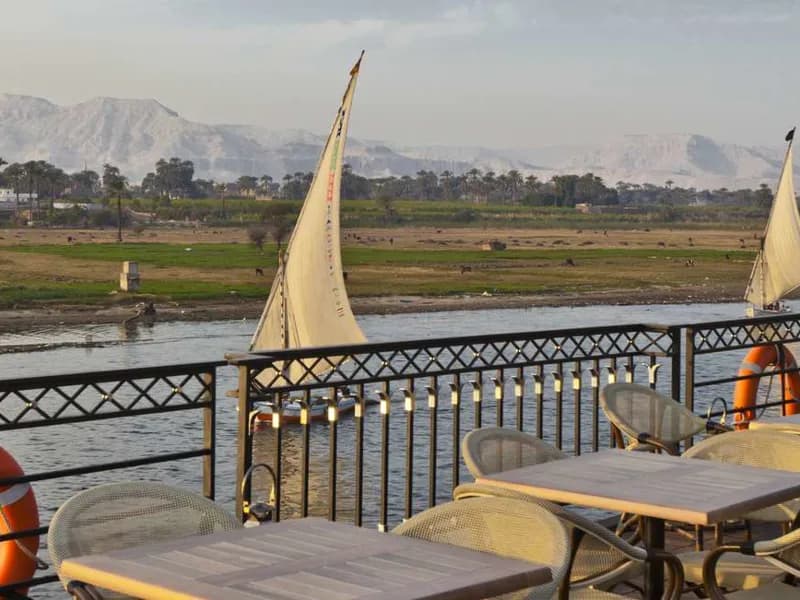
A cruise moving between these sites, rather than visiting them out of sequence by road, restores something of the logic ancient Egyptians themselves would have recognised: temples that face the water, tombs positioned deliberately opposite the temples that served them, and a journey from Luxor to Aswan that follows the same current the stone for every one of these buildings was, in some form, once floated down.
By Arthur Penhallow, the name Atlas & Passage’s editorial team writes under. Prices and dates in the trips below come from the operators and can change.