Journeys
The Philippines' rice terraces, Banaue and Sagada in the Cordillera
High in the mountains of northern Luzon, the Ifugao people have carved whole valleys into staircases of rice. Banaue and Batad are the famous names, Sagada the quieter neighbour with its caves and hanging coffins.
By Walter Pellow2 November 20263 min read
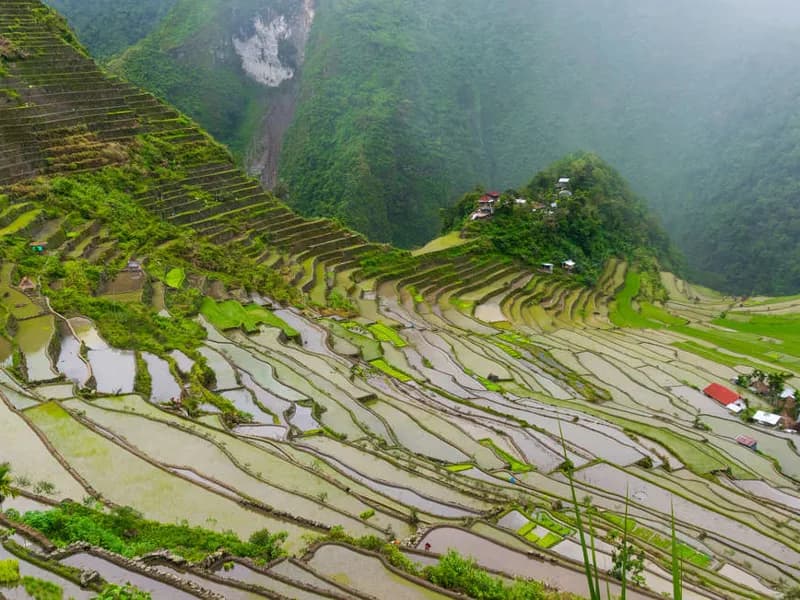
The road into the Cordillera, the great mountain spine of northern Luzon, climbs for hours through pine forests and cloud. Then, at Banaue, the mountainsides open up, and you see them: terraces of rice climbing the slopes from the valley floor almost to the ridges, one above another, each a narrow shelf of green or silver water held in place by walls of stone or earth, following every curve of the hill.
These are the rice terraces of the Ifugao people, built by hand and maintained by hand, generation after generation.
A living landscape
The terraces are very old. Exactly how old is uncertain, and argued over, but UNESCO describes the landscape as one that can be traced back as far as two thousand years. What is certain is that they are a remarkable piece of engineering: fed by water channelled from the forests on the mountaintops above, which the Ifugao have always protected, the water runs down from terrace to terrace through a system of channels and sluices, watering the whole valley.
In 1995 UNESCO inscribed the Rice Terraces of the Philippine Cordilleras on the World Heritage List, the first property to be listed in its category of cultural landscapes. The listing covers five clusters of terraces: Batad, Bangaan, Hungduan, Mayoyao Central and Nagacadan. The terraces seen from the famous viewpoint above Banaue town, which most people think of as "the Banaue rice terraces", are not themselves part of it, though they are just as beautiful.
These are farms, not monuments, and they need constant work. Younger people have left for the cities, some terraces have fallen out of use, and there are efforts to keep the farming and the knowledge alive.
Each a narrow shelf of green or silver water, following every curve of the hill.
Batad and Bangaan
Of the listed clusters, Batad is the name most visitors know. It lies in a great bowl of a valley, a steep walk from the nearest road, its terraces forming an amphitheatre around a small village. The walk in, and the descent among the terraces, are hard work but worth it, and the view from the top of the bowl is the image of the Cordillera that most people carry home.
Bangaan, nearby, is a small village of traditional houses surrounded by terraces, easier to reach and beautiful in its own right. Hapao has terraces in a wide river valley.
The look of the terraces changes with the farming year: flooded and mirror-like at planting time, bright green as the rice grows, and gold before the harvest. Weather in the mountains is changeable, and mist can hide the views, so give yourself more than one day if you can.
Sagada
A few hours north, over the mountains by way of Bontoc, is Sagada, a small town in a valley of limestone and pine, cooler than the lowlands and with a different character. It is known for its caves, which can be explored with local guides, and for its hanging coffins: the custom of some of the local people of placing the coffins of their dead on ledges and in crevices high on the cliffs, rather than burying them in the ground. They can be seen from the paths below, and visitors are asked to treat them with respect.
The trips
Explore's twelve-night North Philippines Explorer travels from Manila north to the Ilocos coast, with Laoag, Paoay, Pagudpud, Burgos and the colonial town of Vigan, then into the mountains for Sagada, Bontoc, Banaue, Hapao and Bangaan. It departs from November to May.
Explore's fifteen-night North Philippines Explorer + Bohol Beach Extension follows a similar route, with Cape Bojeador and Batad in its list, and adds time on the beaches of Bohol at the end. It departs in the same months.
The dry season, from about November to May, is the best time to travel in northern Luzon, and the months when these trips run. Nights in the mountains can be cold, so pack warm layers as well as sturdy shoes for the steps and paths. And go slowly. The terraces were built over many generations, by hand; they deserve more than a photograph from a viewpoint.
By Walter Pellow, the name Atlas & Passage’s editorial team writes under. Prices and dates in the trips below come from the operators and can change.