Walking
The Portuguese Camino, a week north from Porto
Most pilgrims to Santiago de Compostela still walk in from France. A quieter route runs north from Porto instead, along the Portuguese Atlantic coast, and crosses into Spain over a bridge built by the same engineers who built the Eiffel Tower.
By Arthur Penhallow26 September 20263 min read
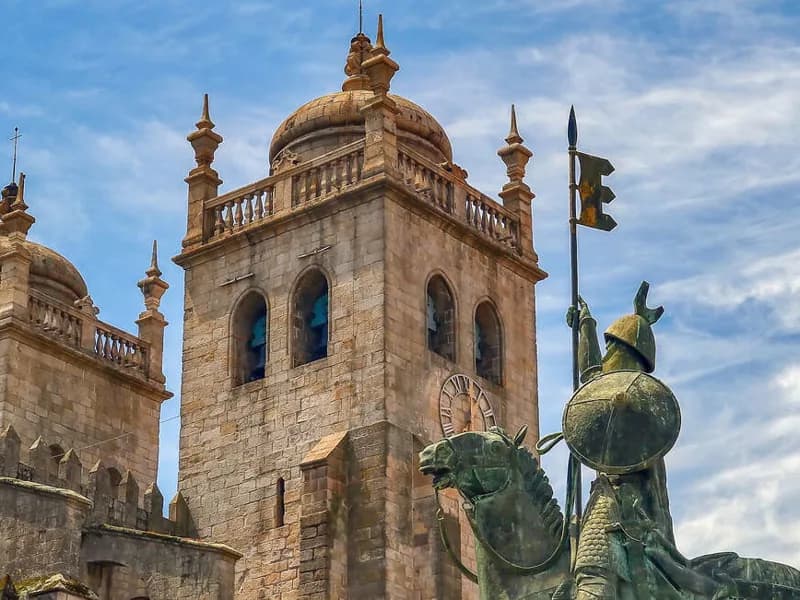
Santiago de Compostela has drawn pilgrims for over a thousand years, walking in from every direction the medieval road network allowed, but two routes now account for most of the traffic: the Camino Francés from the Pyrenees, and the Camino Português, which begins considerably closer, at Porto's cathedral, and heads north along Portugal's Atlantic coast instead. It is generally reckoned the second most walked of the historic routes, and a coastal variant, following clifftop paths and small fishing towns rather than inland roads, has become increasingly popular with walkers who want the sea in view for as much of the week as possible. It is also, by most measures, an easier introduction to long-distance pilgrim walking than the French route: shorter, flatter for long stretches, and never far from a train line back to Porto for anyone who decides, partway through, that a week is plenty.
Porto to Viana do Castelo
The route out of Porto follows the coast north through a string of small towns, most working fishing harbours rather than resorts, before reaching Viana do Castelo, the largest town on the Portuguese stretch of the walk. Above it stands the Santuário de Santa Luzia, a hilltop basilica reached by a funicular that has carried pilgrims and visitors up the same slope since the early twentieth century, with views back down the coast the walkers have just covered and ahead to the Spanish border still to come.
A bridge with a familiar signature
The Portuguese stretch of the Camino ends, and the Spanish stretch begins, at the Minho river, where the fortified towns of Valença, on the Portuguese bank, and Tui, on the Spanish one, face each other across the water. The bridge that links them, the Ponte Internacional, was built in the 1880s by the engineering firm of Gustave Eiffel, the same company responsible for the Maria Pia railway bridge in Porto a few years earlier, and its double-decked iron structure still carries pilgrims across the border on foot exactly as it has done since it opened. It is a small but pointed reminder that the Camino's infrastructure, as much as its history, has always been a cross-border affair.
A bridge built by the same engineers who built the Eiffel Tower.
Into Spain, and on to Santiago
Once across the river, the route continues through Galicia's Rías Baixas, via Pontevedra, and on to Padrón, a town whose name, tradition holds, comes from the stone landing that marked where the boat carrying the body of Saint James is said to have come ashore. From Padrón it is a short final push, roughly a day's walk, into Santiago itself and the cathedral square that has been every pilgrim's destination regardless of which direction they arrived from. Walkers who have come the whole way from Porto arrive at that square having crossed a national border on foot partway through, which is more than can be said for most of the Camino Francés crowd arriving from within Spain alone.
When to go, and how to see the coast either way
Explore's week-long walk covers the coastal route from Porto to Santiago in daily stages that rarely exceed a comfortable day's distance, useful for anyone weighing up a first long-distance walk against the more demanding weeks required further along the French route. Spring and early autumn offer the most reliable weather on this stretch of the Atlantic coast; the same months that suit a cruise along the same shoreline, for anyone who would rather see Vigo, Oporto and Lisbon from a ship's rail than from underfoot.
Two ways to cover broadly the same coast, one on foot over a week and one from a deck over a fortnight, arrive eventually at the same conclusion: this corner of the Iberian peninsula rewards taking the coast road rather than the quickest one. Whichever pace you choose, the border crossing at Valença and Tui is worth pausing on, on foot at least, if only to notice that a bridge built for an entirely different age of travel is still doing quiet, steady work for this much older one.
By Arthur Penhallow, the name Atlas & Passage’s editorial team writes under. Prices and dates in the trips below come from the operators and can change.