Journeys
Victoria Falls, the smoke that thunders, from both sides
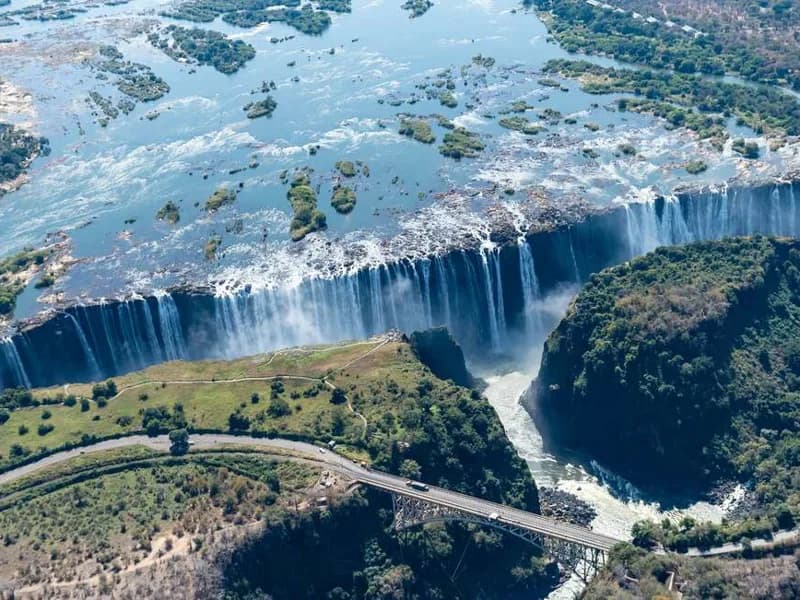
The Zambezi drops over a basalt cliff more than a kilometre and a half wide into a narrow gorge, raising a column of spray that can be seen from miles away. Victoria Falls straddles the border of Zimbabwe and Zambia, and each side shows it differently.
By Walter Pellow20 October 20264 min read
The local name for Victoria Falls is Mosi-oa-Tunya, "the smoke that thunders", and it describes the place exactly. The Zambezi, one of the great rivers of Africa, flows wide and calm across a flat plateau, and then, quite suddenly, it drops over the edge of a sheer basalt cliff into a narrow chasm more than a hundred metres deep. The falls are about seventeen hundred metres wide, often described as the largest single curtain of falling water in the world. When the river is high, the spray rises in a great white column hundreds of metres into the air, visible from a long way off, and the roar can be heard well before the falls come into view.
The Scottish missionary and explorer David Livingstone was the first European to see the falls, in 1855, and he named them after Queen Victoria. They are a World Heritage Site, and they mark the border between Zimbabwe and Zambia.
High water and low water
The falls change enormously through the year. The Zambezi rises after the rains in the catchment upstream, and the falls are at their fullest from about February to May. At their peak, the volume of water is so great, and the spray so thick, that it can be hard to see the falls at all, and anyone on the paths is soaked within minutes. By the end of the year, in the dry season, the flow drops dramatically. Parts of the cliff, especially on the Zambian side, may run almost dry, revealing the bare rock face.
The best compromise for most visitors is the middle of the year, roughly from June to August, when there is still plenty of water but the spray has eased enough to see the falls clearly. At full moon in the high-water season, the spray can produce a lunar rainbow, a pale arc of light visible at night.
From both sides
The Zimbabwean side has most of the classic viewpoints. A path runs through a strip of rainforest, kept green by the constant spray, along the edge of the gorge opposite the falls, with a series of viewpoints looking across at the curtain of water. The main falls, the Horseshoe Falls and the Rainbow Falls can all be seen. Raincoats are available for hire, and they are needed.
The Zambian side gives a closer, more dramatic view of part of the falls. A narrow footbridge, the Knife-Edge Bridge, crosses a chasm in the spray. In the low-water season, when conditions are safe, visitors can be taken to Livingstone Island, on the lip of the falls, and some swim in a rock pool at the very edge. Visiting both sides is easy, across the Victoria Falls Bridge, a steel arch opened in 1905 that spans the gorge and carries road and rail. A combined visa allows many nationalities to cross between the two countries.
The Victoria Falls Bridge, completed in 1905, spans the gorge just below the falls and links Zimbabwe and Zambia. It was built as part of Cecil Rhodes' dream of a railway from the Cape to Cairo, and he is said to have wanted it placed close enough for the spray to fall on passing trains. People still walk across it, between the border posts of the two countries, for the view back towards the falls and down into the gorge.
Beyond the falls
The town of Victoria Falls, on the Zimbabwean side, is a base for adventure: white-water rafting in the gorges below the falls, bungee jumping from the bridge, helicopter flights over the falls and sunset cruises on the river above. Within easy reach are some of the great wildlife areas of southern Africa: Hwange National Park, Zimbabwe's largest, and Chobe National Park in Botswana, famous for its elephants.
Explore Worldwide's Zimbabwe and Botswana Wildlife Safari, thirteen nights, includes Victoria Falls with Hwange National Park, the Matobo Hills and Bulawayo in Zimbabwe, and the Makgadikgadi and Ntwetwe pans, Moremi, Maun, Savuti, Chobe and Kasane in Botswana.
Travelsphere's Livingstone's Africa: Victoria Falls, Botswana and Zimbabwe, eleven nights, includes Victoria Falls, Kasane for Chobe, and Hwange. Just You's Experience South Africa with Victoria Falls Add-on, seventeen nights for solo travellers, adds the falls to a South African route through Cape Town, the Garden Route, Kruger and Johannesburg.
Whenever you go, take a waterproof, protect your camera from the spray, and allow time to come back at a different hour. The falls change with the light as much as with the season.
By Walter Pellow, the name Atlas & Passage’s editorial team writes under. Prices and dates in the trips below come from the operators and can change.