History
Vilnius and Trakai, Lithuania's baroque capital and its island castle
Vilnius has a large old town full of baroque churches, and a district that declared itself an independent republic on April Fools' Day. Out among the lakes at Trakai, the red-brick castle of the grand dukes stands on an island in a lake.
By Walter Pellow2 November 20265 min read
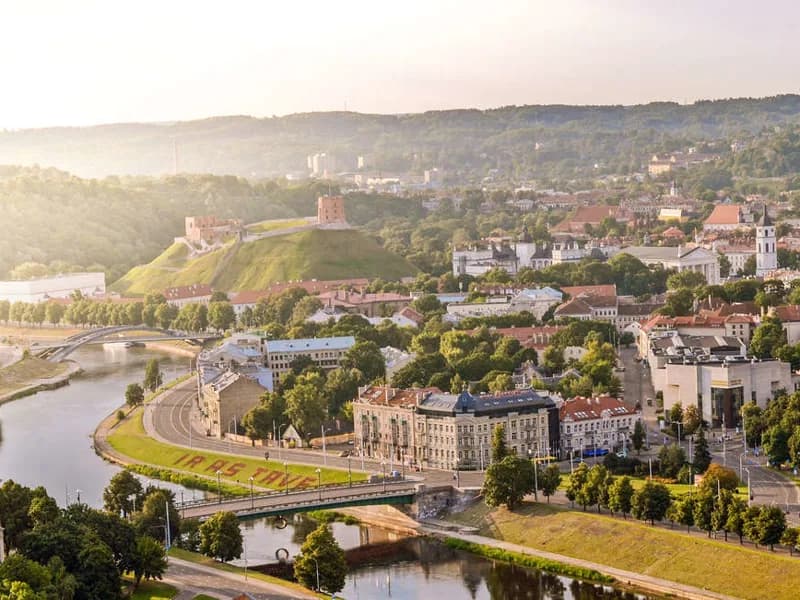
Of the three Baltic capitals, Vilnius is the one of church domes and baroque façades. Its old town is a jumble of domes, towers and church fronts, and walking through it is like turning the pages of a very large, slightly crumpled book of architecture.
A baroque capital
The historic centre of Vilnius was inscribed by UNESCO as a World Heritage Site in 1994. It covers a large area, and its streets are a mixture of Gothic, Renaissance and classical buildings, but the dominant note is baroque. The city's churches are full of the curving façades of the age, and St Theresa's is often picked out as one of the finest late baroque churches in the city.
Close by is the Gate of Dawn, the only one of the city's old gates still standing; the others were pulled down in the early nineteenth century on the orders of the Russian Empire. Over the gate is a chapel holding an icon of the Virgin Mary, a place of pilgrimage in its own right.
Walking through it is like turning the pages of a very large, slightly crumpled book of architecture.
Across the little River Vilnia from the old town is Užupis, an old quarter that was once rundown and became the home of artists. On 1 April 1997 it declared itself an independent republic. The date was chosen with care, and the republic is mostly a joke, but it is a joke the city is fond of, and Užupis has become one of its liveliest corners, with the statue of its angel as its emblem. The angel is meant to stand for the rebirth of a district that had been neglected for years, and the UNESCO listing of the old town reaches across the river to include it, which seems appropriate. A quarter that began as a joke is now part of the city's heritage, and it carries the honour lightly.
The castle on the lake
A short way west of Vilnius, among lakes and woods, is Trakai, a town of the grand dukes of Lithuania. Its famous sight is the Island Castle, a red-brick Gothic fortress standing on an island in Lake Galvė, reached by a bridge. It was begun by Grand Duke Kęstutis in the late fourteenth century and completed by his son Vytautas in the early fifteenth.
The castle was later damaged in the wars with Sweden and Russia and fell into ruin. In 1929 its restoration began, and over most of the twentieth century it was rebuilt, a long project finished only in 1987. Purists can argue about how much of what you see is medieval, but the picture of red towers rising from the water, with boats on the lake around them, is one of the best-known images of Lithuania. It has housed a history museum since 1962.
The Karaim of Trakai
Trakai has another story. Under Vytautas a community of Karaim, a Turkic people with a language and a faith of their own, settled in the town, and they guarded his castles and the bridge to the island. Their descendants still live in Trakai. Their language is now spoken by very few people. Their pastry, the kibinai, is better known: dough wrapped round a filling, traditionally mutton and onion, and very good on a cold day.
Baltic tours that reach Vilnius and Trakai
Explore Worldwide's seven-night Baltic Capital Cities includes Vilnius and Trakai, then Kaunas, Pakruojis and the Hill of Crosses, Riga, Parnu and Tallinn. It has departures in April, May, June, July, August, September, October and December.
Explore Worldwide's eight-night Cycling the Baltic States also has Vilnius and Trakai among its places, before heading for the coast at Kintai, Vente Cape, Dreverna and Klaipeda, the Curonian Spit with Juodkrante, Nida and Smiltyne, and Palanga and Sventoji. It has departures in May, June, July, August and September.
Explore Worldwide's eleven-night Upgraded – The Baltic States and Poland includes Vilnius, with Tallinn, Riga, the Hill of Crosses and Pakruojis Manor, and then Wolf's Lair, the Polish Lake District, Swieta Lipa, Warsaw, Krakow and the Kazimierz District. It does not list Trakai. It has departures in May, June, July, August and September.
Give Vilnius at least a full day on foot. Then go to Trakai, walk out across the bridge to the castle, and eat a kibinas on the shore of the lake before you go back.
By Walter Pellow, the name Atlas & Passage’s editorial team writes under. Prices and dates in the trips below come from the operators and can change.