First time
Albania for the first time, a week from Tirana to the Ionian
For most of the twentieth century Albania was the European country hardest to visit. It now fits a week comfortably, from a capital still working out its colour scheme to a coast that looks across at Corfu.
By Walter Pellow20 October 20264 min read
For roughly four decades after the Second World War, Albania was the most closed country in Europe. Under Enver Hoxha's communist government it broke in turn with Yugoslavia, the Soviet Union and China. It was left with almost no allies, few visitors and a landscape dotted with concrete bunkers built against an invasion that never came. The regime fell apart in the early 1990s, and the country that came out of it was poor, unfamiliar and, to most of the rest of Europe, almost entirely unknown.
That is the background worth carrying on a first visit, because it explains a good deal: why so much of the country looks unspoilt, why the roads are newer than the towns, and why Albanians tend to be curious about visitors rather than tired of them. What a week covers is the classic route, from the capital in the centre to the Ionian coast in the south. It isn't the whole country, since the northern mountains are another trip, but it's a fair introduction.
Tirana, and the towns on the hills
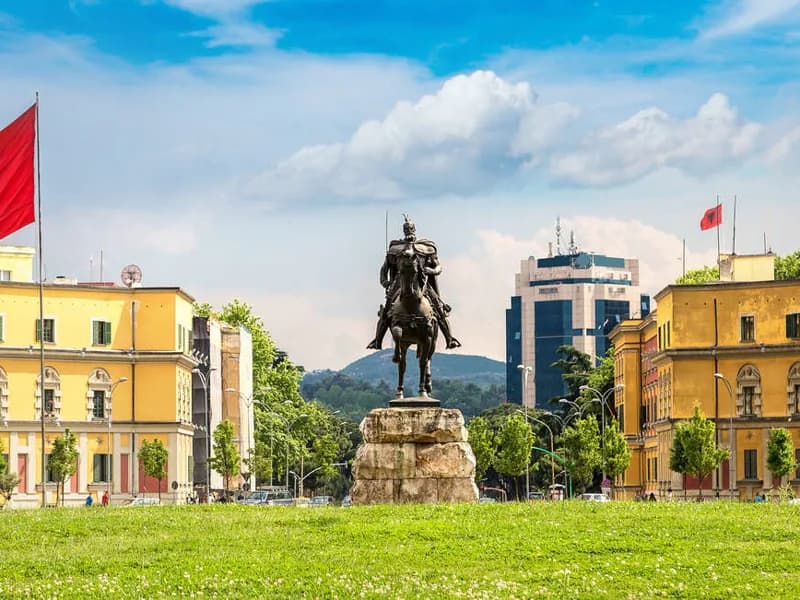
Tirana has been the capital only since 1920, and it shows. The centre is a mix of Italian-era ministries, socialist blocks and new towers. Many of the older blocks were painted in bright colours in the early 2000s, a cheap way to cheer the city up that became its trademark. Skanderbeg Square, at the centre, is named after the fifteenth-century noble who led the resistance to the Ottomans. In the suburbs, one of Hoxha's enormous bunkers has been turned into a museum of the communist period, and it is the most useful hour you can spend there.
Krujë, in the hills north of the capital, is where Skanderbeg held out. Its castle withstood repeated Ottoman sieges in his lifetime, and the bazaar below it still leads uphill to the walls. South of Tirana is Berat, whose old Ottoman houses climb the hillside with rows of windows that earned it the name "the town of a thousand windows". Further south is Gjirokastër, built of grey stone with stone-slabbed roofs, and the birthplace of both Hoxha and the novelist Ismail Kadare. Berat and Gjirokastër share a single World Heritage listing for their Ottoman architecture. Each repays a slow walk with a stop for coffee, and both are steep.
The ancient sites on the coast
Albania's classical past is better preserved than many visitors expect. Apollonia, near the coast, was founded by Greek colonists around 600 BC and later grew into a Roman city of learning. The young Octavian, the future emperor Augustus, was studying there in 44 BC when the news came that Julius Caesar had been assassinated. Much of the site is still unexcavated farmland, which gives it an unhurried, rather rural feel.
Butrint, in the far south, is the larger and more complicated of the two. It sits on a wooded peninsula in a lagoon, almost within sight of Corfu, and has layers from almost every period: a Greek theatre, Roman baths, a Byzantine baptistery with a mosaic floor, and Venetian walls. It was one of Albania's first World Heritage Sites, and the setting, half ruin and half woodland, is a large part of its appeal. The early morning is the time to be there, before the heat and the day trippers from the coast.
The Ionian, and what a week leaves out
The coast road south from Vlorë, the port where Albanian independence was declared in 1912, climbs over the Llogara Pass and comes down onto the Albanian Riviera: a string of small bays and villages between the mountains and a clear, very blue sea, running down to Sarandë. Porto Palermo, on the way, has a small fortress on a promontory associated with Ali Pasha, the Ottoman governor who ruled much of this region in the early nineteenth century. Spring and early autumn are the times to come. High summer brings heat and the crowds of a coast many people have only recently discovered.
Travelsphere's Albania Discovered: Tirana and Beyond, seven nights, covers Tirana, Krujë, Berat, Gjirokastër, Butrint and the coast at Sarandë and Vlorë, with stops in the coastal villages of Borsh and Qeparo. Just You's Albania Uncovered, also seven nights, follows a similar route, adding Apollonia and Porto Palermo, for those travelling solo.
Explore Worldwide's Highlights of Albania takes ten nights and a wider loop: east to Elbasan, Lake Ohrid at Pogradec and the town of Korçë, then south to Gjirokastër, Butrint and the coast, with time in Llogara National Park on the way back towards Vlorë. It runs from March to October.
What none of them reach in a week is the north, the high Accursed Mountains and the valleys of Theth and Valbona, which are a walking trip in their own right. A week in the south is enough to see why people are coming, and to understand the bunkers by the roadside.
By Walter Pellow, the name Atlas & Passage’s editorial team writes under. Prices and dates in the trips below come from the operators and can change.