Journeys
Albania by bike, through the south-east's lakes and mountains
Albania's south-east is a quiet country of lakes, mountain passes, wild rivers and stone towns, crossed by roads with little traffic. Cycling it, from Lake Ohrid down the Vjosa valley to the Ionian coast, shows a side of the country few visitors see.
By Walter Pellow20 October 20264 min read
Albania's roads have a mixed reputation, and in the cities and along the main highways the traffic can be chaotic. But much of the country's interior, especially in the south-east, is crossed by quiet roads through remarkable landscapes, and the country has been discovered by cyclists. The distances are short, the scenery changes constantly, the climbs are hard and rewarding, and the welcome in the villages is warm. Ending the day in a small family guesthouse with home cooking and a glass of local raki is part of the appeal.
Lake Ohrid and Korçë
The south-east of Albania borders North Macedonia and Greece, and its gateway is Lake Ohrid, one of the oldest and deepest lakes in Europe, shared with North Macedonia. Pogradec, the Albanian town on its southern shore, looks across the water to the mountains on the far side. From there the road climbs over the hills to Korçë, the main city of the region and one of the most cultured in Albania. It has an Orthodox cathedral, a museum of medieval art with a remarkable collection of icons, an old bazaar quarter that has been carefully restored, and a brewery whose beer is known across the country. The first school to teach in the Albanian language opened here in 1887.
Down the Vjosa valley
South of Korçë, the road climbs through high, empty country of pasture and forest, past villages such as Germenj, towards Leskovik, close to the Greek border. It then descends to the valley of the Vjosa, one of the last large wild rivers in Europe. It flows from the Pindus mountains of Greece through Albania to the Adriatic without dams for most of its length, its wide gravel beds braided into many channels. In 2023 it was declared a national park, the first wild river national park in Europe.
The valley road runs past Çarshovë, near the border, and on to Përmet, a small town in a valley of vineyards and orchards, known for its fruit preserves, its raki and its roses. Nearby are thermal springs where you can soak in warm pools beneath an old Ottoman bridge.
The Vjosa is one of the last large wild rivers in Europe.
To Gjirokastër and the sea
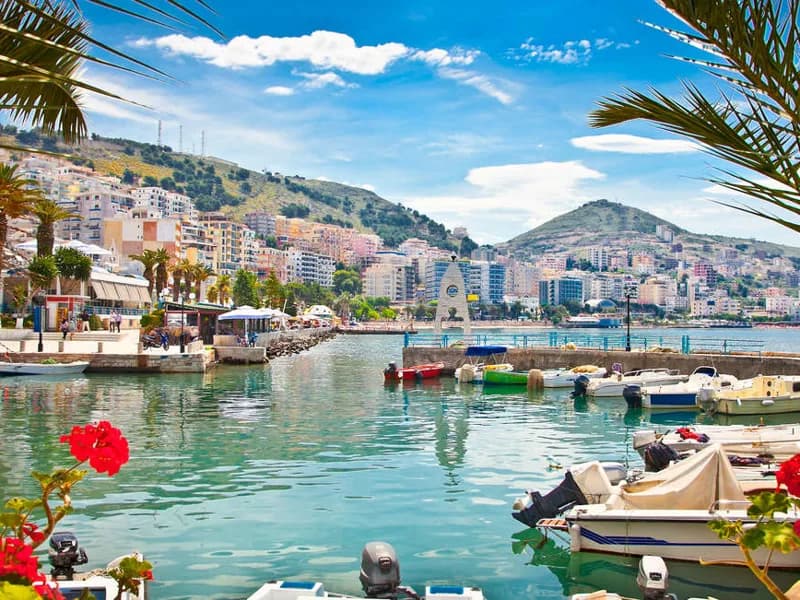
From the Vjosa, the route continues to Gjirokastër, the stone-built Ottoman town on its mountainside, a World Heritage Site. Then it crosses towards the coast by the Blue Eye, a spring of extraordinarily clear blue water rising from a deep hole in the rock. At the coast lie Butrint, the great archaeological site in its lagoon, Sarandë, and the coastal village of Lukovë above the Ionian Sea.
Explore Worldwide's Cycle Albania, seven nights in spring and autumn, includes Tirana, Pogradec, Korçë, Germenj, Leskovik, Çarshovë and Përmet, Gjirokastër, the Blue Eye, Butrint, Saranda and Lukova.
The villages along the way are some of the most traditional in Albania. In the mountains around Korçë and Leskovik, life follows the farming year, and many villages have emptied as young people have moved to the cities or abroad. Those who remain are generally delighted to see visitors. A stop at a village café for a Turkish coffee, a glass of raki or a plate of byrek, the flaky pie filled with cheese or spinach, is an essential part of the day, and conversation, with or without a shared language, comes easily.
Voskopojë, high in the hills above Korçë, was in the eighteenth century one of the largest towns in the Balkans, with dozens of richly painted churches, before it was sacked. A handful of its churches survive, with remarkable frescoes.
A Balkan ride, from Croatia to Albania
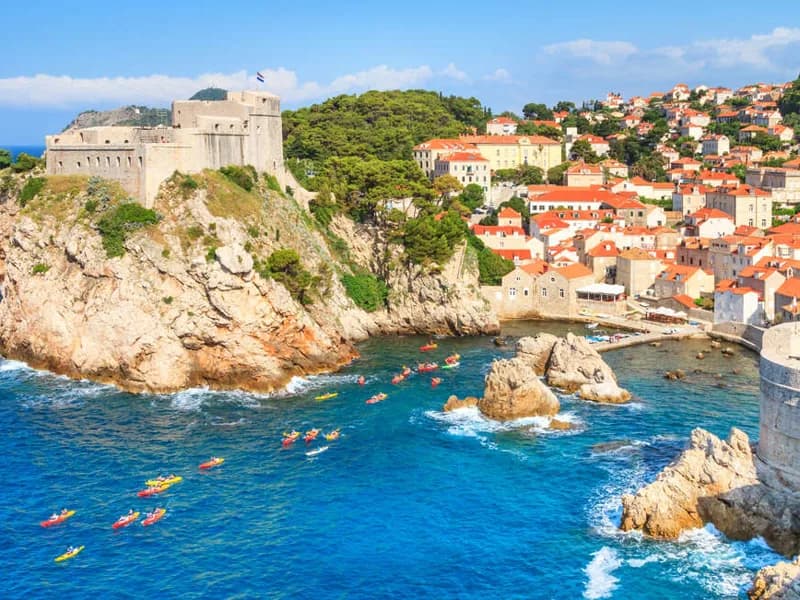
For a different route into Albania, Explore Worldwide's Cycle the Balkans: Croatia to Albania, seven nights, includes Dubrovnik and the Konavle valley in Croatia. In Montenegro its places include Herceg Novi, the Luštica peninsula and Kotor, Mount Lovćen and the village of Njeguši, famous for its smoked ham and cheese, and the old royal capital of Cetinje. They also include Lake Skadar, the largest lake in the Balkans, with Rijeka Crnojevića and Virpazar on its shores, and Vladimir near the Albanian border.
Spring and autumn are the best seasons for cycling in Albania. Summer is very hot in the valleys and on the coast, and winter brings snow to the mountains. The climbs in the south-east are long and steep in places, so a good level of fitness and a willingness to walk the occasional hill are useful.
By Walter Pellow, the name Atlas & Passage’s editorial team writes under. Prices and dates in the trips below come from the operators and can change.