History
Bergen, the Hanseatic port in the rain
Bergen grew rich on dried cod from the far north, and for four centuries German merchants of the Hanseatic League ran the trade from a row of wooden warehouses on its harbour. The warehouses are still there, and so, very often, is the rain.
By Walter Pellow2 November 20265 min read
Bergen has a reputation, and it is a wet one. The city is often called the rainiest in Europe, a claim that is argued about, but nobody argues about the rain itself. Bergen gets something like 2,250 millimetres of precipitation a year, most of it as rain, and it has measurable precipitation on roughly two hundred days of the year. Its people are philosophical about it. They have to be.
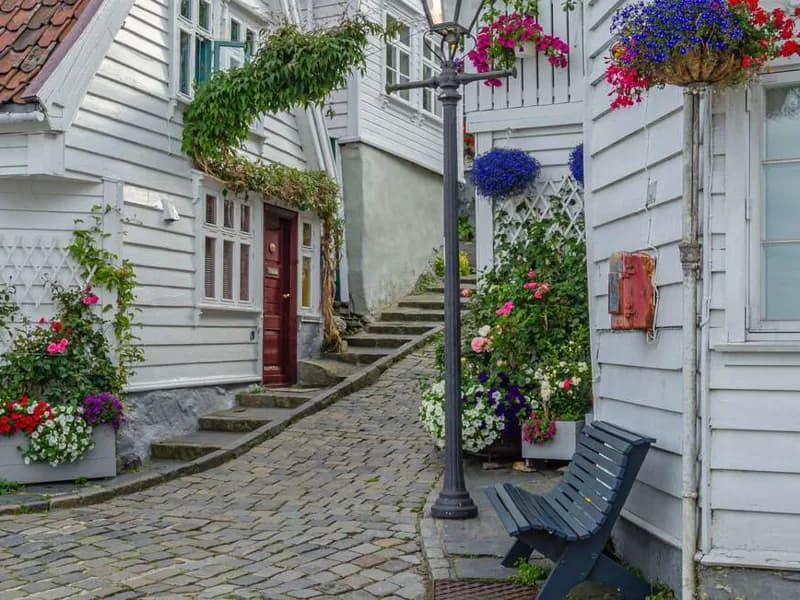
The rain is the price of the setting. Bergen lies on the west coast of Norway, facing the Atlantic weather, among steep hills around its harbour, and when the clouds lift, as they do, the light on the water and the colours of the wooden houses climbing the slopes are a sight that makes up for a great deal. Bring a good coat, and an umbrella you do not mind losing to the wind, and you will be fine.
The wharf of the Hansa
Bergen's wealth came from fish. Not fresh fish, but stockfish: cod caught in the far north, around the Lofoten islands, and dried. Bergen held the monopoly on the trade from northern Norway, and stockfish was the main reason the city became one of the great commercial centres of northern Europe.
The people who ran that trade were Germans. In the middle of the fourteenth century the Hanseatic League, the great association of German merchant towns, set up a Kontor, one of its trading offices, on the harbour at Bergen, and its merchants bought the fish from the northern fishermen, sorted it by quality and shipped it south. The Kontor lasted until 1754. For four centuries, a whole quarter of Bergen was effectively a German town.
That quarter is Bryggen, the wharf, a row of wooden buildings along the harbour. After a great fire in 1702 it was rebuilt on the same old plots and in the same way, so that what you see now, though mostly eighteenth century, preserves the plan and the shape of the medieval wharf. In 1979 UNESCO inscribed Bryggen as a World Heritage Site, as a rare survival of the way the Hanseatic merchants organised their lives and their space.
Up the mountain, out to the fjords
Bergen is surrounded by hills, and the easiest way up one of them is the Fløibanen, a funicular railway that has climbed from the town centre to the top of Mount Fløyen since it opened on 15 January 1918. It took its time arriving. A local member of parliament proposed a line up the mountain in 1895, building began in 1914, and the First World War, shortages and a great fire in the city in 1916 all held it up. The cars running today belong to the fifth generation of the system, which opened in 2022. At the top, some 320 metres up, there is a view down over the harbour and Bryggen which on a clear day is worth the whole trip, and on a wet one at least proves that you made the effort.
Bergen is also the gateway to the fjords. The railway to Oslo, the Bergen Line, runs east across the mountains, and at Myrdal it meets the Flåm Railway, which runs for about twenty kilometres between Myrdal, at some 867 metres, and Flåm, down by the fjord. With gradients of up to 55 in a thousand along much of its length, it is often described as the steepest standard-gauge railway in Europe, and it is one of the classic journeys of Norway.
Holidays and a cruise that call at Bergen
Ambassador Cruise Line's six-night Flam Railway & Bergen's Winter Wonders sails from London Tilbury in December, with Bergen, Flam, the Sognefjord and the Aurlandsfjord on its itinerary.
Travelsphere's seven-night Norwegian Wonders – Cities, Fjords and Mountains includes Oslo, Balestrand, Myrdal, Flåm, Ulvik and Bergen.
Explore Worldwide's seven-night Walking the Fjords of Southern Norway includes Stavanger, Jaeren, the Lysefjord and Preikestolvegen, Utstein Monastery, Odda and the Hardangerfjord, Sand, Buer and Øystese, and Bergen and Glesvær. It has departures in June, August and September.
With a day in Bergen, walk the passages of Bryggen early, before the crowds, then go up on the Fløibanen and look down on the harbour. If it is raining, as it may well be, do it anyway. Bergen in the rain is still Bergen, and the locals will think better of you for it.
By Walter Pellow, the name Atlas & Passage’s editorial team writes under. Prices and dates in the trips below come from the operators and can change.