Rail
Scandinavia by train, the fjords to Stockholm
The railway from Bergen to Oslo crosses the roof of Norway, over the highest mountain plateau in northern Europe, and connects with a branch line that falls down a mountainside to a fjord. From Oslo, the trains run on to Stockholm and Copenhagen, three capitals in a week.
By Walter Pellow2 November 20264 min read
Scandinavia is a good place to travel by train. Its railways are comfortable and punctual, its cities are compact, and its scenery, especially in Norway, is some of the finest in Europe. A journey from the fjords of western Norway to the capitals of Sweden and Denmark crosses mountains, lakes and forests, and links three very different cities, each a capital of a country that once, at various points in its history, ruled one or both of the others.
Bergen
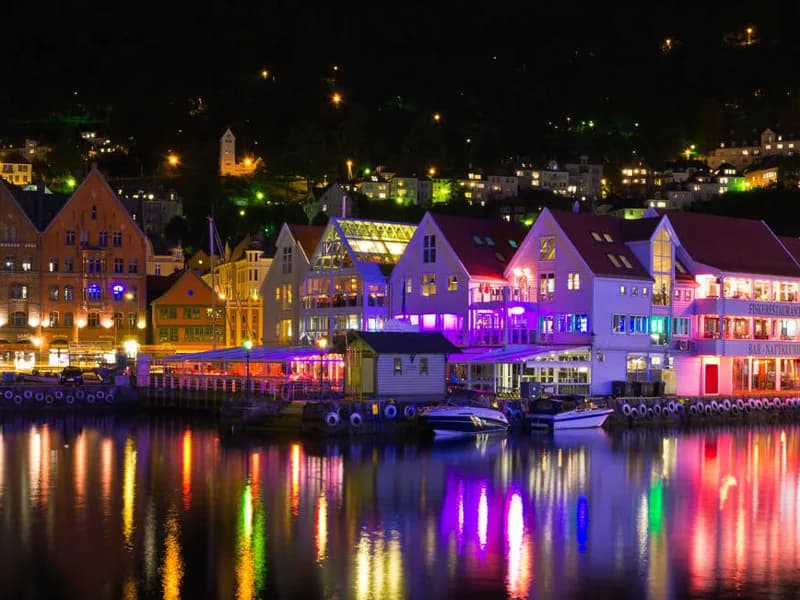
The journey begins, usually, in Bergen, Norway's second city, on the west coast between the mountains and the sea. It was for centuries a great Hanseatic port, and the row of tall wooden warehouses on its harbour, Bryggen, is a UNESCO World Heritage Site. A funicular climbs Mount Fløyen behind the city for views over the harbour and the islands. Bergen is famously wet, with rain on a great many days of the year, but its setting is magnificent in any weather.
Over the mountains
The Bergen Railway, which opened in 1909, runs east from Bergen to Oslo across the mountains of southern Norway, and it is one of the great rail journeys of the world. From the fjords it climbs through Voss and up onto the Hardangervidda, the largest mountain plateau in northern Europe, a vast, treeless expanse of lakes, snowfields and bare rock, home to wild reindeer. Its highest station, Finse, stands at over twelve hundred metres beside a glacier, and it was here that the scenes on the ice planet in The Empire Strikes Back were filmed. Even in midsummer, there can be snow beside the line.
At Myrdal, high on the plateau, the Flåm Railway branches off and drops down to the fjord. It is one of the steepest standard-gauge railways in the world, descending more than eight hundred metres in about twenty kilometres, through tunnels and past waterfalls, to the village of Flåm at the head of the Aurlandsfjord. From there, boats sail through the Nærøyfjord, a narrow arm of the Sognefjord between sheer walls of rock, a UNESCO World Heritage Site, to Gudvangen, where a road leads back towards Voss.
One of the steepest standard-gauge railways in the world.
Oslo, Stockholm and Copenhagen
Oslo, the Norwegian capital, lies at the head of its own long fjord. Its sights include the Fram, the polar exploration ship, and the Kon-Tiki raft, in their museums on the Bygdøy peninsula, the Vigeland sculpture park, and the white Opera House on the waterfront, whose sloping roof you can walk up.
Stockholm, the Swedish capital, is built on fourteen islands where Lake Mälaren meets the Baltic, and it is one of the most beautiful capitals in Europe. Gamla Stan, the old town, is a maze of narrow lanes and ochre houses around the royal palace, and the Vasa Museum holds a warship that sank on its maiden voyage in 1628 and was raised, almost intact, in 1961.
Copenhagen, the Danish capital, is a city of canals, bicycles and handsome squares, with the colourful houses of Nyhavn, the royal palace of Amalienborg, the Tivoli Gardens and, on the waterfront, the statue of the Little Mermaid. Reffen, an old industrial area on the harbour, is now a big street-food market.
Between Sweden and Denmark, the railway crosses the Øresund Bridge, opened in 2000, which links Malmö to Copenhagen by a long cable-stayed bridge and a tunnel under the sea, and became famous far beyond Scandinavia through a television crime series set on it. In central Sweden, Örebro has a moated castle in the middle of the town, and Jönköping lies at the southern tip of Lake Vättern, one of the largest lakes in the country.
The tours
Explore Worldwide's Discover Scandinavia, nine nights, travels from Bergen through Voss, Gudvangen and Flåm to Oslo, then on to Copenhagen, with Reffen, and Stockholm. It runs from May to September.
Travelsphere's Scandinavian Explorer, eight nights, links Oslo, Örebro, Stockholm, Jönköping and Copenhagen, crossing Sweden past its great lakes.
The season for the journey runs from late spring to early autumn, when the mountain line is at its most spectacular and the evenings are long. In June, the light barely fades in the north. Winter has its own appeal, with snow on the plateau and the cities lit for Christmas.
By Walter Pellow, the name Atlas & Passage’s editorial team writes under. Prices and dates in the trips below come from the operators and can change.