Journeys
Hardangerfjord, the orchards and waterfalls of western Norway
Norway's second-longest fjord is its gentlest: a long reach of water lined with fruit farms, with glaciers and a high plateau above and waterfalls pouring off it. Eidfjord, Ulvik and Odda are the places to know.
By Walter Pellow2 November 20263 min read
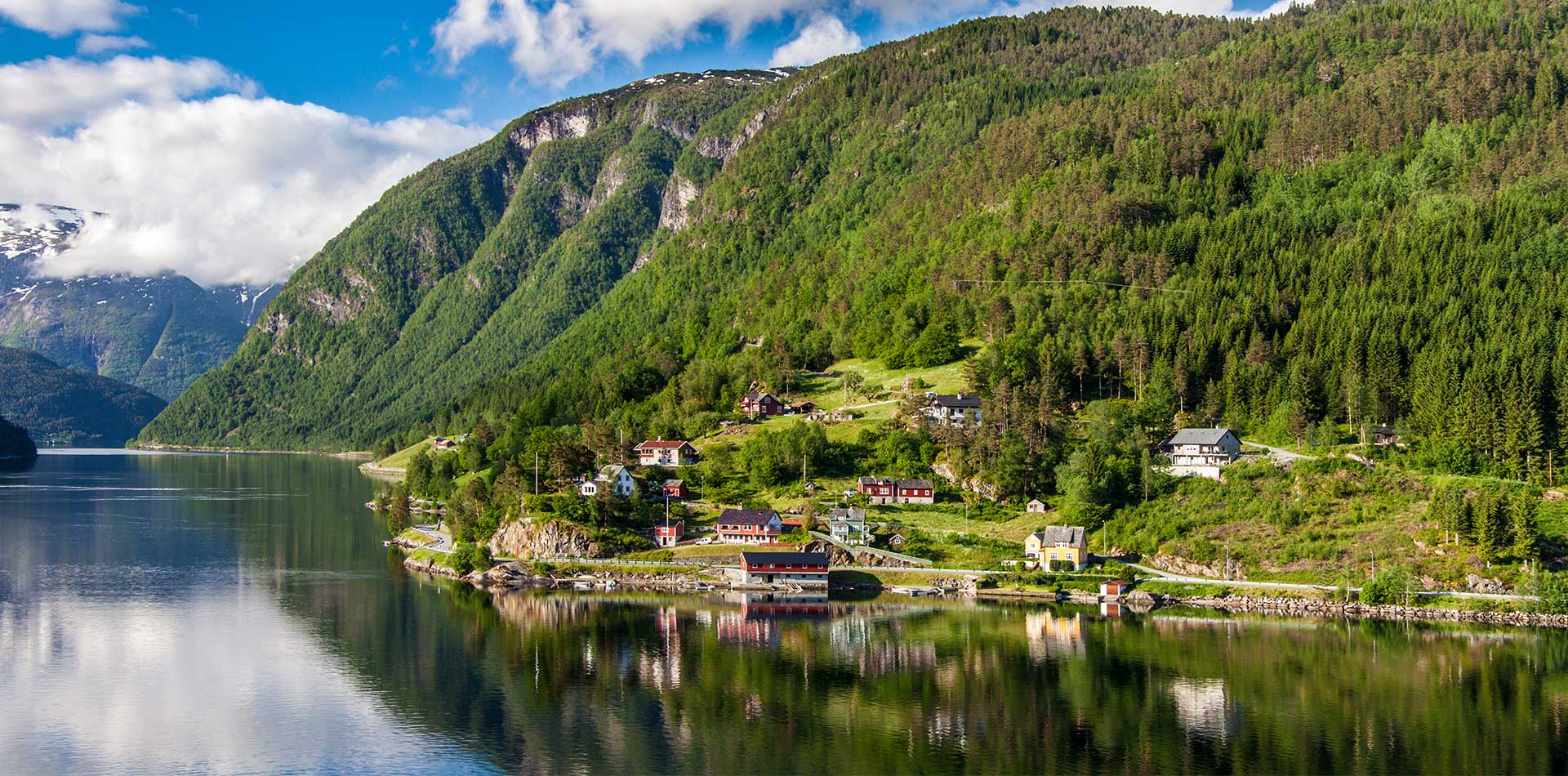
Most of Norway's famous fjords are grand in a stern way: grey walls of rock, dark water, a narrow strip of green at the bottom. The Hardangerfjord is different. It is long, roughly 179 kilometres from the open sea to its innermost arms, the second longest in Norway after the Sognefjord, but its shores are lower and softer, and along them, on every sheltered slope with a little soil, there are fruit trees. Apples, pears, plums and cherries grow here, further north than they have any right to, in rows that run down almost to the water.
Above the orchards the landscape is anything but soft. The Folgefonna glacier sits on the mountains to the south; to the east the land rises to the Hardangervidda, the largest mountain plateau in northern Europe, and when its snow melts the water has to go somewhere. It goes over the edge.
Orchards and cider
The fruit growing is old. Cider and fruit have been made in Hardanger for centuries, and the farms along the shore, around Ulvik, Lofthus and Øystese, still sell their own juice and cider. Since 2009, Cider from Hardanger has been a protected name, which can only be used for cider made from apples grown here, and a few of the farms open their doors to visitors who want to taste it.
In May, when the trees are in blossom below the snowline, the fjord is at its prettiest. In late summer and autumn, the branches are heavy and the stalls by the road fill with fruit. Either way, it is a rare sight in a landscape that otherwise belongs to rock, water and ice.
The waterfalls
The best known is Vøringsfossen, near the head of the fjord above Eidfjord, where the river falls about 182 metres from the edge of the Hardangervidda into the Måbødalen valley. The road up from Eidfjord climbs the valley in a series of tunnels and bends, and at the top there are viewing platforms and a bridge across the gorge, so that you can look straight down into the spray.
There are many others. The Hardangerfjord's side arms are lined with falls, and in early summer, when the meltwater is at its height, there are more than anyone could name. On the Maurangerfjord, a southern arm, Furebergsfossen drops down the mountainside to the water.
Apples and cherries grow here, further north than they have any right to.
Eidfjord, Ulvik and Odda
The fjord's innermost reaches are its most dramatic, and three small places mark them. Eidfjord, at the very head of its arm, is the starting point for Vøringsfossen and the Hardangervidda. Ulvik, at the end of its own short arm, is the orchard village, with fruit trees on the slopes behind the church and the cider farms close by. And Odda, at the head of the long Sørfjord, is a former industrial town with a glacier valley behind it and, a long hike above, the rock spur of Trolltunga.
Crossing the fjord between them is easier than it used to be. The Hardanger Bridge, which opened in 2013, spans the fjord between Ullensvang and Ulvik with a main span of 1,310 metres, the longest suspension span in Norway, and it has shortened the drive between the two sides considerably. The car ferries that did the job before still run on other crossings, and a ferry is still the best way to see the water.
By ship or on foot
Two short cruises from Newcastle come here. Fred. Olsen's five-night Bank Holiday Fjords of Norway sails in August, and its places are the Lysefjord, Bergen, Ulvik, the Hardangerfjord, the Maurangerfjord and the Fureberg waterfall. Ambassador's five-night Springtime Fjords Short Break sails in May, which is blossom time, and its places are Ulvik, the Hardangerfjord, Sandnes and the Boknafjord.
For walkers, Explore's seven-night Walking the Fjords of Southern Norway begins in Stavanger, with the coast of Jæren, the Lysefjord and the Preikestolen path, and the old Utstein Monastery, then crosses to Odda and the Hardangerfjord, with Sand, Buer and Øystese, before finishing in Bergen and at Glesvær on the coast. It departs in June, August and September.
May brings the blossom and the first meltwater; June and July the long light and the fullest waterfalls; August the warmest days and the first fruit; September the harvest and the first autumn colour on the birches. Winter is quiet and dark, and much of what is described here closes. If you can choose, I would go in late May, when the orchards are white, the falls are loud and the snow is still bright on the mountains above.
By Walter Pellow, the name Atlas & Passage’s editorial team writes under. Prices and dates in the trips below come from the operators and can change.