Cruise
Nordfjordeid and the Nordfjord, where Norway's fjord horses are bred
The little dun horse with the striped mane belongs to western Norway, and its home is a small town on the Nordfjord. Nordfjordeid also keeps a full-size copy of the largest Viking ship found in the country.
By Walter Pellow2 November 20265 min read
Look at almost any picture of a Norwegian fjord horse and you will notice the mane first. It stands up stiffly, cut short in a curve like the crest of a helmet, and down the middle of it runs a dark stripe between two pale edges. The effect is entirely deliberate. Breeders trim the pale outer hair a little shorter than the dark centre so that the stripe shows, and they have been doing it for so long that a fjord horse with a long, flowing mane looks faintly as though it has forgotten to get dressed.
The place to see them is Nordfjordeid, a small town on the Nordfjord in western Norway, which is home to the Norsk Fjordhestsenter, the national centre for the breed. It is not a museum but a working place: riding lessons, advice for owners, and a part in the breeding of the horse itself, which the breed society, Norges Fjordhestlag, carries out together with the centre at Nordfjordeid and the national horse centre in eastern Norway. Each year Nordfjordeid holds the stallion show, and people who care about fjord horses travel a long way to watch it.
A small horse with a long history
The fjord horse is a farm horse, built for a country of steep fields, narrow tracks and long winters. It is small, stocky and strong, with a short neck and a deep chest, and it was bred to plough, haul timber and carry loads up hillsides that a tractor would think twice about. It is also known for its temperament, which is calm and willing, the reason it is now ridden by children and driven in harness as often as it is worked.
What makes the breed so easy to recognise is its colour. Every fjord horse is dun, a coat with dark legs and a dark line along the back, and roughly nine in ten of them are what Norwegians call brown dun: a pale fawn body with black or very dark brown markings. Red dun, grey and white dun appear too, and a yellow dun now and then. The dark stripe begins in the forelock, runs through the middle of the mane, along the spine and down the tail, which is why the mane is cut the way it is: the stripe is the breed's signature, and the trimming shows it off.
Horses like these were shown in western Norway from 1864, and the breed's first studbook was opened in 1910. The breed society followed in 1949. The pattern has held ever since, and Nordfjord, the district around the fjord, is the heart of it.
A fjord horse with a long, flowing mane looks faintly as though it has forgotten to get dressed.
Sagastad and the Myklebust ship
Nordfjordeid has a second claim on a visitor's time, and it is a much bigger one. In 1874 a young archaeologist from Bergen, Anders Lorange, dug into a burial mound at Myklebust in the town. The ship inside had been burned as part of the burial, unlike the famous ships of Oseberg and Gokstad, which were found intact, so what survived was mostly ash, grave goods and iron rivets, more of them than he could carry away. The size and number of those rivets are the evidence for the ship's size: the Myklebust ship is thought to be the largest Viking ship whose remains have been found in Norway, though the archaeologists are careful to say they cannot be certain.
In May 2019 the town opened Sagastad, a centre for the Viking Age beside the fjord, and built inside it a full-scale reconstruction of the ship, about thirty metres long. It is worth being clear about what that means. Nobody knows exactly what the Myklebust ship looked like, and the reconstruction is an informed guess, its dragon's head carved by a local woodcarver from the evidence of other Viking finds. But a guess at full size is a powerful thing. Standing beside it, you understand in a way no drawing manages how much timber, labour and wealth went into one of these ships, and how much it meant to put one in the ground.
The fjord itself
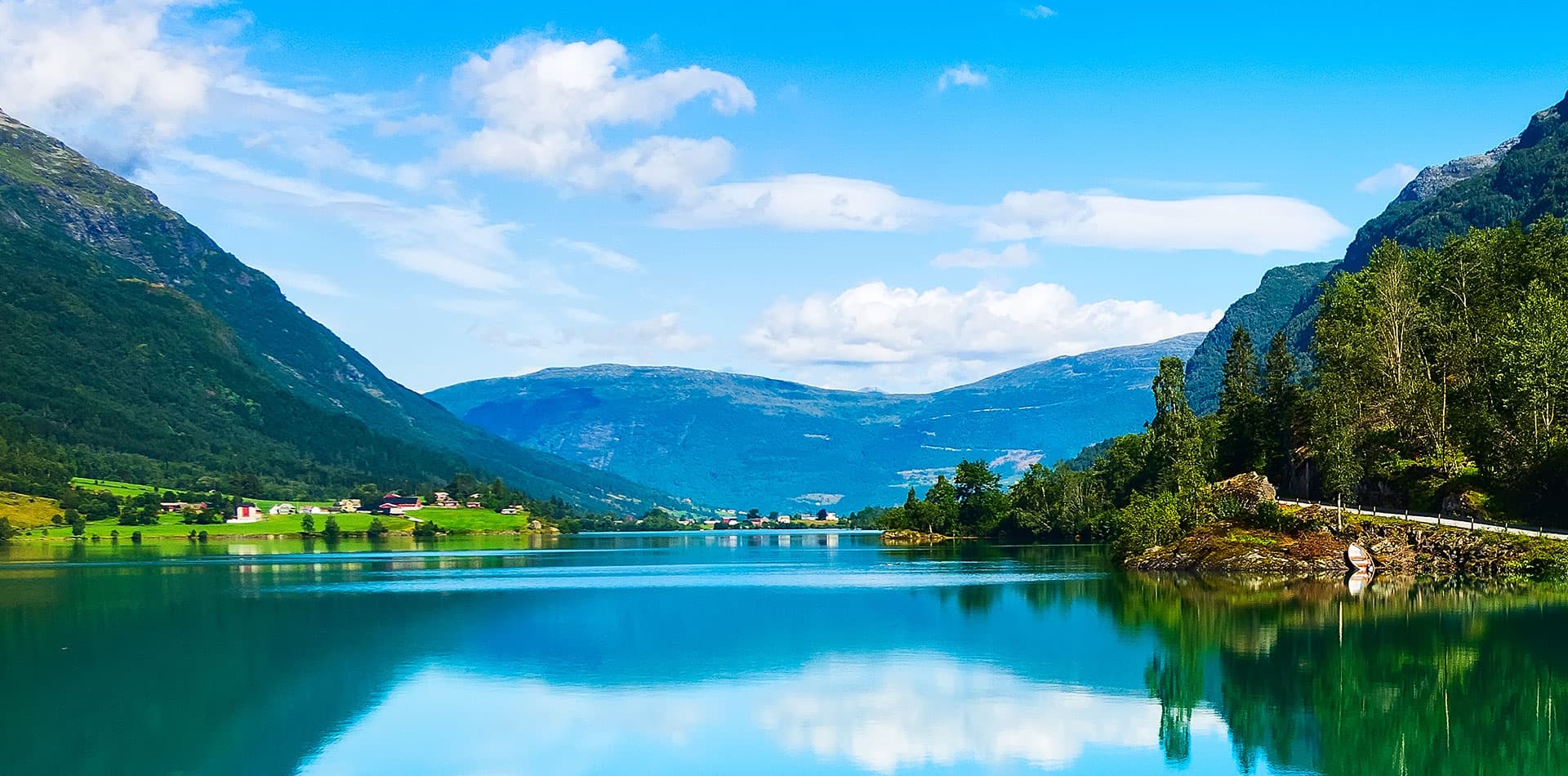
The Nordfjord runs inland from the coast towards the mountains, and the further in you go the steeper the sides become. Nordfjordeid sits partway along, on gentler ground, which is one reason it has long been a farming and market town rather than a village clinging to a ledge. Further in lies Olden, near the inner end of the fjord.
For a ship, the approach is the point. Fjord cruising is slow by nature, and the Nordfjord is a long, quiet fjord with farms on the slopes, small ferry quays and snow on the tops well into summer. The view from the rail on the way in is half of what you came for.
Cruises that go there
Three cruises here go into the Nordfjord, and two of them list Nordfjordeid itself.
Ambassador Cruise Line's eight-night Summertime Fjords & Mountains of Norway sails from Dundee in July. Its places include Bergen, Flåm and the Sognefjord, Nordfjordeid and the Nordfjord, Geiranger and Ålesund.
Fred. Olsen's seven-night Scenic Fjords & Mountains of Norway sails from Newcastle in August, with the Lysefjord, Bergen, Skjolden and the Sognefjord, Nordfjordeid and the Nordfjord, and Eidfjord on the Hardangerfjord among its places.
Fred. Olsen's Norwegian Fjords in Five Nights also sails from Newcastle, in May. It lists the Nordfjord and Olden but not Nordfjordeid, so it is the fjord rather than the horse town that it shows you.
With a day in Nordfjordeid, I would see the ship at Sagastad first and then go and find the horses. One is a reconstruction of something lost for a thousand years; the other has never gone anywhere.
By Walter Pellow, the name Atlas & Passage’s editorial team writes under. Prices and dates in the trips below come from the operators and can change.