Journeys
Machu Picchu and the Galápagos in one trip
The mountain city of the Incas and the islands that helped shape the theory of evolution are two of the great sights of South America. They lie in different countries, but they can be combined in a single journey of a fortnight.
By Walter Pellow20 October 20264 min read
For many people, Machu Picchu and the Galápagos are the two places in South America they most want to see. One is a work of human ambition, a city of stone built on a mountain ridge. The other is a work of nature, a group of volcanic islands where animals have evolved in isolation and show little fear of people. They lie in two countries, Peru and Ecuador, about two hours apart by air, and joining them in one trip is a natural combination for a first visit to the continent.
Cusco and the Sacred Valley
Cusco was the capital of the Inca empire, which at its height in the early sixteenth century stretched for thousands of kilometres along the Andes. The Spanish captured the city in 1533 and built their churches and mansions on top of Inca walls. Those walls still line many of its streets. They are made of great blocks of stone cut to fit together so precisely, without mortar, that a knife blade cannot be slipped between them. The cathedral stands on the main square, and the Dominican monastery of Santo Domingo was built over the Coricancha, the Incas' temple of the sun.
Cusco lies at about three thousand four hundred metres, and the altitude affects almost everyone at first. Many trips spend the first nights lower down, in the Sacred Valley of the Urubamba river, to adjust.
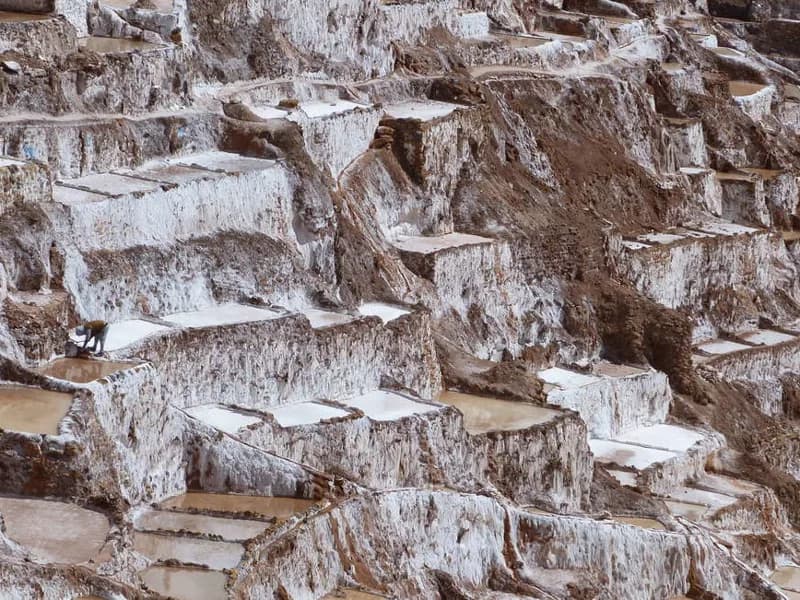
The valley, a fertile strip of farmland between high mountains, was the heartland of the Incas. At Moray, the Incas built a set of great circular terraces, sunk into the ground like an amphitheatre, which may have been used to study the growing of crops at different temperatures. Nearby, at Maras, thousands of small salt pans cover a hillside, fed by a salty spring, and they have been worked since before the Incas. Ollantaytambo is a town still laid out on its Inca street plan, below a great temple fortress of terraces and stone.
Machu Picchu
From Ollantaytambo, the railway follows the river through a narrowing gorge to Aguas Calientes, the town at the foot of Machu Picchu, from where buses climb the hill to the site.
Machu Picchu was built in the fifteenth century, probably as an estate for the Inca emperor Pachacuti. It sits on a ridge between two peaks, with the river looping far below and mountains all around. Its temples, palaces, houses, terraces and stairways were abandoned around the time of the Spanish conquest, and the Spanish appear never to have found it. It became known to the wider world after the American explorer Hiram Bingham was led there by local farmers in 1911. Today, entry is by timed ticket, and numbers are limited to protect the site.
There are two ways to reach the site on foot. The classic Inca Trail is a walk of four days over high passes and past other Inca ruins, entering Machu Picchu through the Sun Gate. Permits are limited and sell out months ahead. Those arriving by train can still walk up to the Sun Gate from the site for a view back over the ruins, or climb one of the two peaks beside it, Huayna Picchu or Machu Picchu mountain, which need their own tickets.
Quito and the islands
Quito, the capital of Ecuador, is the gateway to the Galápagos, which lie about a thousand kilometres out in the Pacific. In the islands, Santa Cruz is the hub, with the town of Puerto Ayora and the Charles Darwin Research Station, where giant tortoises are bred. Isabela, the largest island, has the quiet town of Puerto Villamil, lagoons with flamingos, and sea lions, marine iguanas and penguins along its shores.
Explore Worldwide's Machu Picchu and Galápagos, fourteen nights, includes Cusco, the Sacred Valley, Moray, Maras, Ollantaytambo, Aguas Calientes and Machu Picchu in Peru, and Quito, Santa Cruz with Puerto Ayora, and Isabela with Puerto Villamil in Ecuador.
For travellers who would rather leave Peru for another time, Just You's Natural Wonders of Ecuador and the Galápagos, fourteen nights for solo travellers, stays in Ecuador. It includes Quito, Mindo, Otavalo and Cotacachi on the mainland, and Santa Cruz, Isabela and San Cristóbal in the islands, but not Machu Picchu.
The best time for Machu Picchu is the dry season in the Andes, from about May to September, though it is also the busiest. The Galápagos can be visited all year. Allow time for the altitude in Cusco, and book Machu Picchu entry well in advance if you are travelling independently.
By Walter Pellow, the name Atlas & Passage’s editorial team writes under. Prices and dates in the trips below come from the operators and can change.