Journeys
Ecuador from the Andes to the Amazon in under a fortnight
Ecuador is one of the smallest countries in South America, and that is its great advantage. In a couple of weeks you can see a colonial capital, a market town, snow-capped volcanoes, hot springs and the edge of the Amazon rainforest, without spending days on the road.
By Walter Pellow20 October 20264 min read
Ecuador takes its name from the equator, which runs through it a few kilometres north of the capital. It is a compact country, a little larger than the United Kingdom, but it holds a remarkable range of landscapes. Two chains of the Andes run through the middle, lined with volcanoes, some of them snow-capped and active. To the west, the land falls to the Pacific coast. To the east, it falls through cloud forest to the Amazon basin. Because distances are short, it is possible to move between these worlds in a few hours.
Quito and the volcanoes
Quito stands in a high valley at about two thousand eight hundred metres, beneath the volcano Pichincha, one of the highest capitals in the world. Its old town, founded by the Spanish in 1534 on the site of an Inca city, was among the very first places in the world to be named a World Heritage Site, in 1978. Its churches and monasteries are among the finest in South America. The Jesuit church of La Compañía is covered inside with gold leaf, and the great monastery of San Francisco, one of the oldest in the Americas, faces a broad square. North of the city, a monument marks the equator, where visitors stand with a foot in each hemisphere.
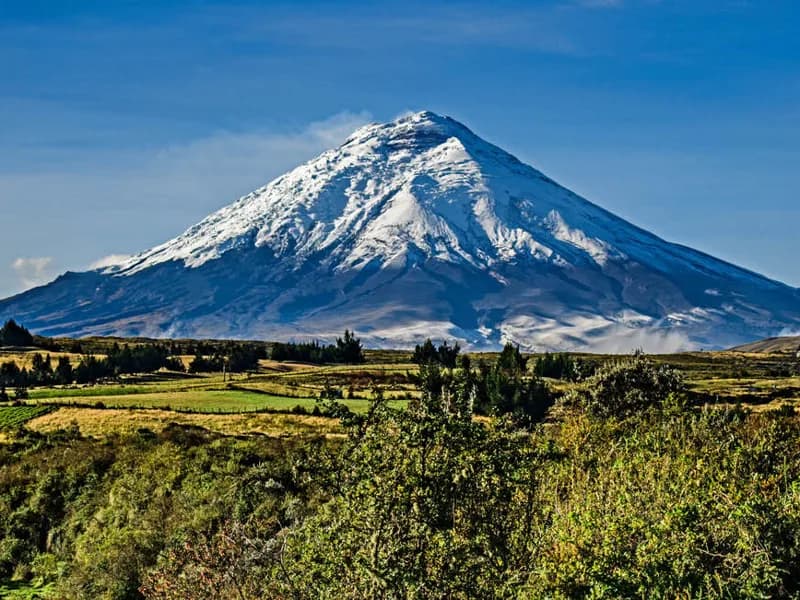
South of Quito, the road runs down a valley lined with volcanoes, which the German explorer Alexander von Humboldt, who travelled here in 1802, called the avenue of the volcanoes. Cotopaxi, almost perfectly conical and capped with a glacier, rises to nearly six thousand metres and is one of the highest active volcanoes in the world. The national park around it is a high, open landscape of grassland, lakes and wild horses. Further south, Chimborazo is the highest mountain in Ecuador, at more than six thousand two hundred metres. Because the earth bulges at the equator, its summit is the point on the earth's surface farthest from the planet's centre.
Hot springs and the Amazon
East of Quito, the road climbs over a high pass and drops to Papallacta, where hot springs feed pools surrounded by mountains, often in the clouds. Beyond, it descends steeply through the cloud forest to the Amazon lowlands.
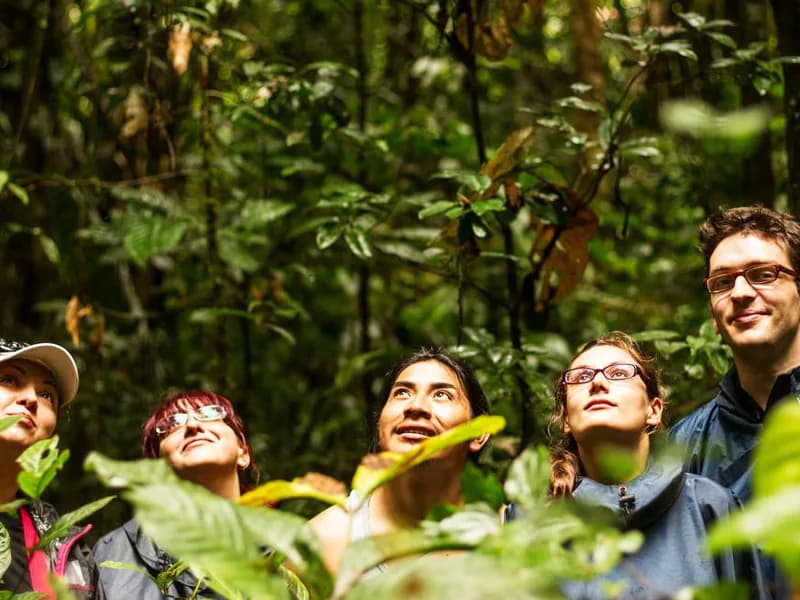
Tena and Misahualli, on the rivers of the upper Amazon basin, are gateways to the rainforest. Here the air is hot and humid, and the forest is full of birds, butterflies, insects and, in the canopy, monkeys. Visits by motorised canoe along the Napo river, walks in the forest with local guides, and meetings with Kichwa communities, who live along the rivers, give an introduction to the Amazon in a short time. It is not the deep rainforest of a long expedition, but it is the real thing.
Coming out of the forest, the change is abrupt. Within a few hours the road climbs back from the heat of the lowlands into the cool of the mountains, through a landscape of waterfalls, tree ferns and steep green slopes, and the difference in climate, plants and people over so short a distance is one of the most striking things about the country.
Baños
Baños, at the foot of the Tungurahua volcano, is a small town named after its hot baths, fed by thermal springs. It lies at the top of the Pastaza valley, where the river drops from the Andes towards the Amazon through a gorge of waterfalls. The best known, the Pailón del Diablo, the devil's cauldron, plunges into a deep rocky pool and can be approached by a path and suspension bridges. Baños is a centre for outdoor activities, from cycling down the valley to rafting.
Explore Worldwide's Ecuador: Andes to Amazon, thirteen nights in March, May, June, September and October, includes Quito, Otavalo, San Pablo Lake, Cuicocha, Peguche, Cotopaxi National Park, Papallacta, Tena, Misahualli, Baños and the Chimborazo Forest Reserve.
Explore Worldwide's Volcanoes and Galápagos, fourteen nights, includes Quito, Otavalo, Peguche, Cuicocha, Mindo and Cotopaxi on the mainland, combined with Santa Cruz and Isabela in the Galápagos, but not the Amazon.
Ecuador's weather varies more by altitude and region than by season. In the Andes, the drier months, roughly from June to September, bring the clearest views of the volcanoes. In the Amazon, it rains at any time of year. Allow a day or two in Quito to adjust to the altitude before heading higher.
By Walter Pellow, the name Atlas & Passage’s editorial team writes under. Prices and dates in the trips below come from the operators and can change.