History
Darwin and the Galápagos, and what the finches did and did not tell him
The story goes that Charles Darwin saw the finches of the Galápagos, noticed their different beaks and understood evolution. The truth is slower and more interesting. The finches mattered, but not in the way the legend says, and it was the mockingbirds and tortoises that first set him thinking.
By Walter Pellow20 October 20264 min read
In September 1835, HMS Beagle, a small Royal Navy survey ship, arrived in the Galápagos Islands. It was nearly four years into a voyage around the world, charting the coasts of South America, and on board was a young naturalist of twenty-six, Charles Darwin. The ship spent about five weeks in the archipelago. Darwin went ashore on four islands: San Cristóbal, then called Chatham, Floreana, called Charles, Isabela, called Albemarle, and Santiago, called James.
He was fascinated by what he found: the black lava, the giant tortoises, the marine iguanas swimming in the sea, the birds so tame they could be pushed off a branch with a gun. He collected plants, birds, reptiles and insects. But he did not leave the islands with a theory of evolution, and the famous moment of insight over the finches never happened.
The mockingbirds and the tortoises
The first clue came from the mockingbirds. Darwin noticed that the mockingbirds he collected on different islands were not quite the same, and, unusually, he labelled them by island. On the voyage home, he wrote in his notes that if the differences proved to be real, they would undermine the idea that species were fixed and unchanging.
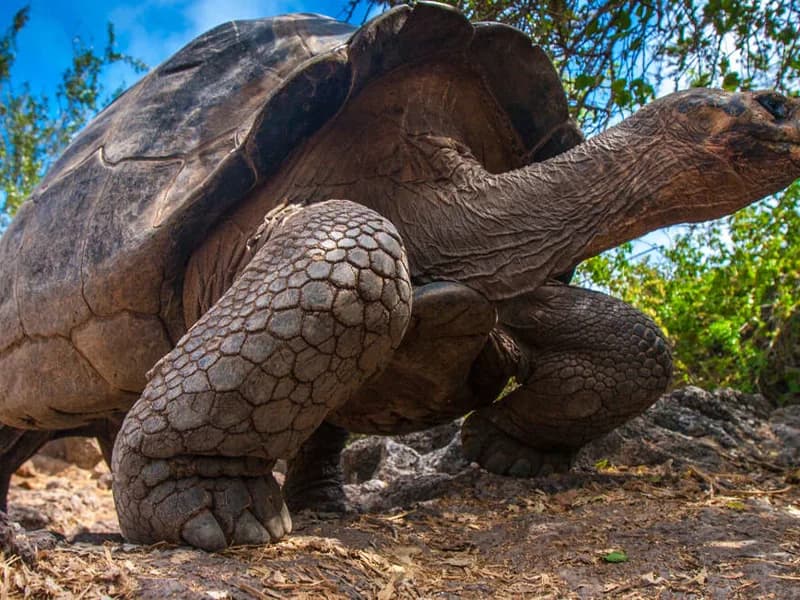
The tortoises gave him another clue. On Floreana, the vice-governor of the islands, Nicholas Lawson, told him that he could tell which island any tortoise came from by the shape of its shell. Darwin paid little attention at the time, and later regretted it. The Beagle's crew, meanwhile, took tortoises on board as food, as ships had for centuries, and they were eaten on the voyage.
The finches
Darwin did collect finches, but he did not recognise them as a group of related species, and he did not label most of them by island. Some, he thought, were not finches at all. It was only after he returned to England in 1836 that the ornithologist John Gould examined his birds and told him that they were a group of closely related finches, a dozen or so species, found only in the Galápagos, with beaks of very different shapes. Gould also confirmed that the mockingbirds from different islands were different species.
That news helped convince Darwin that species could change. He began his notebooks on the "transmutation" of species in 1837. Over the next two decades he gathered evidence from many sources, from pigeon breeders, barnacles and plants as well as the voyage, and he published On the Origin of Species in 1859. The Galápagos finches barely appear in it.
The finches became famous later. In the twentieth century, biologists recognised them as a classic example of one ancestor giving rise to many species, each adapted to a different way of life. From 1973, the biologists Peter and Rosemary Grant studied the finches on the tiny island of Daphne Major year after year. After a severe drought in 1977, when small seeds ran out, they found that birds with larger, deeper beaks survived better, and that the next generation had larger beaks on average. It was evolution by natural selection, measured in the field, within a few years.
Seeing the islands today
Almost two centuries on, the animals Darwin saw are still there. Giant tortoises survive on several islands, and at the Fausto Llerena Breeding Centre in Puerto Ayora, on Santa Cruz, young tortoises are raised to be returned to the wild. Darwin's finches are everywhere, hopping around the visitor sites, though telling the species apart is a challenge even for experts. The mockingbirds, bold and curious, often come to investigate visitors' bags.
Just You's Natural Wonders of Ecuador and the Galápagos, fourteen nights for solo travellers, includes Santa Cruz, Isabela and San Cristóbal, the island where Darwin first landed, with Quito, Mindo, Otavalo and Cotacachi on the mainland.
Explore Worldwide's Volcanoes and Galápagos, fourteen nights, includes Santa Cruz with Puerto Ayora, Isabela with Puerto Villamil and the Tintoreras islets, and Cotopaxi, Otavalo and Mindo on the mainland. Its Galápagos: Central, North, South and East Islands aboard the Archipel I, a nine-night cruise, includes Genovesa, Bartolomé, Santa Cruz with the breeding centre, Floreana with Post Office Bay, and Española.
Reading Darwin's own account of the islands, in his book about the voyage of the Beagle, is the best preparation for a visit. It is full of his wonder at what he saw.
By Walter Pellow, the name Atlas & Passage’s editorial team writes under. Prices and dates in the trips below come from the operators and can change.