Wildlife
The Galápagos by small boat, and why the route matters
Every boat in the Galápagos follows a fixed itinerary approved by the national park, and no two routes see quite the same islands or the same animals. Choosing a cruise is really choosing a route, and it pays to know what each part of the archipelago holds.
By Walter Pellow20 October 20264 min read
The Galápagos Islands lie on the equator in the Pacific, about a thousand kilometres west of mainland Ecuador. They are volcanic, young in geological terms, and they were never joined to any continent. Every plant and animal that lives on them arrived across the sea, by air, by swimming or by drifting on rafts of vegetation, and over time many evolved into species found nowhere else. Because the islands had no human population until recent centuries, many of the animals show little fear of people, which is what makes a visit so extraordinary.
Most of the archipelago is a national park, and visits are closely controlled. Visitors may land only at designated sites, must stay on marked trails, and must be accompanied by a licensed naturalist guide. For a boat, that means a fixed itinerary, approved in advance, which sets out the sites it may visit on each day.
Why the route matters
The islands are spread over a large area of ocean, and they differ a great deal. Some species live on only one or two of them, and some sites are best at particular times of year. A cruise of a week or so can only reach part of the archipelago, so the route decides much of what you will see. Comparing itineraries before you choose a boat is the single most useful thing you can do.
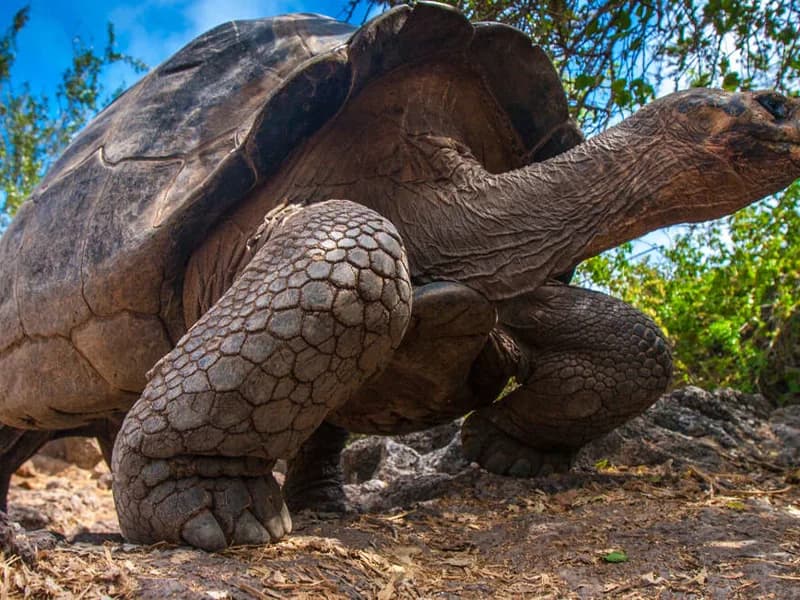
The central islands, around Santa Cruz, are the hub. Puerto Ayora, the largest town, is home to the Charles Darwin Research Station and the Fausto Llerena Breeding Centre, where giant tortoises are raised to be returned to the wild. In the highlands of Santa Cruz, wild tortoises graze in the damp pastures. Almost every cruise passes through this part of the islands, if only to collect passengers from the airport on Baltra.
West, south and east
The western islands, Isabela and Fernandina, are the youngest and most volcanic, with vast black lava fields and active volcanoes. The cold, nutrient-rich waters of the Cromwell Current well up to the surface around them, feeding a wealth of marine life. This is the home of the flightless cormorant, which lives nowhere else in the world, and of the Galápagos penguin, the only penguin to live on the equator. On Fernandina, marine iguanas crowd the black rocks in their hundreds. Tagus Cove, on Isabela, has graffiti left by visiting ships' crews going back to the nineteenth century.
Choosing a cruise is really choosing a route, and it pays to know what each part of the archipelago holds.
To the south and east, the islands are older and lower. Española, one of the oldest, is almost the only breeding place in the world of the waved albatross, which nests there from about April to December, and its marine iguanas are tinged red and green. Floreana has a curious human history. At Post Office Bay, a barrel set up by whalers in the eighteenth century still serves as a post box, and visitors leave postcards and take others home to deliver by hand. Off its coast, Devil's Crown, the eroded rim of a sunken volcano, is a well-known place for snorkelling.
Further north, Genovesa is a low, horseshoe-shaped island where red-footed boobies, frigatebirds and short-eared owls nest. Bartolomé, with its pinnacle of rock above a sandy bay, gives one of the most photographed views in the islands.
Life on board
The cruises described here travel on small boats, which carry a limited number of passengers and a naturalist guide. The days follow a pattern. There are usually two landings or excursions a day, by small inflatable boat, either a dry landing onto rocks or a wet landing onto a beach. Between them come snorkelling from the beach or the boat, among sea lions, turtles, rays and reef fish, and much of the sailing is done at night, so that each morning brings a new island.
The sea can be rough at times, especially in the cooler months, from about June to November, when the Humboldt Current brings cooler water and a grey mist called the garúa. Those months are good for seabirds and marine life. From about December to May the sea is warmer and calmer, the skies clearer, and the land birds busy breeding.
Explore Worldwide's Galápagos: Central and West Islands aboard the Solaris, eight nights, includes Quito with Bachas Beach, Tintoreras and Puerto Villamil, Moreno Point, Tagus Cove, Punta Espinoza, Vicente Roca Point, Espumilla Beach, Puerto Egas, Rábida and Sombrero Chino, sailing to the western islands.
Explore Worldwide's Galápagos: Central, South and East Islands aboard the Archipel I, nine nights, includes Santa Cruz and the Fausto Llerena Breeding Centre, Puerto Ayora, Floreana with Devil's Crown, Post Office Bay and Baroness Lookout, and Española with Gardner Bay. Its shorter Galápagos Express aboard the same boat, six nights, takes in Santa Cruz, Isabela, Fernandina, Santiago, Rábida and Black Turtle Cove.
The islands can be visited all year round, and the departures for these cruises run through the year. Look first at the islands you most want to see, then at the boat that goes there.
By Walter Pellow, the name Atlas & Passage’s editorial team writes under. Prices and dates in the trips below come from the operators and can change.