Journeys
Singapore, the stopover worth more than a night
Most people see Singapore from the airport, on the way to somewhere else. Given a few days, the island state turns out to be one of the most interesting cities in Asia, where Chinese, Malay, Indian and colonial British traditions sit side by side, and where people eat very well.
By Walter Pellow2 November 20264 min read
Singapore is small, a diamond-shaped island off the southern tip of the Malay Peninsula, with a population of around six million, and for many travellers it is no more than a long wait between flights to Australia or the Far East. That is a pity. The city rewards a few days, and it is one of the easiest places in Asia to begin: English is widely spoken, public transport is excellent, and nearly everything is close at hand.
A port that became a country
The modern city began in 1819, when Stamford Raffles, an official of the British East India Company, set up a trading post at the mouth of the Singapore River. The site had been a trading settlement centuries before, but in 1819 it was a small fishing village. Raffles saw its position, at the meeting of the great sea routes between the Indian Ocean and the South China Sea, and the port grew with astonishing speed. Merchants and labourers came from China, India, the Malay world and beyond, and the colonial town was laid out with separate districts for each community, a pattern still visible today.
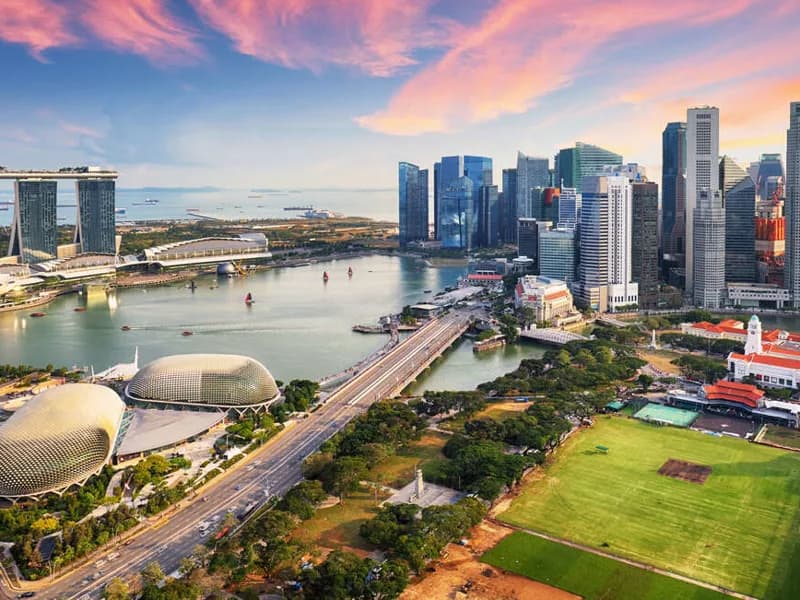
Singapore became self-governing in 1959, joined the new Federation of Malaysia in 1963, and left it two years later to become an independent city-state. In the decades since, it has turned itself into one of the richest countries in the world, with a forest of towers along its waterfront.
The old districts
The colonial core lies on the north bank of the river, around the green expanse of the Padang, with its cricket club, its grand white civic buildings and St Andrew's Cathedral. Raffles Hotel, opened in the late nineteenth century and named after the city's founder, is the place where the Singapore Sling is said to have been invented.
Across the river, Chinatown is a district of restored shophouses, the narrow two- or three-storey buildings with a shop below and living quarters above that once lined all of Singapore's streets. Its temples include the Sri Mariamman, the oldest Hindu temple in the city, a reminder that the communities were never entirely separate. Little India, to the north, is a riot of colour, with garland sellers, spice shops and the smell of curry. Kampong Glam, the old Malay and Arab quarter, has the golden-domed Sultan Mosque and streets of textile shops.
Singapore's real national pastime is eating.
Hawker centres, and the new city
Singapore's real national pastime is eating, and the best food is often the cheapest. In the 1960s and 1970s, the government moved the city's street food sellers off the pavements and into hawker centres, open-sided halls full of small stalls, each specialising in a single dish or two. They remain the heart of the city's eating, and the culture of the hawker centre has been recognised by UNESCO as part of the world's intangible heritage.
The dishes reflect the island's mix. Hainanese chicken rice is the unofficial national dish, poached chicken with rice cooked in its stock. Laksa is a spicy coconut noodle soup; char kway teow, fried flat noodles; roti prata, a flaky flatbread served with curry, came with the Indian community. Some hawker stalls have even been awarded Michelin stars.
The modern city has its own sights. Gardens by the Bay, on reclaimed land beside the harbour, has two huge glass conservatories and the Supertree Grove, tall steel structures planted with ferns and climbing plants, which are lit up in a light and sound show each evening. The Singapore Botanic Gardens, much older, are a UNESCO World Heritage Site, with a famous orchid garden. And the city has kept large areas of rainforest in its nature reserves, where long-tailed macaques are common.
The tours
Explore Worldwide's Malaysia and Singapore Explorer, eleven nights, starts in Singapore and travels north up the Malay Peninsula through Malacca, Kuala Lumpur, the Cameron Highlands, Ipoh, Kuala Kangsar and Chenderoh Lake to Penang and Langkawi. It runs through most of the year, apart from July and August.
Travelsphere's The Best of Borneo: Orangutans and Rainforests with a Singapore Add-on, fifteen nights, spends most of its time in Malaysian Borneo, with Kota Kinabalu, the orangutan sanctuary at Sepilok, Abai, Sukau on the Kinabatangan River, Sandakan and the Rasa Ria Nature Reserve, and ends in Singapore.
Singapore is hot and humid all year, close to the equator, with heavy showers that come and go. It is a city best explored early in the morning and in the evening, with the hottest part of the day spent in a museum, a garden conservatory or a hawker centre, which is never a hardship.
By Walter Pellow, the name Atlas & Passage’s editorial team writes under. Prices and dates in the trips below come from the operators and can change.