Journeys
The caves at Mulu, and the bats that empty them every evening
Gunung Mulu holds some of the largest cave passages on Earth, and most evenings, weather allowing, close to three million bats leave one of them in a single continuous stream.
By Arthur Penhallow26 September 20263 min read
Gunung Mulu National Park, in the interior of Sarawak, holds a cave system that is, by most measures used to compare such things, among the largest in the world. Deer Cave, its best-known chamber, has a passage wide and tall enough, by some estimates, to fit several jumbo jets inside, and it houses a resident bat population estimated at somewhere around three million, drawn from at least a dozen species, that leaves the cave most evenings in a long, continuous, swirling column, a spectacle timed loosely to dusk and visible, weather and bat behaviour permitting, from a viewing platform outside the cave mouth.
A landscape built on limestone
Mulu's caves exist because of the same basic process that shaped Halong Bay's islands hundreds of kilometres away: limestone, laid down as marine sediment millions of years ago and later exposed, is unusually vulnerable to slow dissolution by acidic rainwater, and given enough time that process carves chambers, passages and, above ground, the dramatic razor-sharp limestone spires known as the Pinnacles, one of Mulu's other well-known formations, reached by a demanding climb through steep forest. The park was declared a UNESCO World Heritage Site in 2000, recognised for both its cave systems and the biodiversity the surrounding rainforest still supports.
Longhouses, still lived in
Sarawak's interior is home to several indigenous groups, the Iban among the largest, traditionally organised around longhouses, single elongated timber structures housing multiple related families under one roof, each with a private section and a shared communal gallery running the building's length. Villages such as Mongkos still maintain this arrangement, and visits arranged through community-based tourism initiatives typically involve a genuine overnight stay rather than a staged demonstration, with the longhouse's residents hosting rather than performing for visitors passing through.
A long, continuous, swirling column of bats, timed loosely to dusk.
Proboscis monkeys and mangrove forest
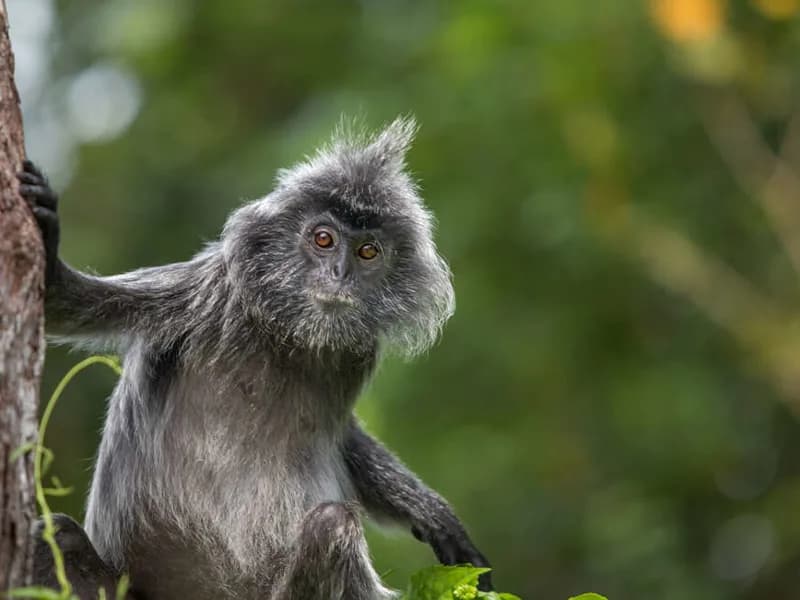
Closer to Kuching, Sarawak's capital, Bako National Park occupies a small peninsula of coastal rainforest and mangrove, reachable only by boat, and is one of the more reliable places in Borneo to see proboscis monkeys, the large-nosed species found nowhere outside the island, alongside silvered langurs and, along the shoreline, long-tailed macaques accustomed enough to visitors to require a degree of caution around unattended food.
Combining the two states
Sarawak and neighbouring Sabah are frequently combined on a single Borneo itinerary, Sarawak for Mulu's caves and Iban longhouses, Sabah for Mount Kinabalu and the wildlife-dense Kinabatangan River, a pairing that reflects a genuine geographical and cultural divide between Malaysia's two Bornean states rather than an arbitrary tour operator's route. Internal flights, rather than road transport, typically connect the two, since Sarawak and Sabah's interiors remain separated by terrain that has kept much of both states' rainforest intact in the first place.
Mulu's remoteness is part of what has kept it intact: there is no road connection to the rest of Sarawak, and the park is reached by a short domestic flight into an airstrip built specifically to serve it, or, for the more determined, a considerably longer river journey by longboat. That isolation has shaped the park's infrastructure too, boardwalks rather than paved paths, simple lodges rather than large hotels, and a visitor experience built around a handful of well-maintained show caves and marked trails rather than open, unsupervised access to the wider cave system, much of which remains genuinely unmapped even after decades of expedition caving.
Timing the bat exodus
The nightly bat exodus from Deer Cave is not on a fixed schedule, and it depends on weather, insect activity and the bats' own behaviour on any given evening, which means a viewing platform vigil sometimes rewards patience with a dramatic, extended stream and occasionally delivers a shorter, more modest showing, or on rare evenings, heavy rain, very little at all. Local rangers generally have a good working sense of likely timing based on recent patterns, and evenings around dusk during the drier months tend to offer steadier conditions than the height of the wet season, when persistent rain can suppress the exodus considerably.
By Arthur Penhallow, the name Atlas & Passage’s editorial team writes under. Prices and dates in the trips below come from the operators and can change.