History
Tamil Nadu's temple towns: Madurai, Thanjavur and Mamallapuram
The south-eastern state of Tamil Nadu has some of the greatest temples in India, built by dynasties whose names few outside India know: the Pallavas, the Cholas, the Nayaks. Three towns between them span a thousand years of temple building.
By Walter Pellow2 November 20264 min read
In the north of India, many of the great Hindu temples were damaged or destroyed during centuries of invasion and war. In the far south, in what is now Tamil Nadu, they survived, and they are some of the most spectacular in the world. The Tamil kingdoms built temples on an ever greater scale over more than a thousand years, and many of them are still at the centre of daily religious life, busy from before dawn until late at night with worshippers, priests, musicians and pilgrims.
Three towns tell the story of that building: Mamallapuram on the coast, where it began in stone; Thanjavur in the Kaveri delta, where it reached its peak under the Cholas; and Madurai, where it took its most extravagant form.
Mamallapuram, the carvings by the sea
Mamallapuram, south of Chennai on the Bay of Bengal, was a port of the Pallava kings in the seventh and eighth centuries, and it was here that they experimented with stone. The site is scattered with their work: cave temples cut into the rock, five monolithic shrines carved from single outcrops of granite and known as the five rathas, and the Shore Temple, a pair of slender stone towers standing right by the waves.
The most famous carving is a great relief cut across the face of two huge boulders, known as Arjuna's Penance or the Descent of the Ganges. It shows gods, people, animals and the river itself flowing down a cleft in the rock, with a life-size family of elephants among the figures. The whole group of monuments is a UNESCO World Heritage Site.
Thanjavur, the great Chola temple
The Chola dynasty, which ruled much of the south from the ninth to the thirteenth centuries, was one of the most powerful in Indian history, with a navy that reached South-East Asia. Its capital was Thanjavur, in the rich rice country of the Kaveri delta, and there, around the year 1010, King Rajaraja I completed the Brihadeeswarar Temple, dedicated to Shiva.
It is a building of enormous ambition. Its main tower rises about sixty metres above the shrine, built of granite in a region with no granite quarries nearby, and it is topped by a great capstone, its weight usually put at around eighty tonnes. How it was lifted into place is still debated. In the courtyard is a huge statue of Nandi, Shiva's bull, carved from a single stone. The temple is still in worship, and it is a UNESCO World Heritage Site along with two other great Chola temples.
Many of them are still at the centre of daily religious life, busy from before dawn until late at night.
Madurai, the temple city
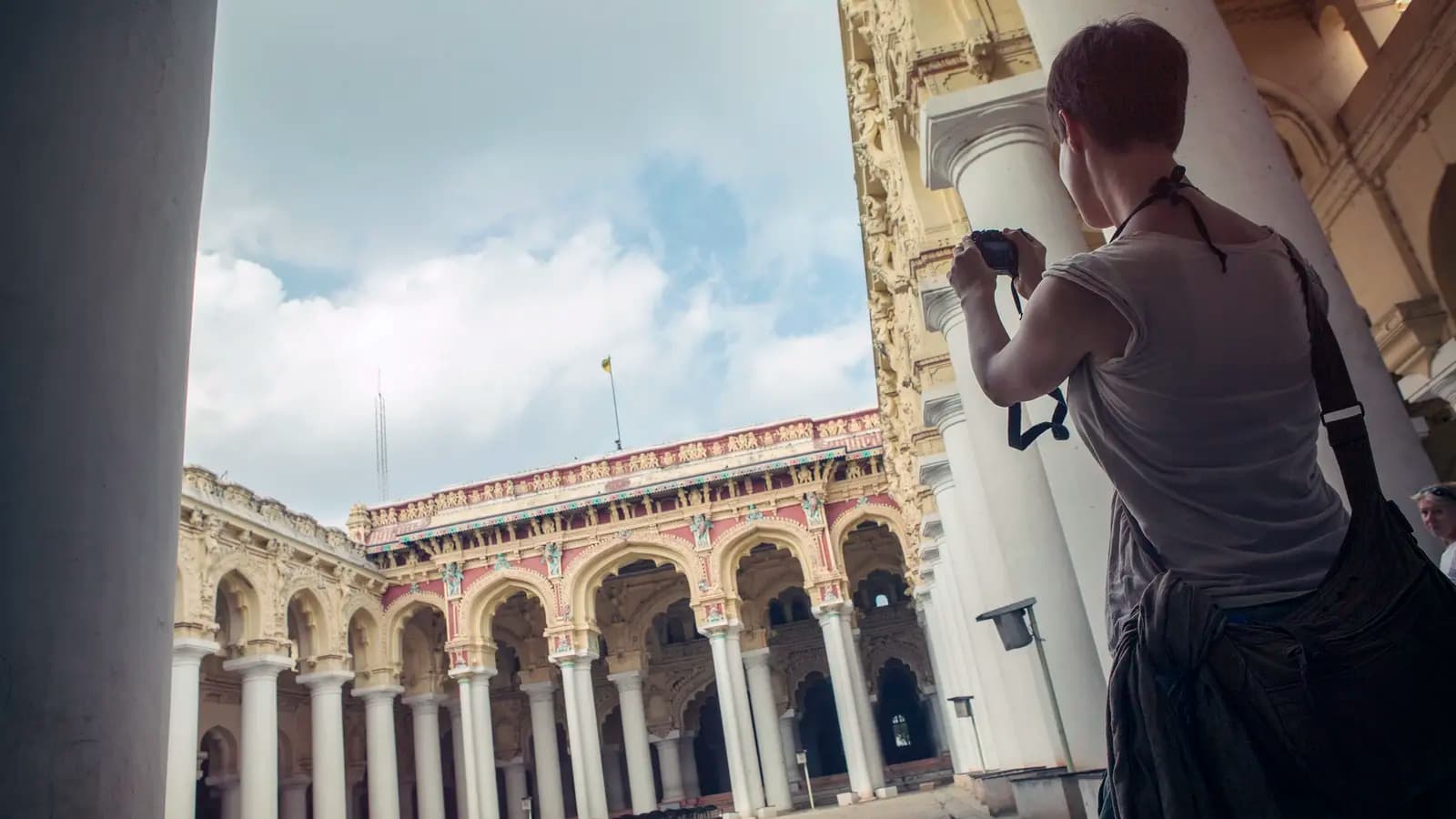
Madurai is one of the oldest cities in India, a centre of Tamil learning for well over two thousand years, and its whole old town is built around a single temple, the Meenakshi Amman, dedicated to the goddess Meenakshi and her consort, a form of Shiva. The present temple largely dates from the sixteenth and seventeenth centuries, when the Nayak rulers rebuilt it on a grand scale.
It is a temple city in its own right. Its fourteen gateway towers, the gopurams, rise above the streets, covered from top to bottom with thousands of brightly painted figures of gods, goddesses, demons and animals. Inside are pillared halls, a sacred tank and the thousand-pillar hall, each column carved. Every evening, the image of Shiva is carried in procession to the goddess's shrine for the night, accompanied by drums and pipes.
The tours
G Adventures' East to West Coast: Southern India, eight nights, crosses the south from Mamallapuram to Thanjavur and Madurai, then over the mountains to Thekkady, Alleppey and Kochi. It runs in October and November.
Explore Worldwide's Cycle South India: Tamil Nadu to Kerala, thirteen nights, rides from Puducherry and Mamallapuram through Auroville, Chidambaram, Thanjavur, Athangudi and Madurai, into Kerala for Thekkady, Vagamon, Kumarakom, Alleppey and Marari Beach. Its departures are in October, November, January and February.
Explore's Highlights of Southern India, fourteen nights, starts in Chennai and travels through Puducherry, Tiruchirappalli, Srirangam and Madurai to Thekkady, the Kerala backwaters and Kochi.
The best time to visit is from November to February, after the north-east monsoon, which brings much of Tamil Nadu's rain in October and November. The temples are open from early morning, and dawn and dusk are the times to see them at their most alive. Dress modestly, and expect to leave your shoes at the gate.
By Walter Pellow, the name Atlas & Passage’s editorial team writes under. Prices and dates in the trips below come from the operators and can change.