History
Hampi, the boulder-strewn ruins of Vijayanagara
In the sixteenth century, Vijayanagara was one of the largest and richest cities in the world. After it was sacked in 1565, its people left and never came back. Its temples, palaces and bazaars still stand among a landscape of giant granite boulders that looks almost unreal.
By Walter Pellow2 November 20264 min read
The landscape around Hampi, in the southern Indian state of Karnataka, would be remarkable even without its ruins. For miles along the Tungabhadra river, the land is strewn with granite boulders, some the size of houses, piled in heaps and balanced on top of each other in ways that seem to defy gravity, with paddy fields and banana plantations in between. Among them stand the remains of a great city: hundreds of temples, palaces, markets, gateways, water tanks and stables, spread across an area of many square kilometres.
This was Vijayanagara, the City of Victory, capital of the last great Hindu empire of southern India, and in the early sixteenth century one of the largest cities in the world.
An empire at its height
The Vijayanagara empire was founded in the fourteenth century, and for two centuries it dominated the south of India, its armies holding back the Muslim sultanates of the Deccan to the north. Its capital grew enormously wealthy, from the trade in spices, cotton and precious stones, and from its control of the region's agriculture. Portuguese and Persian visitors left descriptions of a city of great size and splendour, its bazaars full of jewels, horses and silk, its population numbering in the hundreds of thousands.
The empire reached its height under Krishnadevaraya, in the early sixteenth century, a king famous as a patron of temples, poetry and learning. Many of Hampi's finest buildings date from his reign.
The fall
In 1565, the armies of the Deccan sultanates defeated the Vijayanagara forces at the Battle of Talikota. The capital was left undefended, and over the following months it was sacked and largely destroyed. Its people fled, and the city was never reoccupied. The empire continued for a time elsewhere, but the great city on the Tungabhadra was left to the boulders and the jungle.
The ruins
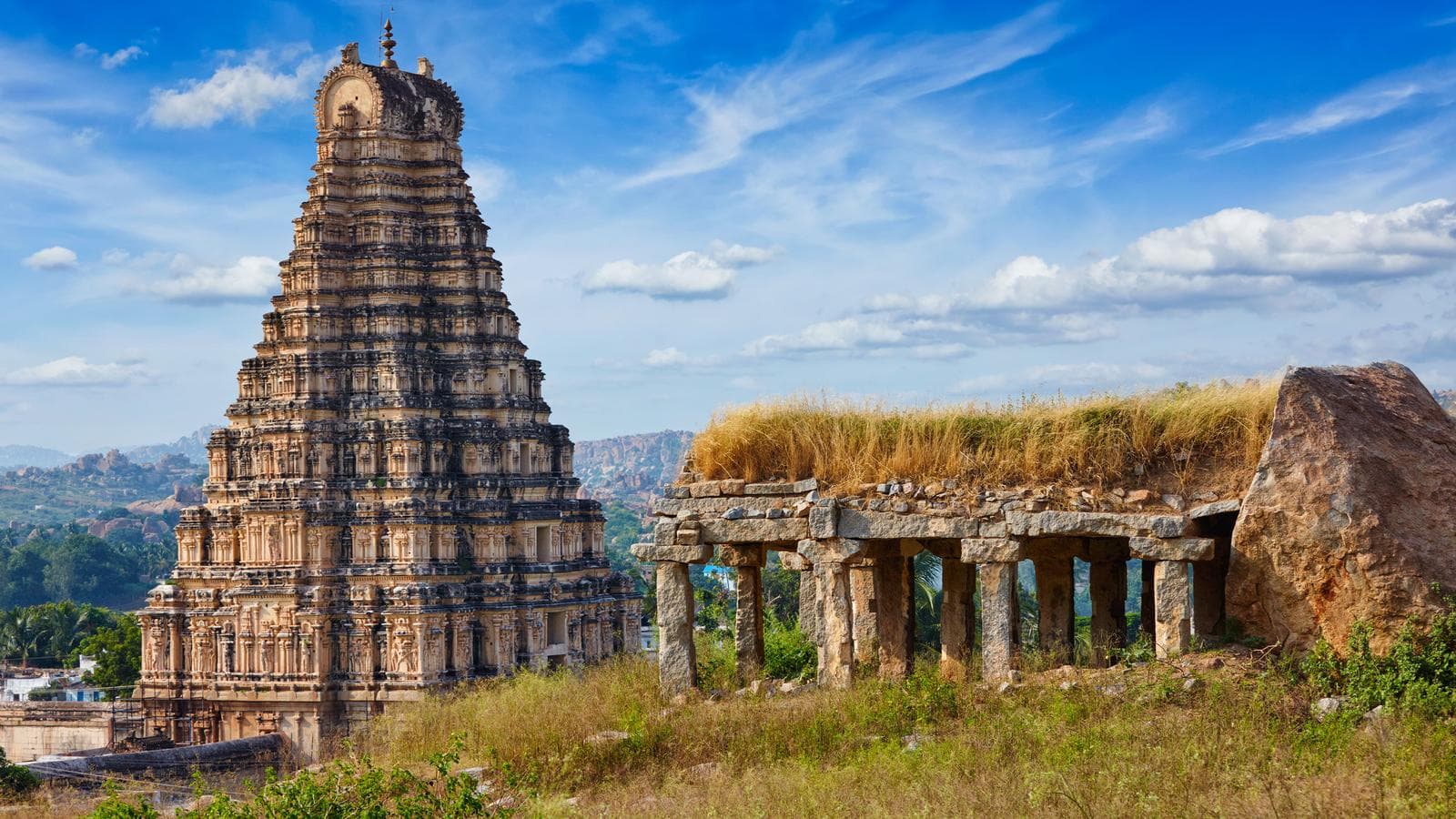
Hampi's ruins fall into two main areas. The sacred centre, along the river, is dominated by the Virupaksha Temple, whose tall gateway tower still rises above the village bazaar. It is still a living temple, with pilgrims, priests and offerings, and the busiest place in Hampi.
Further east, the Vittala Temple is the most famous of all, with its pillared halls carved in astonishing detail, some of whose columns are said to ring with musical notes when tapped, and the stone chariot in its courtyard, a small shrine carved in the form of a temple car with stone wheels. The image appears on Indian bank notes.
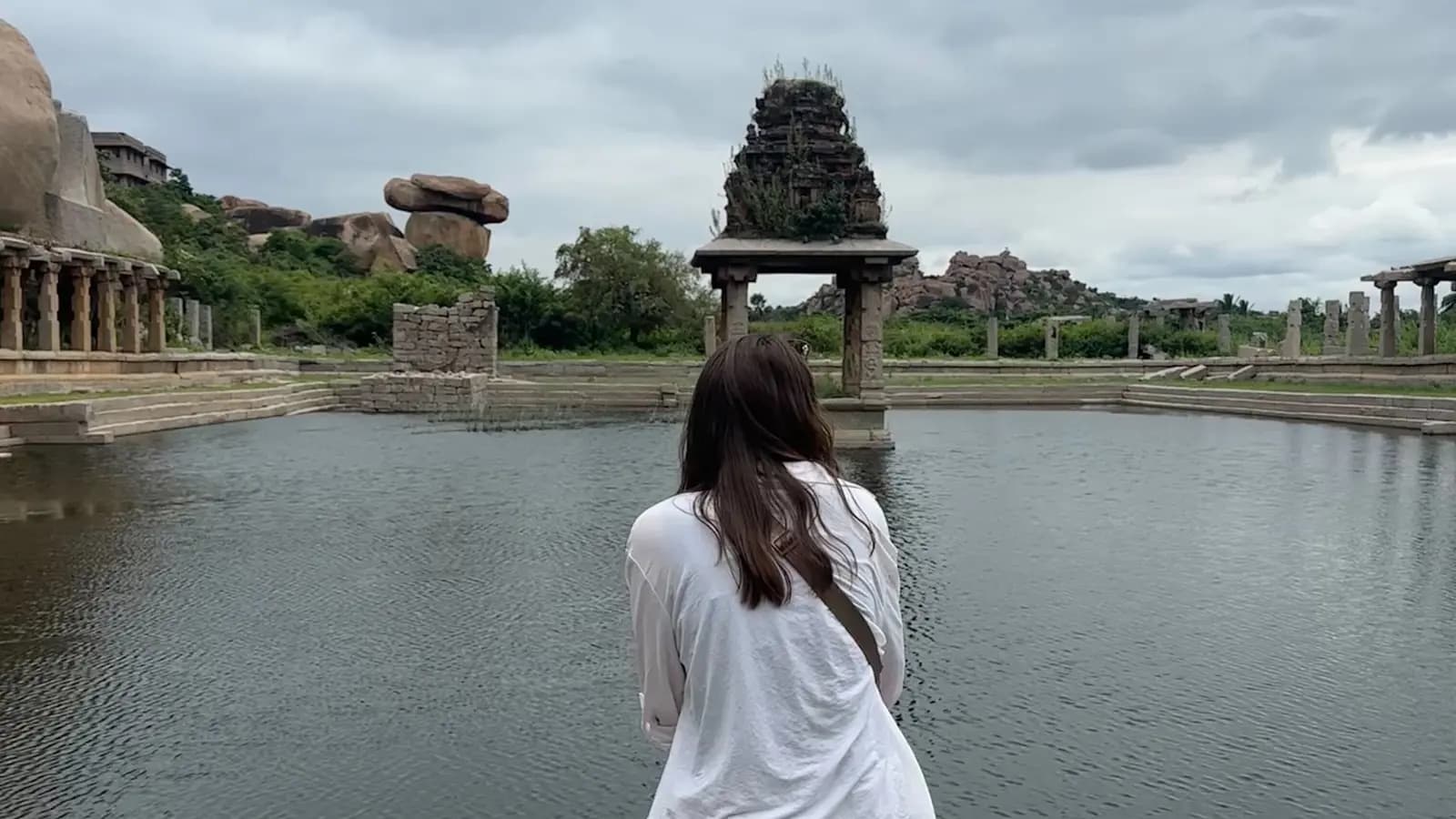
The royal centre, to the south, has a different character: the platforms and foundations of palaces, the Lotus Mahal, an elegant pavilion in a mixture of Hindu and Islamic styles, the long range of the Elephant Stables, with its domed chambers, and the stepped tanks that supplied the palaces with water.
In front of the Virupaksha Temple runs Hampi Bazaar, a long, straight street once lined with the colonnaded pavilions of the city's market, where travellers described traders selling diamonds and pearls. Down by the river, round wicker coracles, coated with tar, still ferry people across the Tungabhadra to the village of Anegundi on the far bank, an older royal seat with temples, a fort and a slower pace of life than the ruins.
The whole site is a UNESCO World Heritage Site. It is best explored over two or three days, by bicycle, on foot or by auto-rickshaw, and climbing one of the boulder hills, such as Matanga, at sunrise or sunset gives a sense of the scale of the place.
The tours
G Adventures' India: Ancient Ruins & Kerala Beaches, seven nights, travels from Hampi to the hill station of Ooty, Mysore and Fort Kochi, and runs in October and November.
G Adventures' India's West Coast: North to South, eight nights, starts in Mumbai and travels through Goa and Hampi, then the temples at Halebidu, Mangalore and Kochi. It runs from October to January.
G Adventures' India: Kochi & Goa's Golden Beaches, thirteen nights, combines Hampi with Mysore, Ooty, Kochi and the Kerala coast at Alleppey, Kollam and Varkala.
The best time to visit Hampi is from October to February, when the days are warm and the nights cool. By April the heat among the boulders is fierce.
By Walter Pellow, the name Atlas & Passage’s editorial team writes under. Prices and dates in the trips below come from the operators and can change.