Wildlife
The Peruvian Amazon from Puerto Maldonado
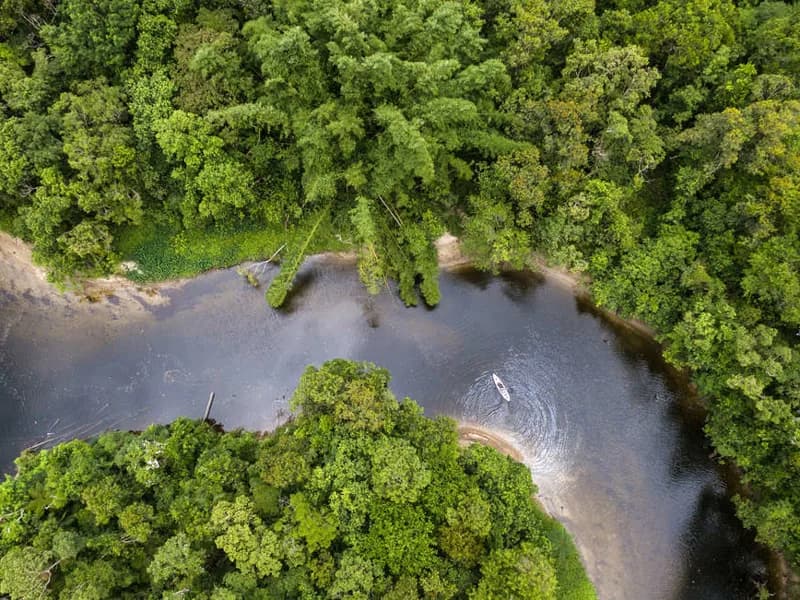
Most of Peru is not mountain or desert but rainforest. From the frontier town of Puerto Maldonado, boats run up the rivers to lodges in the forest of Tambopata, where macaws gather at clay licks and giant otters fish in the oxbow lakes.
By Walter Pellow2 November 20264 min read
Peru is usually thought of as a country of mountains, of the Andes, the Incas and Machu Picchu. But more than half of it lies east of the mountains, in the Amazon basin, covered in tropical rainforest. It is one of the most biologically rich regions on earth, and, unlike the Brazilian Amazon, much of it is easily reached from the Andes: from Cusco, it is a short flight down to the frontier town of Puerto Maldonado, on the banks of the Madre de Dios river.
Puerto Maldonado
Puerto Maldonado is a busy, unglamorous town, a centre for the gold mining, logging and Brazil-nut trade of the south-eastern Amazon, with streets full of motorcycle taxis and a lively market. It is not the destination, but the gateway. From its riverbanks, long wooden boats with outboard motors carry visitors up the rivers to the lodges in the forest, a journey of an hour or several, depending on the lodge.
Most of the lodges lie along the Madre de Dios or the Tambopata river, close to or within the Tambopata National Reserve and the Bahuaja-Sonene National Park beyond it, which together protect a huge area of forest. They are usually simple but comfortable, with thatched roofs, mosquito nets and open sides, sometimes without electricity at night, and the sounds of the forest are all around.
Life in the forest
Days in the forest follow a rhythm set by the animals. Many of the best sightings are early in the morning and late in the afternoon, so guides take visitors out before dawn, on foot along forest trails or by boat on the rivers, and again in the late afternoon and after dark, with torches, to look for frogs, insects, caimans and nocturnal mammals.
The forest is full of life, though much of it is hard to see. Several species of monkey are common, from tiny tamarins to howler monkeys, whose roaring calls carry for kilometres at dawn. Capybaras, the largest rodents in the world, graze on the riverbanks. There are tapirs, peccaries and, very rarely seen, jaguars. The birds are spectacular, with hundreds of species recorded in the region, among them toucans, hoatzins, kingfishers and harpy eagles.
Clay licks and oxbow lakes
Few sights in the Amazon are as memorable as the macaws at a clay lick. At certain places along the riverbanks, parrots and macaws gather in large numbers in the early morning to eat the clay, which is thought to provide them with salt and other minerals missing from their diet. The noise and colour of hundreds of red, blue, green and yellow birds on the cliff face, as they wait their turn and then descend in a burst of wings, is extraordinary. The Tambopata region has some of the largest licks in the world.
The rivers of the region wind in great loops, and when a loop is cut off, it becomes an oxbow lake, a still, quiet water surrounded by forest. These lakes are home to the giant otter, an endangered animal that can grow to nearly two metres long and lives in noisy family groups, fishing and calling to each other. Canoeing on an oxbow lake at dawn, with luck, is the best way to see them.
The tours
Explore Worldwide's Upgraded: Discover Peru + the Amazon, seventeen nights, combines the Andes with the Amazon. From Lima and Barranco it travels to Arequipa, the Colca Canyon and Chivay, Puno and Lake Titicaca, Cusco and the Sacred Valley, Machu Picchu and Aguas Calientes, and finally Puerto Maldonado. It runs from March to May, in July and August and in October and November.
Travelsphere's Wonders of Peru: Machu Picchu and Amazon Adventure, thirteen nights, visits Lima and Puerto Maldonado, then the Sacred Valley, Machu Picchu, Cuzco, Puno and Lake Titicaca, and the colonial church at Andahuaylillas.
The forest can be visited at any time of year. The drier season, from May to October, is the easiest for walking, with lower river levels and fewer mosquitoes. The wet season brings heavy rain, high water and the forest at its greenest. Whatever the month, it is hot, humid and wonderful.
By Walter Pellow, the name Atlas & Passage’s editorial team writes under. Prices and dates in the trips below come from the operators and can change.