Culture
Tirana, the capital that painted its way out of grey
When communism fell, Tirana was a drab, run-down city of grey blocks. An artist turned mayor began painting them in bright colours, and the city has been reinventing itself ever since, without hiding the bunkers and secret-police files of the past.
By Walter Pellow20 October 20264 min read
Tirana is a young capital. It was founded as a small Ottoman town in the early seventeenth century and only became Albania's capital in 1920, a few years after independence. In the 1920s and 1930s, under King Zog and then Mussolini's Italy, it was given a grand new centre of ministries and boulevards in an Italian style. After the Second World War, the communist regime of Enver Hoxha rebuilt much of the rest in its own image, with Soviet-style apartment blocks, monuments to the party and, eventually, more than a few bunkers.
When the regime fell in the early 1990s, the city was poor, shabby and chaotic, with illegal kiosks and buildings filling its parks and riverbanks. Its rebirth since has been one of the more remarkable urban stories in Europe.
The painted city
In 2000, an artist and former art teacher named Edi Rama was elected mayor of Tirana. With little money and a great many problems to solve, he did something unusual. He began painting the façades of the drab communist-era blocks in bright colours and bold patterns: stripes, squares, zigzags, oranges, purples, greens and yellows. It was cheap, quick and controversial. Critics thought it a gimmick. But it changed the mood of the city, and it gave its residents a sense that things could change. Illegal buildings were cleared from the riverbanks and parks, trees were planted, and Tirana began to look after itself. Rama later became prime minister.
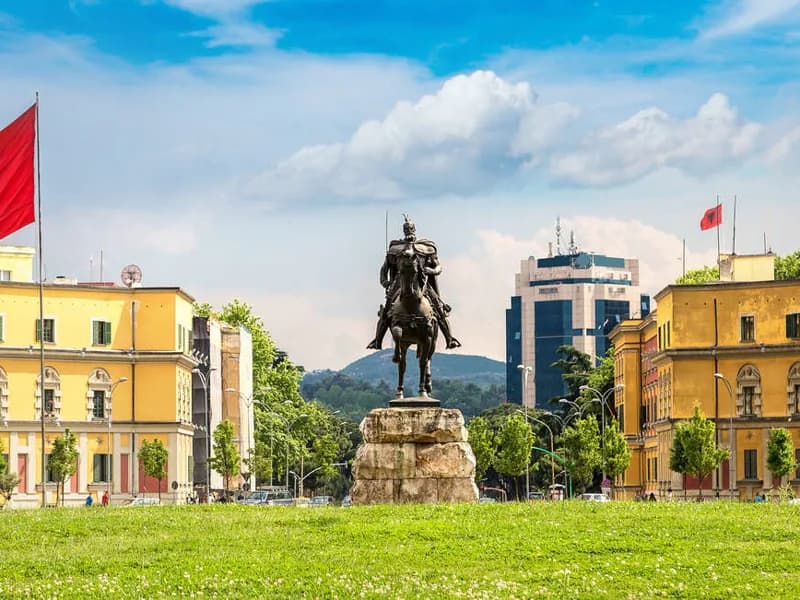
The colours remain a feature of the city, and there have been many other changes since. Skanderbeg Square, the vast central square named after Albania's national hero, was redesigned as a pedestrian space paved with stones brought from all over the country. The Pyramid, built in the 1980s as a museum to Hoxha and later left derelict, has been turned into a youth and technology centre, with steps up its sloping sides.
The past, on display
Tirana doesn't hide its communist past, and several of its most interesting sights deal with it directly. Blloku, a district of villas that was once closed to ordinary Albanians and reserved for the party leadership, is now the city's liveliest area of bars, cafés and restaurants. Hoxha's own villa still stands among them.
Bunk'Art 1, on the edge of the city, is a vast underground bunker built for the leadership in case of nuclear attack, now a museum of the communist period. Bunk'Art 2, in the centre, occupies a bunker built for the Ministry of the Interior and tells the story of the police and the secret police. The House of Leaves, a small museum in a building once used by the secret police, the Sigurimi, deals with the surveillance of ordinary citizens, with its listening devices and files. Visiting them is sobering, and essential for understanding modern Albania.
The Et'hem Bey Mosque, an eighteenth- and early nineteenth-century mosque with beautiful painted frescoes, survived the regime's ban on religion and stands beside the clock tower on Skanderbeg Square.
The city's café culture is one of its great pleasures. Albanians take their coffee seriously, and Tirana has an extraordinary number of cafés, from tiny espresso bars to grand terraces, almost always busy. Sitting outside with a coffee and watching the city go by is a national pastime, and the best way to get a sense of the place. The New Bazaar, near the centre, has been restored as a covered market of fruit, vegetables, cheese and olives, surrounded by restaurants serving traditional Albanian food.
Mount Dajti, and the tours
Above the city, a long cable car climbs to the slopes of Mount Dajti, with views over Tirana and the plain to the sea. It is a good place to escape the city's heat on a summer evening.
Travelsphere's Albania Discovered: Tirana and Beyond, seven nights, includes Tirana with Krujë, Durrës, Berat, Gjirokastër, Sarandë, Butrint, Vlora and the coastal villages of the south.
Just You's Albania Uncovered, seven nights for solo travellers, includes Tirana with Krujë, Berat, Gjirokastër, Sarandë, Porto Palermo, Vlorë, Apollonia and Durrës. Explore Worldwide's Highlights of Albania, ten nights, includes Tirana too.
Tirana is best in spring and autumn. In summer it can be very hot, and many residents head for the coast. Spend at least a day there: it is the best place to understand where Albania has been, and where it is going.
By Walter Pellow, the name Atlas & Passage’s editorial team writes under. Prices and dates in the trips below come from the operators and can change.