First time
Vietnam for the first time, Hanoi to the Mekong in a fortnight
Two weeks is the usual length of a first trip to Vietnam, and the usual route runs the whole country from north to south. Here is how that fortnight fits together, and what it leaves for next time.
By Walter Pellow20 October 20265 min read
Vietnam is long and thin, and the trip most people take the first time is a single line drawn down it. The route is so well established that tours from quite different operators look much alike on paper: Hanoi and a night among the limestone islands in the north, Hue and Hoi An in the middle, Ho Chi Minh City and the Mekong Delta in the south, and a flight or two to stitch it together. It is popular because it works. Each region is distinct enough that nothing feels repeated, and the country's history, from the emperors to the war, unfolds roughly in order as you go.
Two weeks is the right length for it. Ten days can be done, but something has to give, usually the delta or a night in the bay. Three weeks lets you add the mountains of the north or a few days in Cambodia. A fortnight gives each part its due without rushing.
Hanoi and the bay: four or five days
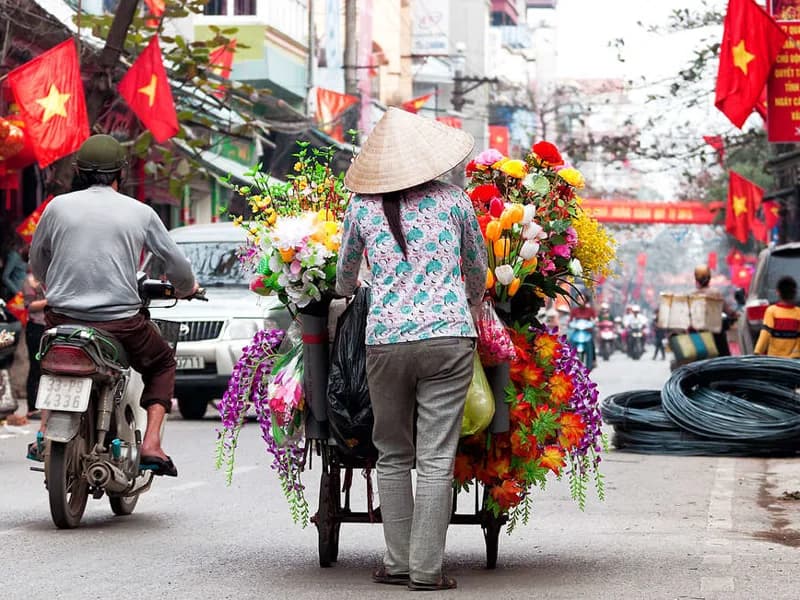
Hanoi is the place to begin. The capital is about a thousand years old, and its old quarter, a knot of narrow streets near Hoan Kiem Lake, still has streets named after the trades once carried on in them. The Temple of Literature, founded in the eleventh century as a temple to Confucius, is a walled series of courtyards and one of the calmer places in the city. The traffic is the first thing everybody notices: a great tide of motorbikes that seems impossible to cross until a guide shows you how, at a slow, steady walk that lets the riders steer around you.
From Hanoi, the expressway runs east for two and a half to three hours to the coast and the limestone islands of the Gulf of Tonkin. Most tours spend a night on a boat, either in Halong Bay itself or, increasingly, in quieter Lan Ha Bay, off Cat Ba Island. Some also go south of Hanoi to Ninh Binh, where the same limestone rises from rice fields rather than the sea and is seen from small rowing boats on the river.
Explore Worldwide's Upgraded - Discover Vietnam, thirteen nights, is a good example of the whole shape: Hanoi, Lan Ha Bay and Ninh Binh in the north, then Hue and Hoi An, then the Mekong Delta, Ho Chi Minh City and Tra Vinh in the south.
Hue and Hoi An: four days in the middle
A short flight, or a night on the train, takes you south to Hue, the capital of the Nguyen emperors from the early nineteenth century until 1945. Its walled citadel sits on the north bank of the Perfume River, much of it damaged in the war and still being restored, and the emperors' tombs are spread out along the river to the south, each one a landscaped garden as much as a monument. A day here is enough for the main sights; two let you see them slowly.
From Hue to Hoi An is a drive of a few hours, over or under the Hai Van Pass, the mountain spur that runs into the sea and divides the country's weather. Hoi An was a trading port for Chinese, Japanese and European merchants for centuries, and when the river silted up and trade moved to Da Nang, the old town was left largely as it was. Its wooden shophouses, assembly halls and covered Japanese bridge are a World Heritage Site, and it is a town for walking, best early in the morning or after dark, when the lanterns are lit. Its tailors are famous for making clothes to measure in a day or two.
Saigon and the delta: four days in the south
A second flight takes you to Ho Chi Minh City, which many of its own residents still call Saigon. It is the country's largest city and its busiest, and its sights tell the story of the last century and a half: the cathedral and post office built under French rule, the Reunification Palace and the War Remnants Museum. Many tours also spend half a day at the Cu Chi tunnels, the network dug north-west of the city during the war.
The Mekong Delta, south of the city, is a world of rivers, canals, orchards and rice fields, travelled mostly by boat. A day trip gives a taste; a night in the delta gives a better one. Some tours go as far as Tra Vinh, a delta province where about a third of the people are Khmer, with well over a hundred Khmer Buddhist pagodas.
Travelsphere's Invitation to Vietnam & the Temples of Angkor, thirteen nights, follows the same line from Hanoi and Halong Bay through Hue and Hoi An to Ho Chi Minh City, then crosses into Cambodia for Siem Reap.
What a fortnight leaves out
A first trip has to choose, and this route leaves out a good deal. The mountains of the far north, around Sapa, with their terraced valleys, need two or three days of their own. The caves of Phong Nha, between Hanoi and Hue, are on few first-time itineraries. The beaches of the south and the central coast are there to be added at the end, for those who want a rest. And Cambodia, a short flight or a boat journey up the Mekong away, is the most common extension of all.
Other tours follow the classic line in their own way: Just You's Discover Vietnam, twelve nights, for solo travellers, and Explore Worldwide's Inside Vietnam, thirteen nights, which adds the Cham temples at My Son. Whichever you choose, the best months for a tour of the whole country are March and April, with the winter months a good second choice if you don't mind a cooler, greyer Hanoi.
By Walter Pellow, the name Atlas & Passage’s editorial team writes under. Prices and dates in the trips below come from the operators and can change.