First time
A first week in Greece: temples, then islands
A first trip to Greece rarely needs deciding between the ruins and the islands. The more common problem is having a week and wanting both, and working out which order to take them in.
By Arthur Penhallow26 September 20263 min read
Greece has an unusual problem for a first-time destination: it has two entirely different holidays living inside it, and a lot of visitors only discover the one they did not book. There is mainland Greece, dense with ancient sites and reachable by coach and foot, and there is island Greece, reached by ferry or ship and organised around harbours, beaches and a considerably slower pace of eating dinner. A first trip does not have to choose between them, but it helps to know both exist before deciding how to split a week or two.
What makes it an easy first trip
Greece has fewer practical hurdles than its reputation as an ancient, complicated country might suggest. It uses the euro, English is widely spoken in Athens, the Peloponnese and on every island with a working harbour, and direct flights from the UK to Athens generally take a little over three and a half hours. None of that determines whether a first trip goes well, but it does mean the effort can go entirely into deciding what to see rather than into working out how to get anywhere once there.
Athens first, for context
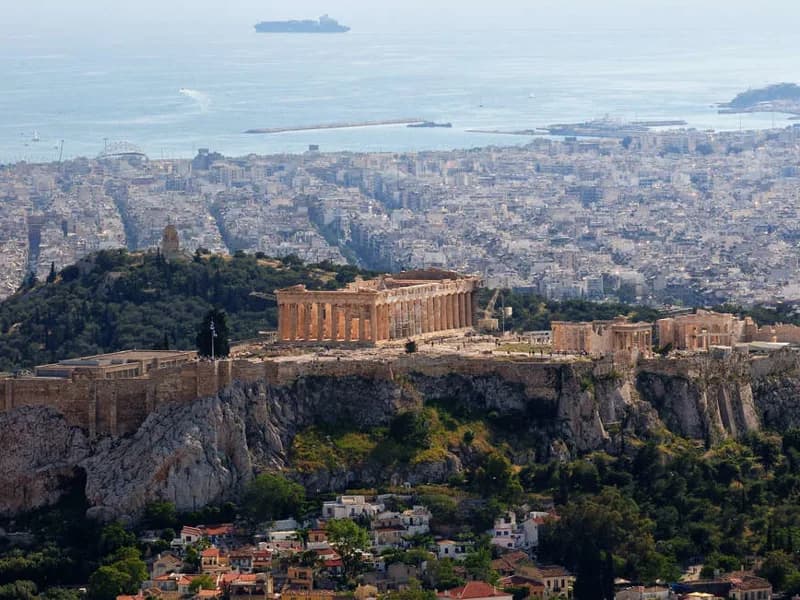
Almost every first trip to Greece begins in Athens, and there is a good argument for not rushing that stage. The Acropolis, with the Parthenon at its summit, sits above a city that has been continuously inhabited for around three and a half thousand years, and the museum built at its foot displays what excavation has recovered from the hill itself, laid out in a way that makes the building above considerably easier to read. The Plaka district below, Athens's oldest surviving neighbourhood, survived rebuilding in the nineteenth century largely because it sat on ground too uneven and historically sensitive to redevelop, and its narrow streets are still the most walkable introduction the city offers.
The Peloponnese, if ruins are the priority
For a first trip weighted towards history, the Peloponnese, the peninsula just south-west of Athens across the Corinth Canal, adds Mycenae, Epidaurus, Olympia and Delphi to the itinerary without requiring a single ferry crossing. It is, in effect, ancient Greece's greatest hits reachable by coach, and a longer version of the trip works through the peninsula at a walking pace, taking in Nafplio and the Mani peninsula as well as the headline sites.
The islands, if the sea is the priority
The alternative first trip trades some of that historical density for the Aegean itself, moving from Athens out to islands that could not be more different from each other in the space of a week: Mykonos, with its windmills and nightlife; Patmos, a quieter, more contemplative island where, according to Christian tradition, the Book of Revelation was written in a cave that is still a site of pilgrimage; Heraklion on Crete, gateway to the Minoan ruins at Knossos; and Santorini, saved for last on most itineraries because nothing else on the route quite matches its caldera view. A route like this also touches the Peloponnese coast at Nafplion and Epidaurus, giving a first-timer a taste of both halves of Greece rather than forcing the choice entirely.
Two entirely different holidays living inside it.
What to actually decide
The honest advice for a first trip is to pick a weighting rather than try to see everything evenly. A week spent mostly on ruins and mostly in the Peloponnese will go deeper into ancient history than a week split five ways between islands ever could; a week spent mostly at sea will give a much better sense of why Greek island life feels the way it does, at the cost of skimming the mainland's history rather than sitting with it. Both are legitimate first trips. Neither is the wrong answer, and either one, done properly, tends to produce a second trip booked before the first one is even over, usually with a firm opinion by then about which half of Greece to see more of.
By Arthur Penhallow, the name Atlas & Passage’s editorial team writes under. Prices and dates in the trips below come from the operators and can change.