History
Rhodes, the old town the Knights built
For two centuries Rhodes belonged to a crusading order of knights, who walled its town, lodged by nation along one street and held out against the Ottoman sultan until 1522. Their medieval city still stands, and a later Italian rebuilding has added a twist of its own.
By Walter Pellow2 November 20265 min read
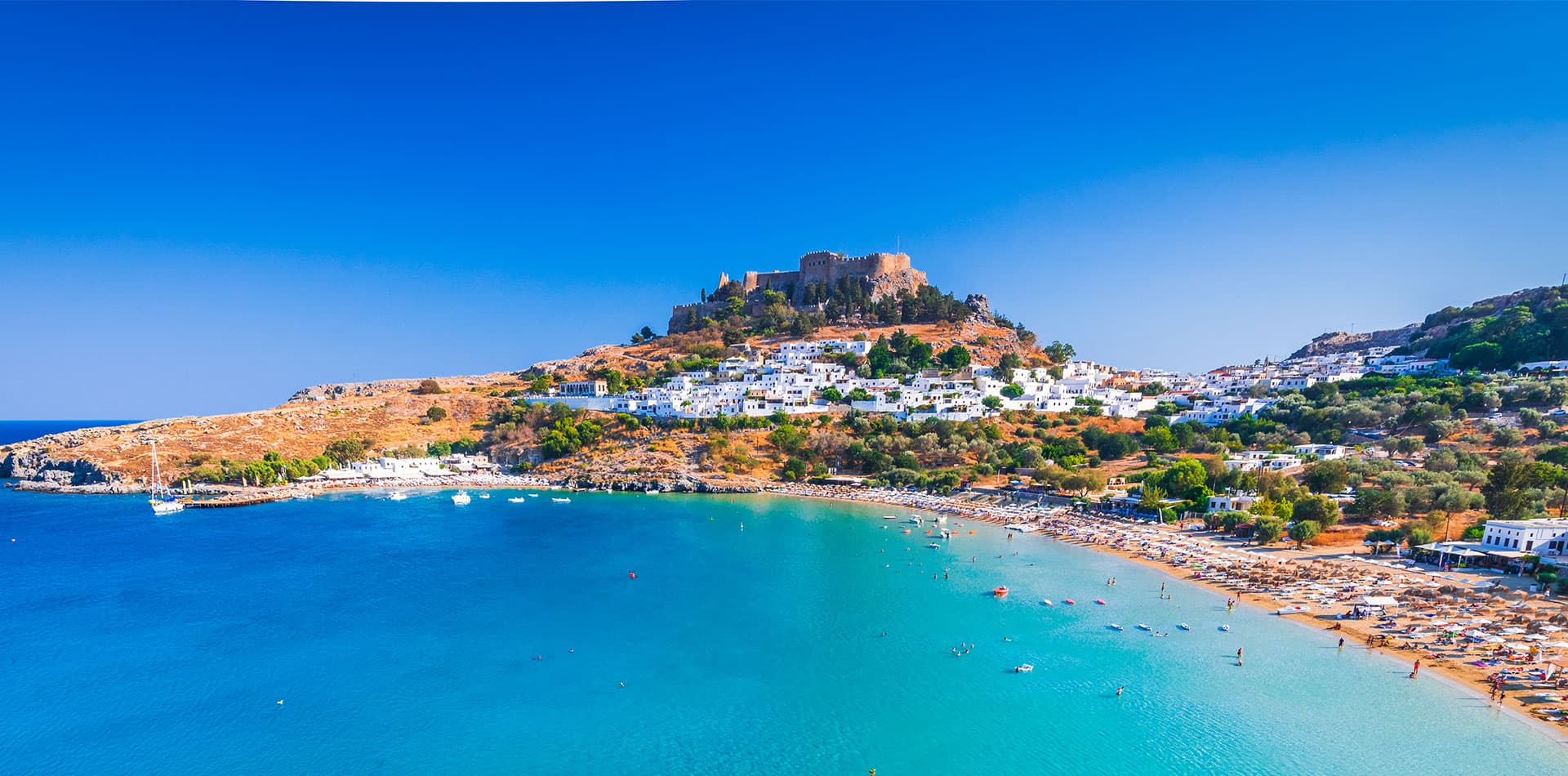
The old town of Rhodes does not look like the rest of Greece. You come to it through a gate in a massive wall and find yourself among stone streets and buildings that seem to belong to medieval western Europe. That is because, for a little over two centuries, Rhodes was ruled not by Greeks or Turks but by a crusading order of knights from all over western Europe.
The Knights of St John
The Knights Hospitaller, the Order of St John, were a military order of the crusades. Pushed out of the Holy Land, the order needed a new home, and in 1309 it took control of Rhodes. For the next two hundred years the island was its base, and the knights made the town into a fortress, with a town of their own inside it. The knights came from many countries, and they were organised by language, or "tongue". Each tongue had its own inn, a kind of headquarters and lodging, and these stand along a single street, the Street of the Knights, which runs up through the town to the castle at the top. It is one of the best-preserved medieval streets in Europe, austere and grand, lined with the stone façades of the inns of France, Italy, Provence, Auvergne, Aragon, England and the rest. The Inn of France, often singled out as the finest, dates from 1492.
The inns were not barracks so much as clubs. The knights of each nation ate together in them, and they put up visiting dignitaries from home, so that a French nobleman arriving in Rhodes would find his countrymen, his language and, presumably, his kind of dinner waiting at the door. Walking up the street now, past one plain stone front after another, it is easy to imagine the order as a kind of medieval United Nations with swords, each delegation in its own building, all of them answering to one Grand Master at the top of the hill.
It is a quiet street today, and it is best seen early in the morning or in the evening, when the light runs along it and there is no one else about.
The knights were organised by language, or "tongue", and each tongue had its own inn.
The siege of 1522
The Ottoman Empire tolerated the knights for a long time and then, in 1522, decided not to. Sultan Suleiman the Magnificent besieged the town with an army usually put at around a hundred thousand men, and the knights held out for about six months before they surrendered in December of that year. Early in 1523 they sailed away, and Rhodes became Ottoman. It stayed so until the Italians took the island in 1912.
The palace and its twentieth-century twist
At the top of the Street of the Knights stands the Palace of the Grand Master, the residence and seat of government of the head of the order. It grew through the fourteenth and fifteenth centuries on the site of an older Byzantine citadel. What you see today, however, is not quite what the knights built. In the 1930s the Italian authorities rebuilt much of the upper part of the palace as a grand residence intended for King Victor Emmanuel III and Mussolini. The result looks medieval and is in good part modern, and the restoration has itself needed repair since.
That twist does not spoil the old town. The medieval city of Rhodes, its walls, streets and buildings, was inscribed by UNESCO as a World Heritage Site in 1988. Walk the old streets slowly and look up: the town rewards it.
Cruises that call at Rhodes
Three cruises in the catalogue call at Rhodes, all with Fred. Olsen.
Fred. Olsen's nine-night Greek Islands & Turkish Riviera sails from Piraeus (for Athens) in November, with Bodrum, Rhodes, Alanya and Heraklion on its itinerary.
Fred. Olsen's eleven-night Exploring the Greek Islands sails from Heraklion in October, calling at Ermoupoli, Thessaloniki, Mytilene, Kos and Rhodes, and Limassol in Cyprus.
Fred. Olsen's twenty-one-night Adriatic, Greek Islands & Turkish Riviera is the longest of the three. It sails from Piraeus (for Athens) in November, and its places include Taranto, Sarandë, Koper, the St. Anthony Channel, Sibenik, Dubrovnik, the Bay of Kotor and Kotor, then Bodrum, Rhodes and Alanya.
With a day in port, head straight for the old town and climb the Street of the Knights early, before the day warms up and the crowds come. Then lose yourself in the lanes below. The knights left in 1523, but their town is still here.
By Walter Pellow, the name Atlas & Passage’s editorial team writes under. Prices and dates in the trips below come from the operators and can change.