Seasons
Easter in Greece, when the Orthodox calendar comes later
Greek Easter follows an older calendar, so it often falls weeks after the British one. In 2027 it is on 2 May, which makes it the best-timed Easter in years for anyone who wants spring in Greece rather than the end of winter.
By Walter Pellow2 November 20264 min read
Every few years a British traveller arrives in Greece at Easter to find that Easter has not happened yet. The shops are open, the churches are quiet and the lambs are still in the fields. The reason is a calendar. The Western churches calculate Easter by the Gregorian calendar; the Orthodox Church still uses the older Julian calendar for the purpose, and the two arithmetics arrive at the same Sunday only some of the time.
In 2027 they are far apart. Western Easter is on 28 March. Orthodox Easter, Pascha, is on 2 May, five weeks later. The two fall together again on 16 April 2028.
For a visitor, the late date is good news. By the start of May the Greek countryside is green and full of wild flowers, the sea is warming, the walking weather is at its best and the summer crowds are still weeks away. And Easter is the most important festival of the Greek year, more so than Christmas, so to be in a town or village for it is to see Greece at its most itself.
Holy Week, night by night
The week before Easter is Megali Evdomada, Great Week, and it builds slowly. Many Greeks fast through Lent, and in the last days the fast is at its strictest. On Maundy Thursday, eggs are dyed a deep red, the colour of the blood of Christ, and kept for Sunday.
Good Friday is a day of mourning. Church bells toll slowly, flags may fly at half mast, and in the evening each parish carries its Epitaphios, a wooden bier representing the tomb of Christ, decorated all afternoon with flowers by the women of the parish, through the streets behind the priest and a band. In a town with several churches, the processions cross and recross in the dark, each with its candles and its slow music.
Then comes Holy Saturday night, which is the one to see. Towards midnight the churches fill, and the crowd spills out into the square holding unlit white candles. Just before twelve the lights go out. The priest emerges with a single flame, the light is passed from candle to candle across the whole square, and at midnight he announces Christos Anesti, Christ is risen. The answer comes back, Alithos Anesti, truly he is risen, and then the bells, the fireworks and, in many places, the firecrackers. People carry the flame home and make the sign of the cross with its smoke above the door.
The light is passed from candle to candle across the whole square.
After that comes food. Magiritsa, a soup made from the lamb's offal with egg and lemon, breaks the fast in the small hours; on Sunday the lamb itself turns on a spit outdoors, for most of the day, and the red eggs are cracked against each other in a contest that one person at the table always wins. Visitors who find themselves near a family celebration are often invited to join it, and should.
Corfu and the falling pots
Corfu does Easter its own way. It was ruled by Venice for four centuries and by Britain for half of one, and its Holy Week has brass bands, an ornate procession of its patron saint, Spyridon, and one custom found nowhere else. On the morning of Holy Saturday, at about eleven o'clock, the people of Corfu Town throw clay pots, the botides, from their balconies and windows into the streets below, where they burst with a great crash. The moment marks the first announcement of the Resurrection, and the noise is said to recall the earthquake that followed it. Crowds gather for it in the old town, and it is a good idea to stand well back from the buildings.
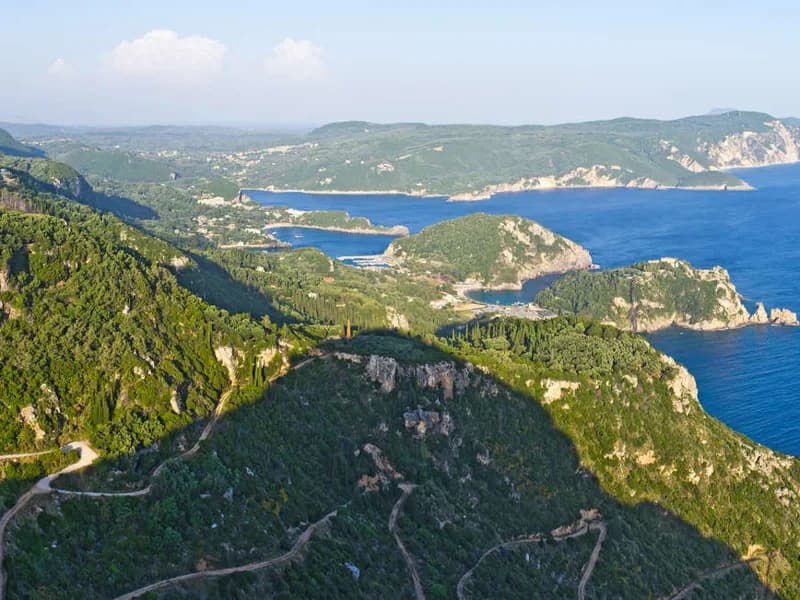
Corfu is also an island to walk. The Corfu Trail runs the length of the island, from the southern tip to the north, through olive groves, hill villages and long stretches of coast. Explore's seven-night Walking the Corfu Trail (South) begins in Corfu Town and covers the southern half, by way of Kavos, Arkoudillas, Asprokavos, Lefkimmi, the Gardeno river valley, Paramonas, Benitses and Sinarades. It departs in April, May, September and October, so a spring departure that coincides with Greek Easter is a matter of checking the calendar.
The fourteen-night Corfu Trail Walking - North and South, also from Explore, joins the two halves, continuing north by way of Pelekas and Liapades. It runs in the same months.
The Peloponnese in spring
On the mainland, the Peloponnese is the other place to spend a Greek spring. Its villages are small and its churches many, and in the Mani, the stony southern peninsula of tower houses, the Easter traditions are old and kept.
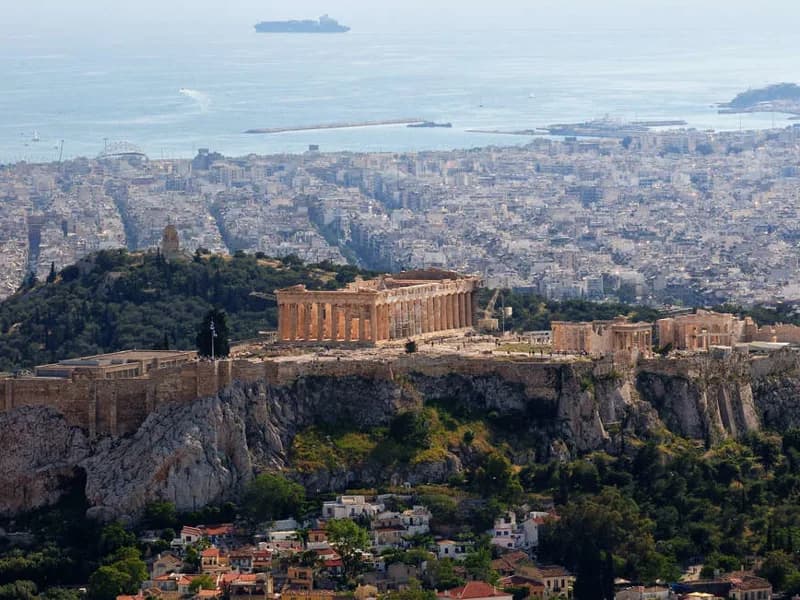
Explore's twelve-night Peloponnese Explorer starts in Athens and goes to the theatre at Epidavros, Nafplion, Mycenae and the Mani Peninsula, with Gythio, Monemvasia, Cape Tenaro, Girolimenas and Vathia, then the Byzantine ruins of Mystras and the bay of Pylos. It departs from April to June and again in the autumn.
A last practical note. Easter Monday is a public holiday in Greece, and the days around Easter are a time when Greeks travel home to their villages, so ferries, buses and hotels can be busy. Museums and archaeological sites may keep shorter hours or close on the main days. Plan around it, and give yourself a full week: you will not want to leave on Sunday afternoon with the lamb still turning.
By Walter Pellow, the name Atlas & Passage’s editorial team writes under. Prices and dates in the trips below come from the operators and can change.