Seasons
Cherry blossom in Korea, from Jeju and Busan up to Seoul
Korea's cherry blossom moves north up the peninsula from late March, from Jeju and Busan to Gyeongju and then Seoul in early April. It is quieter than Japan's, and in places just as beautiful.
By Walter Pellow2 November 20263 min read
Most travellers who chase cherry blossom go to Japan. Korea has the same trees, the same brief, dazzling season and the same habit of turning out in crowds to walk beneath them, and fewer foreign visitors doing it. For a week or so each spring, its cities and old capitals are lined with pale pink blossom: along rivers and lakes, around palaces and temples, on the streets of an old naval port, and over the burial mounds of ancient kings.
How the blossom moves
The season starts in the warm south and moves north. In a typical year the first blossoms open on the island of Jeju and in Busan, on the south coast, in late March; Gyeongju and Jeonju follow a few days later; and Seoul, in the north-west, comes into flower in early April. For 2026, the official forecast from the Korea Tourism Organization put the first blooms at about 25 March in Jeju and Busan, 28 March in Gyeongju and Jeonju, and 3 April in Seoul, a few days earlier than average. Check the forecast for 2027 nearer the time.
Each place stays at its best for only a short time, from the first full flowering to the moment the petals start to fall like snow. Rain and wind can shorten it. So a trip timed for the blossom is always something of a gamble, and the best plan is to be somewhere in the country for the last days of March and the first ten days of April, and follow the season.
Where to see it
The best-known cherry blossom festival in Korea is the Jinhae Gunhangje, in Jinhae, an old naval port near Changwon on the south coast. The town is full of cherry trees, and for the festival, usually held in late March and early April, its streets, its stream and its railway line become tunnels of blossom. It is very crowded.
Gyeongju, the old capital of the kingdom of Silla, is perhaps the loveliest place to see the blossom. The trees line the lakes and roads, and in the Daereungwon tomb park, the grassy burial mounds of the Silla kings rise among them like green hills. The temple of Bulguksa, on the slopes outside the city, is surrounded by blossom too.
In Seoul, the cherry trees line the long road behind the National Assembly on Yeouido, an island in the Han river, and the shores of Seokchon Lake, both of which have festivals, and they flower around the old palaces. Busan has its own avenues of trees by the sea.
For a week or so each spring, the old capitals are lined with pale pink blossom.
Beyond the blossom
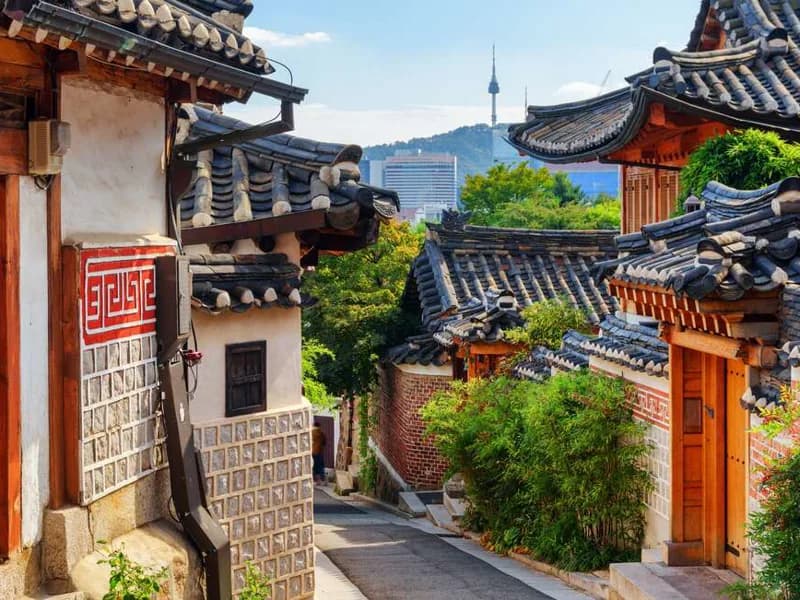
Spring is a fine time to travel in Korea whatever the trees are doing. The days are mild and mostly dry, the hills are coming into green, and other flowers follow the cherry: forsythia, azaleas, and then, in the countryside, rapeseed. In the hanok villages, the traditional neighbourhoods of tiled wooden houses in Seoul, Jeonju and Andong, the blossom against the dark roofs is very beautiful.
Tours in spring
Explore's eleven-night Discover South Korea departs from March to November, and travels from Seoul to Andong and the Hahoe Folk Village, Gyeongju, Busan, Gwangju and Mudeungsan National Park, and Jeonju.
G Adventures' eight-night Solo-ish South Korea departs in March and December, with Seoul, Gyeongju and Busan in its list, and among its places Bukchon Hanok Village, Gyochon Hanok Village, Gwangjang Market, Jongmyo Shrine, Daereungwon Tumuli Park, Bulguksa Temple, Seokguram Grotto, the Gyeongju National Museum and Gamcheon Culture Village.
G Adventures' eight-night Journeys: Soul of South Korea departs in March, April, May, October and November, and goes from Seoul to Gyeongju and Busan, then to Jeju Island, with Yangdong Folk Village, Gamcheon Culture Village, Jagalchi Fish Market, Haedong Yonggungsa Temple, Dongbaek Island, Haeundae Beach and Seongsan Sunrise Peak among its places.
A late March or early April departure gives the best chance of meeting the blossom somewhere along the way. Watch the forecasts, keep an umbrella handy, and do not be disappointed if a city is a few days early or late. In the Korean spring, there is usually blossom somewhere.
By Walter Pellow, the name Atlas & Passage’s editorial team writes under. Prices and dates in the trips below come from the operators and can change.