Seasons
Korea in autumn, when the maples outdo the blossom
Spring blossom gets the photographs, but many Koreans would say autumn is their country's finest season. The skies are clear and the air is dry, and the mountains turn red and gold from the north down to the south.
By Walter Pellow20 October 20264 min read
The Korean word for the autumn colours is danpung, and watching them is something of a national pastime. Each year the forecasts track the colour as it moves down the peninsula, starting in the high mountains of the north-east in early October and reaching the south by early November. At weekends the mountain trails and temple paths fill with hikers in bright outdoor clothing, all heading for the same red slopes. Cherry blossom in April draws its own crowds and is lovely while it lasts. But it lasts about a week, and the weather in spring can be hazy. The autumn colours last for weeks and come with the clearest, driest weather of the year.
Why autumn suits Korea
Korea has a sharply seasonal climate. Summers are hot, humid and wet, with the monsoon rains of late June and July. Winters are cold and dry, with bitter winds from Siberia. Between them, autumn arrives in September, and by October the humidity has gone. Days are warm and bright, nights are cool, and the skies are a deep, clear blue. It is the best walking weather of the year, which matters in a country where much of the land is mountain and where hiking is a hugely popular pastime.
The landscape suits the season, too. Korean hillsides are thickly wooded, and the maples turn deep crimson against evergreen pines. In the cities, the ginkgo trees that line many streets turn a brilliant butter-yellow. They also drop their foul-smelling fruit on the pavements, an autumn hazard that every Korean knows to step around.
Autumn also brings Chuseok, the harvest festival, in September or early October depending on the lunar calendar. It is one of the two great family holidays of the year, when millions travel home. Trains and roads are busy, and some shops and restaurants close for a few days. It is worth checking the dates before you go.
Autumn is also the season of the harvest table. Persimmons are peeled and hung in strings from the eaves of country houses to dry into gotgam, a chewy winter sweet. Roasted chestnuts are sold from street carts, and the new season's rice reaches the shops. In the countryside, the golden rice fields and the red persimmon trees make the season as much a matter of colour on the plains as in the mountains.
Where to see it
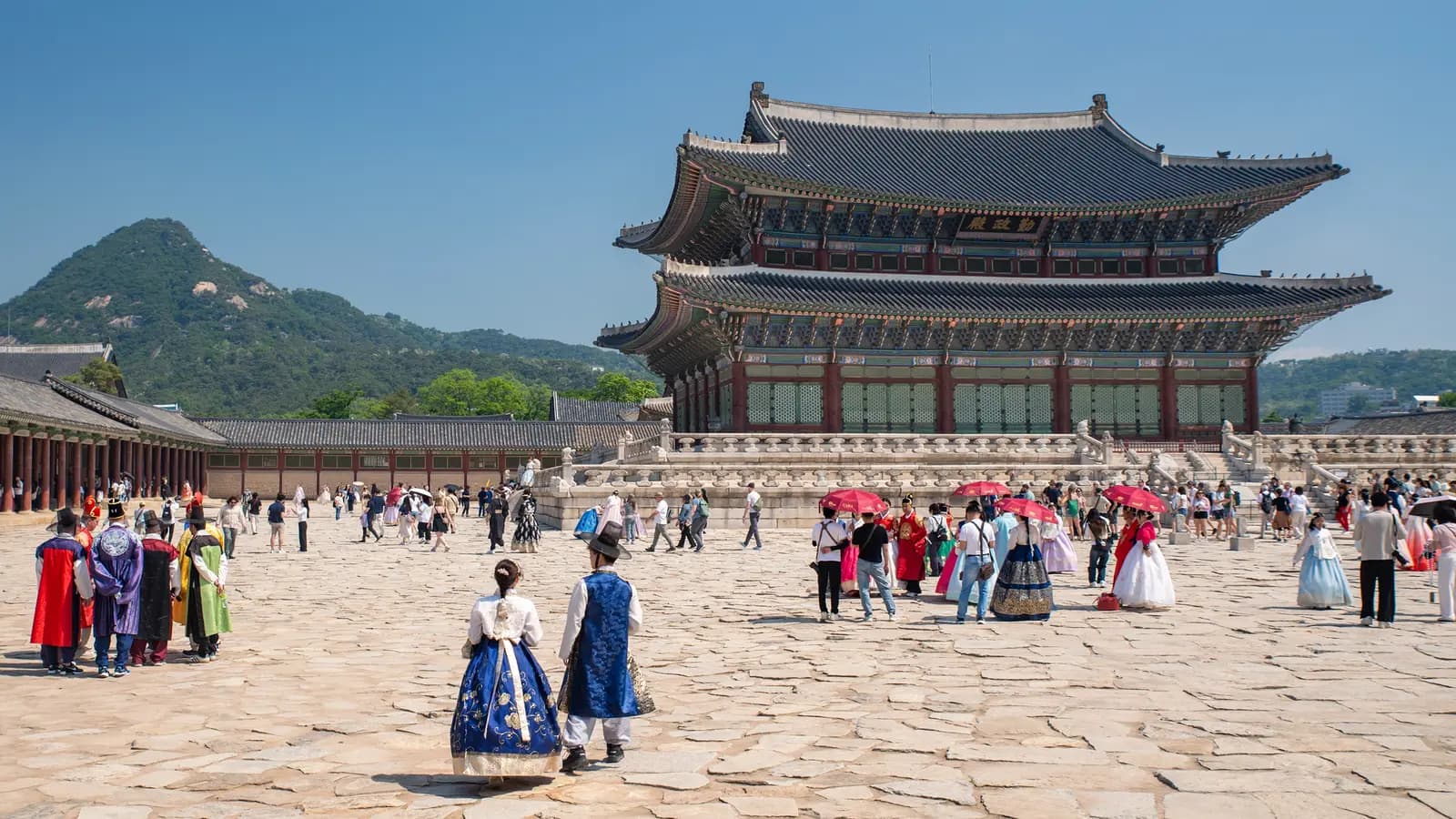
The palaces of Seoul are particularly fine in autumn, when the maples and ginkgos in their courtyards and gardens turn against the painted eaves. Changdeokgung's Secret Garden is at its most beautiful in late October and early November. In Gyeongju, the old Silla capital, the maples around Bulguksa temple and the burial mounds in the town make a famous autumn picture. Further south-west, Mudeungsan National Park, above the city of Gwangju, is a mountain of rocky pillars, with silver grass across its upper slopes and colour on the lower ones.
Two mountains are especially famous for their colour, though neither is on the tours below. Seoraksan, on the north-east coast, a park of granite peaks and deep valleys, is usually the first to turn, in early to mid October. Naejangsan, in the south-west, is known above all for its maples and is at its best in late October and early November, when its temple approaches turn into tunnels of red. Either can be crowded at weekends at the peak of the season, and going on a weekday makes a great difference.
The autumn departures
G Adventures' Best of South Korea, seven nights, runs in October and November. It goes from Seoul and the DMZ to Gyeongju and the folk village of Yangdong, then on to Busan on the coast.
Explore Worldwide's Discover South Korea, eleven nights, runs through the autumn months as well as in spring and summer. It covers Seoul, Andong and the folk village of Hahoe, then Gyeongju, Busan, Gwangju and Mudeungsan National Park, and Jeonju.
G Adventures' Essential Korea, twelve nights, has a departure in November. That is late enough in the season for the colour to have reached the south, on a route that runs from Seoul through Gyeongju, Jeonju and Busan to Yeosu, Boseong, Damyang and the island of Jeju.
Pack layers, because the mornings can be cold, and good walking shoes, because the colour is best seen on foot. And do as the Koreans do: find a temple in the hills, walk up to it slowly, and stop for a bowl of something hot on the way down.
By Walter Pellow, the name Atlas & Passage’s editorial team writes under. Prices and dates in the trips below come from the operators and can change.