Culture
Seoul's palaces, and the hanok lanes between them
Behind Seoul's towers is the old royal city of the Joseon kings. It has five palaces, a shrine to the royal ancestors, and lanes of tiled wooden houses climbing the hill between them.
By Walter Pellow20 October 20264 min read
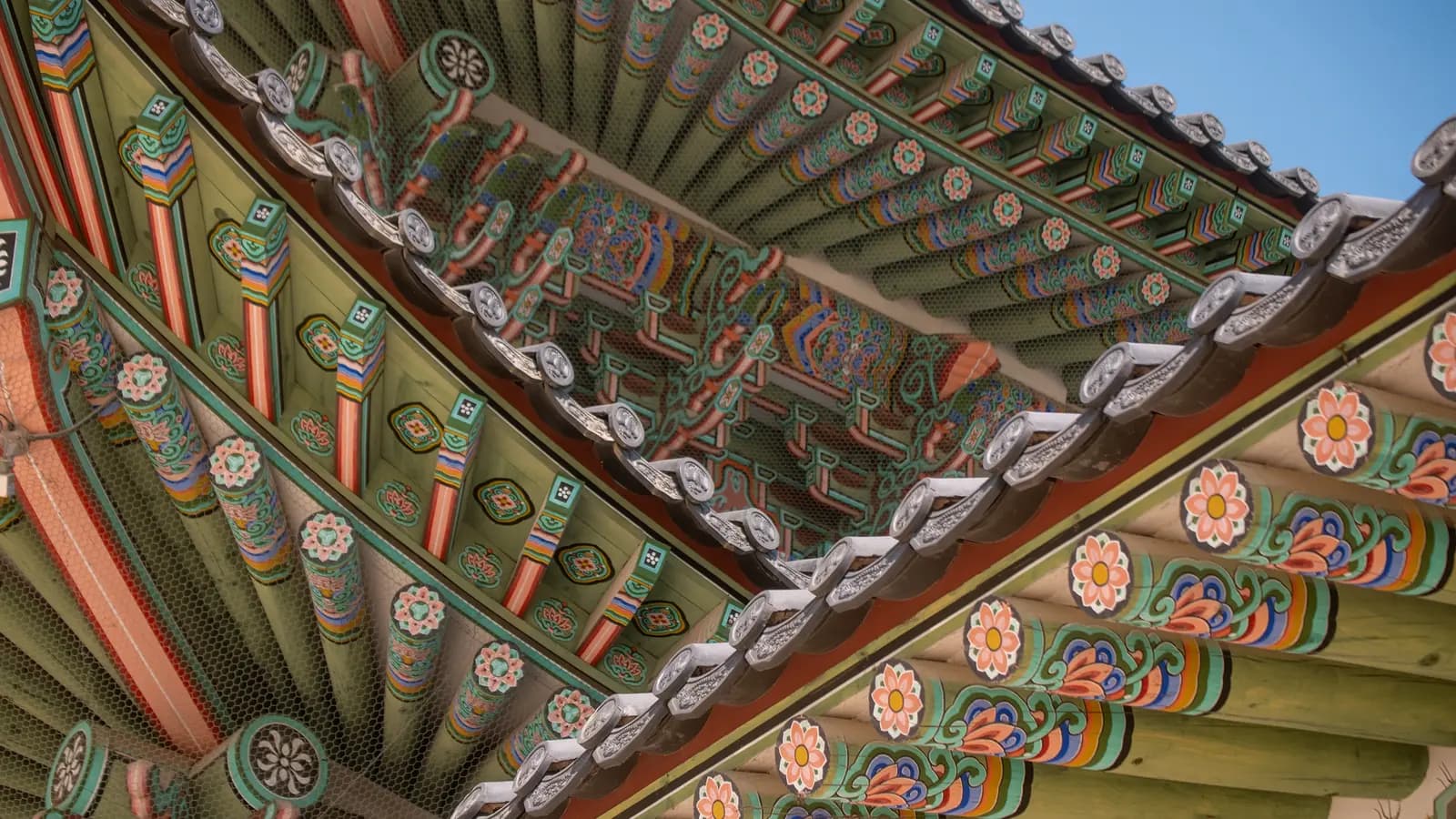
When the Joseon dynasty made Seoul its capital at the end of the fourteenth century, it laid the city out according to the principles of geomancy. The main palace was set against the mountains to the north and faced south over a river valley, protected by hills on either side. Over the next five centuries the Joseon kings built five palaces in the city, and their courts, rituals and households filled the land between them. Much of it was damaged or destroyed in the Japanese invasions of the 1590s, in the colonial period of the early twentieth century and in the Korean War. Much has also been rebuilt and restored. Seen together, the palaces and the lanes around them are the best introduction there is to the Korea that came before the skyscrapers.
The palaces
Gyeongbokgung is the first and largest, the main royal palace founded in 1395. Its great throne hall and its pavilion on a lake are the image of royal Korea, and the changing of the guard at its main gate, in Joseon costume, draws a crowd several times a day. Much of what you see is reconstruction, the result of a long restoration programme since the 1990s, but it is done with care and gives a clear idea of the palace's scale.
Changdeokgung, a short walk to the east, is the one to see if you have time for only one more. It was the palace most used by the Joseon kings, and its buildings follow the contours of the hills rather than a rigid plan. Behind them is the Huwon, or Secret Garden, a wooded valley with pavilions, ponds and old trees that the kings used for study and quiet. The palace and its garden are a World Heritage Site in their own right, and the garden can be seen only on a guided visit.
Deoksugung, near City Hall, is the most unusual of the five, a palace where traditional halls stand beside a neoclassical stone building from the early twentieth century. The path along its stone outer wall is a favourite walk, especially when the ginkgos turn in autumn.
A curious local custom: visitors wearing hanbok, traditional Korean dress, are admitted to the palaces free. As a result, the palace grounds are full of people of every nationality in rented silk, and it is one of the gentler sights of the city.
Jongmyo, the ancestral shrine
Jongmyo, south of Changdeokgung, is not a palace but a shrine. It holds the spirit tablets of the Joseon kings and queens, and it is one of the most solemn buildings in Asia: a single long, low hall with a deep, dark row of chambers behind its columns, in front of a vast, empty stone courtyard. The ancestral rites held there, with music and dance, are among the oldest continuous ceremonies of their kind, and both the shrine and the ritual are inscribed by UNESCO.
The hanok lanes
Between Gyeongbokgung and Changdeokgung, on the slopes above them, lies Bukchon, a neighbourhood of hanok, the traditional Korean house with its tiled roof, timber frame and courtyard. Most of the houses are from the early twentieth century, and many are still private homes. Because of that, parts of the area now restrict visiting hours and ask for quiet, and it is worth respecting both. Ikseon-dong, to the south, is a smaller, newer cluster of hanok lanes where many of the houses have become cafés, restaurants and small shops.
Gwangjang Market, east of the palaces, is one of the oldest markets in the city. Its food alleys are known for bindaetteok, crisp pancakes of ground mung beans fried on the spot.
G Adventures' Solo-ish South Korea, eight nights, includes Bukchon, Jongmyo and Gwangjang Market in Seoul. It then goes south to Gyeongju, including the hanok village of Gyochon there, and on to Busan.
G Adventures' Uncover Korea: K-Pop and Hanok Villages, nine nights, pairs Seoul's hanok lanes, Ikseon-dong and Gwangjang Market with Jeonju, whose old town has one of the largest clusters of hanok in the country. It then goes on to Busan and Jeju.
Whichever way you see them, give the palaces a morning and the lanes an afternoon, and finish at the market with a pancake. It is the oldest Seoul there is, and it sits right in the middle of the newest.
By Walter Pellow, the name Atlas & Passage’s editorial team writes under. Prices and dates in the trips below come from the operators and can change.