History
Gyeongju, the old Silla capital of tombs and temples
For almost a thousand years Gyeongju was the capital of Silla, the kingdom that first united most of Korea. Its kings are buried under grassy hills in the middle of town, and its finest temple stands in the forest above.
By Walter Pellow20 October 20264 min read
The traditional dates for the kingdom of Silla run from 57 BC to AD 935, nearly a thousand years. For all of that time, its capital was at Gyeongju, in the south-east of the Korean peninsula. In the seventh century, with the help of Tang China, Silla defeated its two rival kingdoms and brought most of the peninsula under one rule for the first time. The city at its height was large, wealthy and cosmopolitan, connected by trade to China and beyond. Then the kingdom weakened, and the capital moved elsewhere. Gyeongju became a provincial town, which is largely why so much of it survives.
Today it is often called a museum without walls. The historic areas in and around the town are listed together as a World Heritage Site. It is the best place in Korea to see what the country looked like before the dynasties of Seoul.
The tombs in the town
The first thing visitors notice is the hills. In the middle of Gyeongju, among the roads, parks and low houses, rise dozens of grassy mounds, some of them the size of a small hill. They are the tombs of Silla kings, queens and nobles, built of timber chambers covered in stones and earth, which made them very hard to rob. Several have been excavated, and they have produced some of the most spectacular finds in East Asian archaeology: gold crowns with branching, antler-like ornaments hung with jade, belts, earrings and weapons.
In the tumuli park of Daereungwon, one tomb, the Cheonmachong or Heavenly Horse Tomb, has been opened so that visitors can walk inside and see how it was built. It is named after a painting of a flying horse on a saddle flap found there. The finds themselves, including the gold crowns, are in the Gyeongju National Museum, along with the great bronze Emille bell, cast in the eighth century.
Near the tombs stands Cheomseongdae, a small, bottle-shaped tower of stone blocks from the seventh century. It is thought to be one of the oldest surviving astronomical observatories in East Asia. A short walk away, the reconstructed pavilions of the Donggung palace are reflected in the Wolji pond, a sight that is particularly fine when lit after dark.
Bulguksa and Seokguram
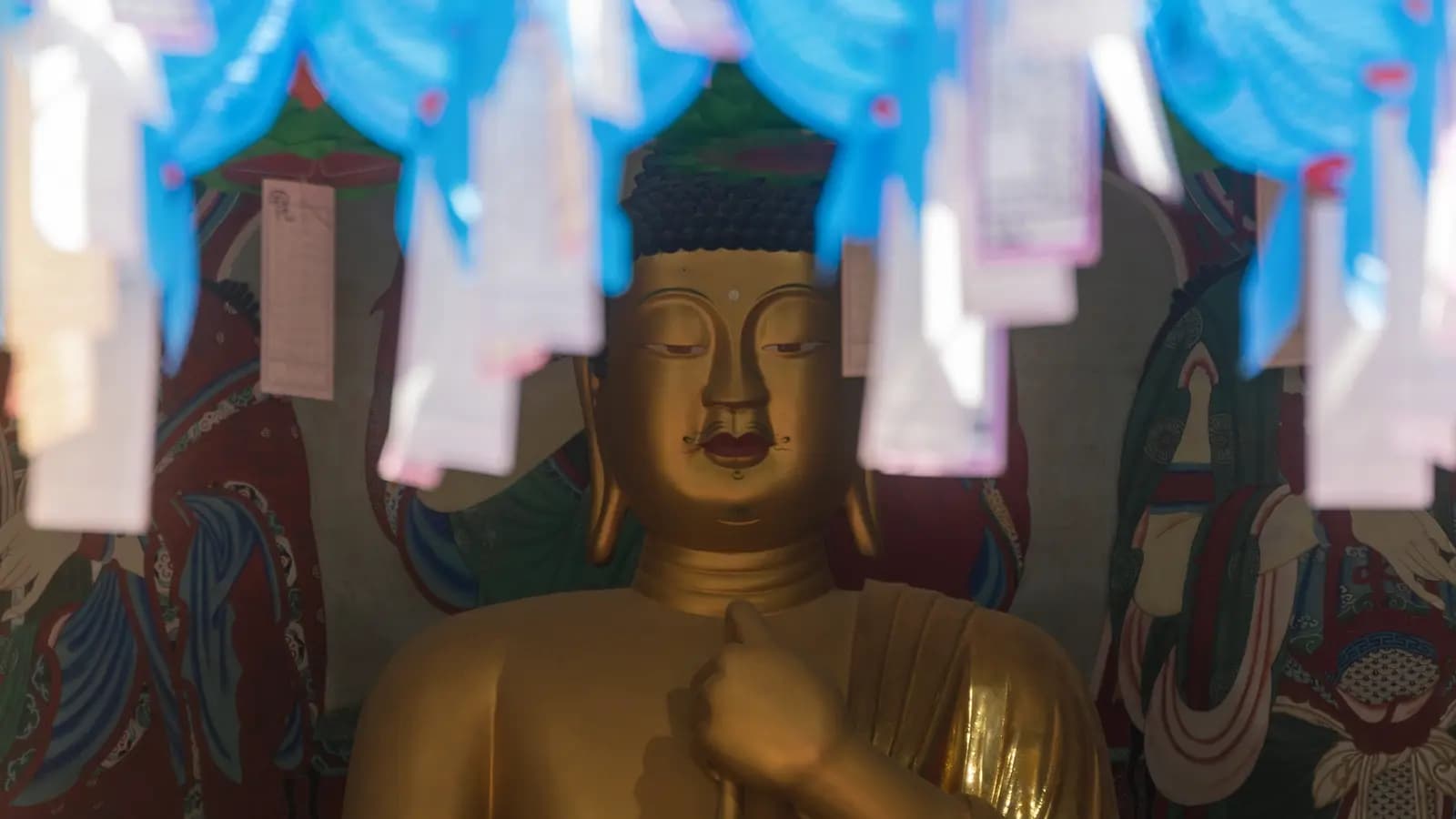
On the wooded slopes of Mount Toham, outside the town, is Bulguksa, the most celebrated Buddhist temple in Korea. It was built in the eighth century, burned by the Japanese invasions of the late sixteenth century and restored in the twentieth. Its stone terraces, bridges and pagodas are original Silla work, and the painted wooden halls above them make a fine contrast with the grey stone. Higher up the mountain, in an artificial cave, sits the granite Buddha of Seokguram, looking out towards the East Sea, one of the great masterpieces of Buddhist sculpture. Both are part of the same World Heritage listing, and both are best seen early, before the coach parties arrive.
Spring and autumn are the best times to go, with cherry blossom in April and maples in late October and November.
Yangdong, and how to fit it in
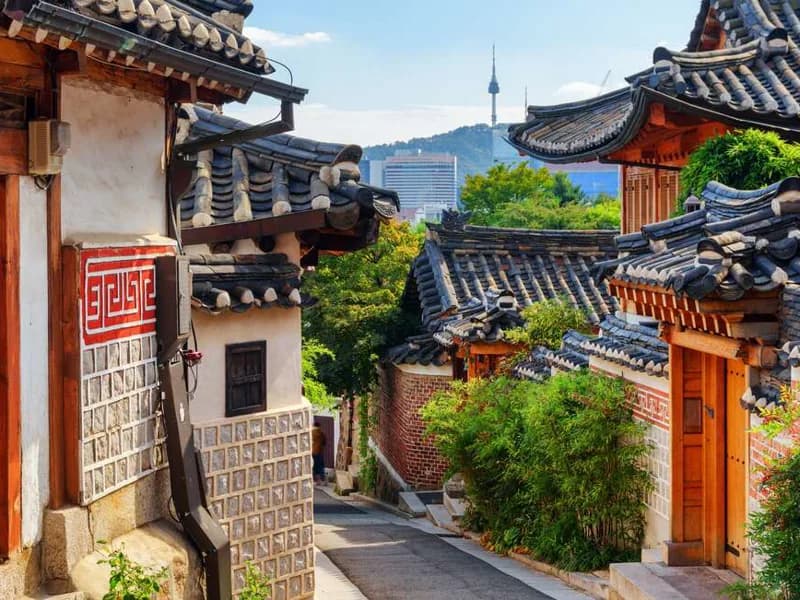
Near Gyeongju, the village of Yangdong is a much later survival. It is a village of the Joseon period, home to two clans of the scholar-gentry, with tiled and thatched houses spread across the hillsides and still lived in today.
G Adventures' Best of South Korea, seven nights, includes Gyeongju and Yangdong on a route from Seoul to Busan. G Adventures' Journeys: Soul of South Korea, eight nights, takes in Gyeongju and Yangdong too, before going on to Busan and the island of Jeju.
Explore Worldwide's Discover South Korea, eleven nights, adds Andong and the folk village of Hahoe, Gwangju and Mudeungsan National Park, and Jeonju to Gyeongju and Busan, which makes it the longest of the three.
Whichever tour you choose, give Gyeongju time. It is a small place, and the temptation is to see it in a day, but it repays a slower walk, particularly in the evening, when the mounds become dark shapes against the sky and the town feels as old as it is.
By Walter Pellow, the name Atlas & Passage’s editorial team writes under. Prices and dates in the trips below come from the operators and can change.