Walking
Corfu on foot, the whole island by trail
Most visitors see Corfu from a sun lounger or a coach window. A long-distance trail running the length of the island shows a greener, steeper, quieter version of the same place.
By Arthur Penhallow26 September 20263 min read
Corfu has spent longer being fought over than most Greek islands, largely because of where it sits: close enough to Italy and the Albanian coast to matter strategically, and green enough, thanks to higher rainfall than the drier Aegean islands further south, to be worth holding onto. Venice ruled it for the best part of four centuries and never lost it to the Ottomans, which is why the old town looks the way it does, and why the island's landscape, terraced with olive groves rather than scrubland, feels closer to parts of Italy than to the Cyclades. A walking route that runs the length of it takes in both the history and the terrain at a pace that a coach tour simply cannot manage.
A trail from one end of the island to the other
The Corfu Trail runs roughly two hundred kilometres from the southern tip near Kavos to Kassiopi in the north, threading through villages, olive groves and pine forest rather than following the coast road, and it is usually broken into a week or two of daily sections rather than attempted in one push. The southern half is gentler and flatter, through farmland around Lefkimmi and the quieter beaches near Santa Barbara. The northern half climbs, repeatedly, through hill villages like Krini and Makrades before reaching its high point on Mount Pantokrator, Corfu's tallest peak, where a monastery has stood at the summit for centuries and the view on a clear day reaches across to the Greek mainland and, in the other direction, to Albania.
Paleokastritsa, and the coast the trail keeps returning to
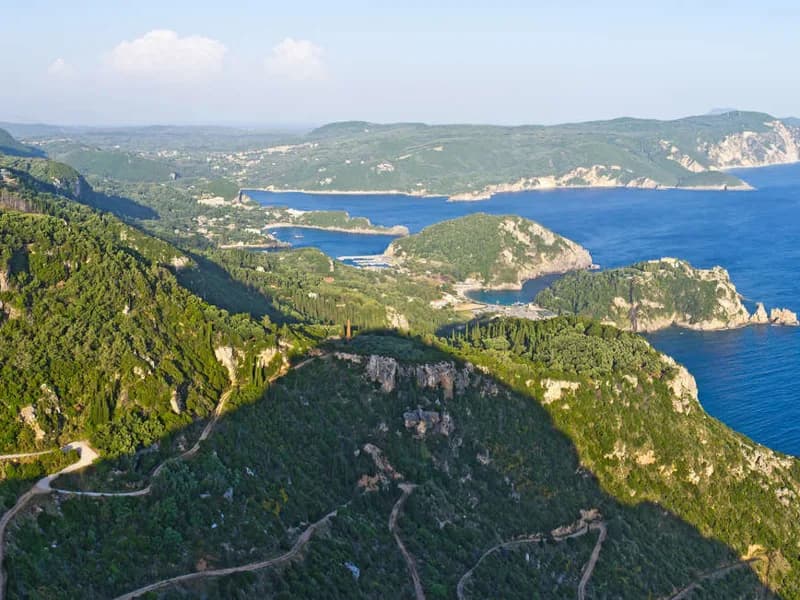
Along the west coast, the trail passes above Paleokastritsa, a series of coves backed by cliffs and, on the headland, another old monastery, and continues through Liapades and the small terraced villages that supply most of the island's olive oil. This stretch is where the walking route earns its keep against the alternative of simply driving the coast road: paths above the bays give views down onto water that the road itself mostly hides behind the cliffs, and the villages here, Lakones and Krini among them, keep a rhythm the beach resorts further south have largely lost.
A greener, steeper, quieter version of the same place.
Corfu splits conveniently into two halves for anyone who would rather walk one at a time. A northern route takes in Pantokrator and the wilder coast around Kassiopi; a southern one covers the gentler farmland and coastal paths towards Kavos, each roughly a week on its own.
The old town, and the view from Kanoni
Corfu Town itself, at the trail's midpoint for most itineraries, is the reason the island is a UNESCO World Heritage Site: a fortified old quarter of Venetian streets, French-built arcades from a later, briefer occupation, and a British-era cricket ground still in occasional use, layered together in a way that few Greek towns can match. A short walk south of the centre, the Kanoni peninsula gives one of the island's most reproduced views: the small white monastery of Vlacherna, connected to the shore by a short causeway, with the wooded islet known as Mouse Island sitting just beyond it in the strait. It is the kind of view that looks almost too tidy to be real, and it has not needed retouching in more than a century of postcards.
Why the whole island, on foot, is worth the effort
A trail that runs coast to coast and top to bottom is a considerably more demanding way to see Corfu than a week by a pool, and it is meant to be: the point is to walk through the working olive terraces, the mountain villages and the quieter southern farmland that a beach holiday never touches, and to arrive at the famous views, Paleokastritsa's coves, Pantokrator's summit, Kanoni's causeway, having earned the approach rather than simply been driven to it. Corfu rewards that kind of attention more than its reputation as a package-holiday island usually suggests.
By Arthur Penhallow, the name Atlas & Passage’s editorial team writes under. Prices and dates in the trips below come from the operators and can change.