First time
Delhi, Agra and Jaipur, a first triangle, not the whole of India
Three cities and a few centuries of Mughal and Rajput history, arranged conveniently close together. It is a sensible place to start, provided you remember it is only a start.
By Arthur Penhallow26 September 20264 min read
The name is a piece of tourist-board geography rather than history: draw a line from Delhi to Agra to Jaipur and back, and you get something roughly triangular on the map, small enough to cover by road in a week or so. It has become the standard first visit to India for a good practical reason. The distances are manageable, the road and rail links are established, and the three cities between them hold a genuinely enormous amount of what most people come to India to see. It is worth saying plainly, though, that a triangle drawn between three cities in the north is not India in miniature. It is a corner of a very large country, chosen for convenience.
A capital built on older capitals
Delhi is not one city but a stack of them. Archaeologists count several distinct settlements on or near the site going back more than two thousand years, and the visible layers are mostly more recent: the Mughal-era Red Fort, a sandstone fortress-palace begun in the 1630s and still the backdrop for the prime minister's Independence Day address each August; the vast Jama Masjid nearby, built by the same emperor, Shah Jahan; and, a short drive away, the planned avenues of New Delhi, laid out by the British architect Edwin Lutyens and inaugurated as the seat of colonial government in 1931, sixteen years before that government left. The old city and the planned one sit within a few miles of each other and read like two different centuries arguing across a road.
Agra, and the reason everyone comes
Agra's fame rests on one building, and the building earns it. The Taj Mahal, a white marble mausoleum on the Yamuna river, was commissioned by Shah Jahan for his wife Mumtaz Mahal, who died in 1631; it took the best part of two decades to complete. Its restraint is easy to underrate in photographs, where the scale gets lost. Up close, the marble is inlaid with semi-precious stone in floral patterns fine enough to reward the time most itineraries allow for a proper look. Agra Fort, upriver, is the more overlooked half of the visit: a red sandstone Mughal citadel from which, tradition holds, Shah Jahan spent his final years under house arrest, with a view of the tomb he had built.
Jaipur, planned rather than grown
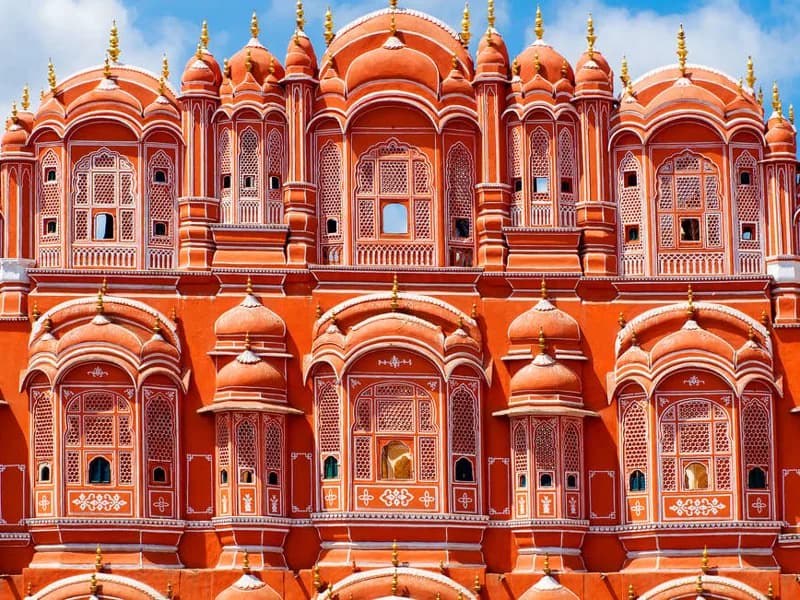
Jaipur is the youngest of the three by some margin, founded in 1727 by Maharaja Sawai Jai Singh II and laid out on a grid, an unusual choice for a city of its age and one that still shapes how it feels to walk through. The old city was painted terracotta pink in the nineteenth century for a royal visit and has stayed that colour by local ordinance ever since, which is the origin of the "Pink City" name. The Hawa Mahal, its honeycombed pink façade of small windows, was built in 1799 so that the women of the royal household could watch the street below without being seen from it. Amber Fort, on a ridge outside town, predates the city itself and is the better place to understand the Rajput dynasty Jaipur belongs to.
A triangle drawn between three cities in the north is not India in miniature. It is a corner of a very large country, chosen for convenience.
What the triangle leaves for later
Most itineraries that cover this ground add Ranthambore, the former royal hunting ground turned tiger reserve between Jaipur and Agra, which is a natural extension rather than a detour. What they do not add, because it would take another kind of trip entirely, is anywhere south of Rajasthan or east of Delhi: no Kerala backwaters, no Himalayan foothills, no coast. That is not a flaw in the itinerary so much as an honest description of what a first trip can reasonably hold. Ten days is enough for the triangle to leave a real impression; it is not enough for the country it sits inside.
The best months for it are the same as for most of northern India: October to March, when the heat that makes April onward a genuine trial has not yet arrived, and Delhi's occasional winter fog is the main weather concern rather than the temperature. Beyond that window, the triangle is still there, but it is a considerably harder one to walk around.
By Arthur Penhallow, the name Atlas & Passage’s editorial team writes under. Prices and dates in the trips below come from the operators and can change.