Journeys
Delhi to Kathmandu overland, by way of the Ganges
The road from Delhi to Kathmandu crosses the heart of northern India, past the Taj Mahal and down to the Ganges at Varanasi, then climbs from the plains of Nepal into the foothills of the Himalaya. It was the route of the old hippie trail, and it is still one of the great overland journeys of Asia.
By Walter Pellow2 November 20264 min read
In the 1960s and 1970s, thousands of young Westerners travelled overland from Europe to India and Nepal, by bus, van and train, on what came to be called the hippie trail. Kathmandu, with its temples, its mountains and its relaxed attitude, was for many of them the end of the road. That world has gone, but the last stretch of the route, from Delhi across the plains of northern India to Kathmandu, remains one of the great overland journeys in Asia. It crosses the heart of Hindu India and climbs into the Himalaya, from the Taj Mahal to the foothills of the Himalaya.
Across the plains
The journey begins in Delhi, a vast city of Mughal monuments and modern sprawl, with the Red Fort, the Jama Masjid and the bustle of Chandni Chowk in the old city. From there, most routes pass through Jaipur, Rajasthan's pink city, and Agra, for the Taj Mahal, the most famous building in India.
East of Agra, Orchha is a quiet place on the Betwa river, once the capital of a Rajput kingdom, with palaces, temples and a line of royal cenotaphs along the water. It is a peaceful contrast to the big cities, and a good place to break the long drive.
The road then reaches the Ganges at Varanasi, the holiest city of Hinduism, where the ghats run down to the river and pilgrims come to bathe and to cremate their dead. A dawn boat trip on the river is one of the high points of any journey through India.
From the Taj Mahal to the foothills of the Himalaya.
Some routes also pass through Lucknow, between Agra and Varanasi, the old capital of the nawabs of Awadh, rulers famous for their courtly culture, poetry and cooking. The Bara Imambara, built in the eighteenth century, has a vast vaulted hall and a maze of narrow passages above it, and the ruins of the Residency still bear the marks of the long siege of 1857, during the Indian uprising against British rule. Lucknow is also one of the great food cities of India, known above all for its slow-cooked kebabs and its biryani.
Into Nepal
North of Varanasi, the road crosses the border into Nepal and the Terai, the flat, fertile lowlands at the foot of the mountains. Chitwan National Park, in the Terai, is one of the best wildlife reserves in Asia, a landscape of jungle and tall grassland where one-horned rhinoceros, elephants, crocodiles and a wealth of birds can be seen, and where tigers live, though they are rarely spotted. Safaris are made by jeep, by canoe on the rivers and on foot.
From Chitwan the road climbs into the hills to Pokhara, on the shore of Phewa Lake, with the peaks of the Annapurna range rising close behind it. At Sarangkot, on a ridge above the town, the sunrise over the mountains is one of the classic sights of Nepal, with Machhapuchhare, the fishtail mountain, glowing pink above the clouds.
The Kathmandu valley
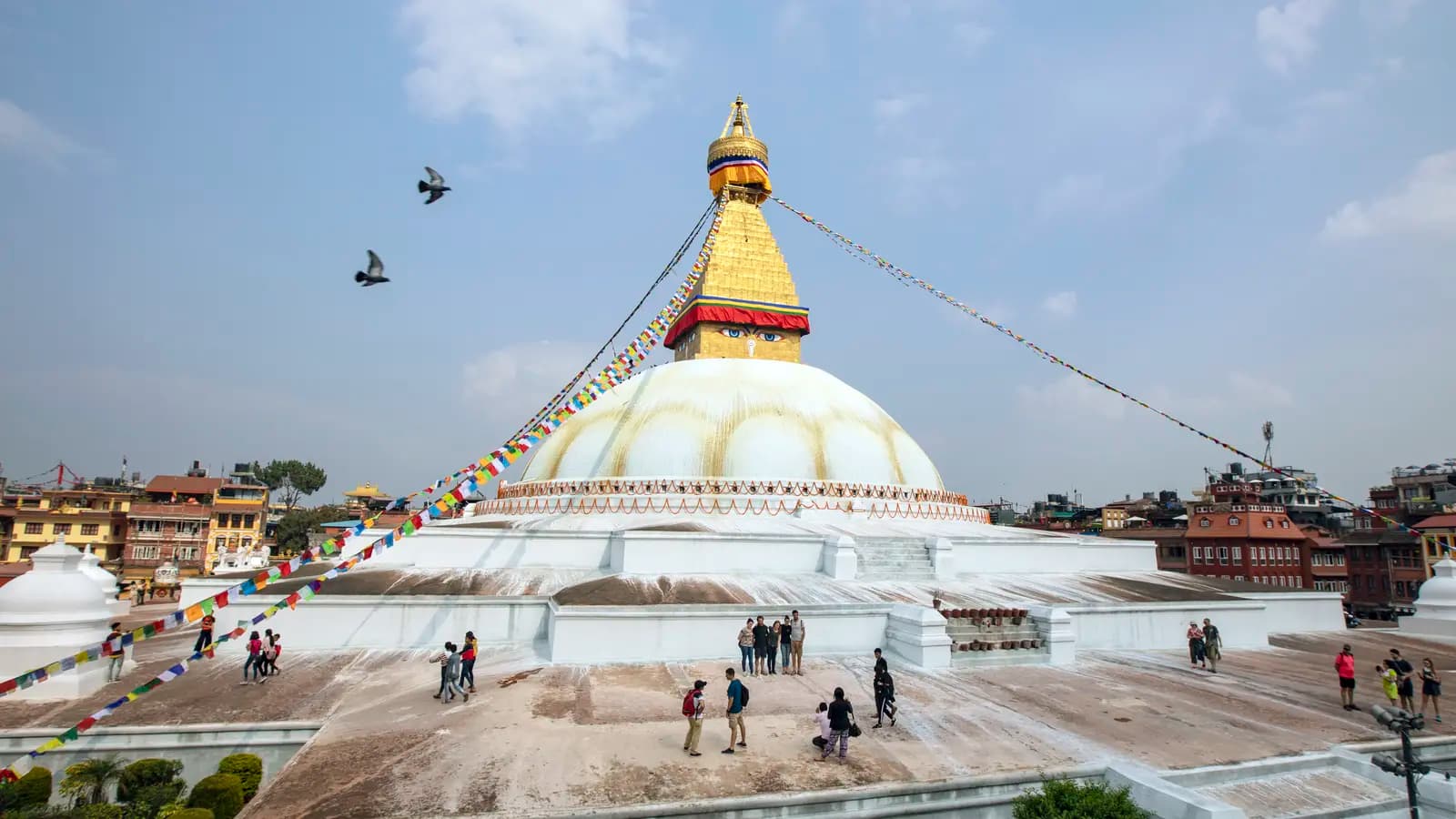
The journey ends in the Kathmandu valley, where three old royal cities, Kathmandu, Patan and Bhaktapur, have some of the finest temples and palaces in the Himalaya, with their tiered pagoda roofs, carved wooden windows and brick squares. The great stupa of Boudhanath, the centre of Tibetan Buddhism in Nepal, and the Hindu temple of Pashupatinath on the Bagmati river are both close by.
The tours
G Adventures' Delhi to Kathmandu Adventure, fourteen nights, travels from Delhi through Jaipur, Orchha and Varanasi to Chitwan, Pokhara and Sarangkot, ending in Kathmandu. It runs from October to December.
G Adventures' Delhi to Kathmandu: River Walks & Epic Wildlife, fourteen nights, takes in Delhi, Pushkar, Jaipur, Agra, Varanasi and Barauli, then Chitwan, Pokhara and Kathmandu, running from November to January.
Travelsphere's Incredible India & Nepal: Culture, Wildlife & Ancient Wonders, seventeen nights, includes Delhi, Agra, Lucknow and Varanasi, then Kathmandu, Pokhara, Chitwan and Nagarkot, a village on the rim of the Kathmandu valley known for its Himalayan views.
The best time for the journey is from October to March. The skies are clearest in October and November, after the monsoon, when the Himalaya are most often in view. The winter months are pleasant on the plains, though the mornings in northern India can be foggy. It is a long journey, with many hours on the road, and it suits travellers who like to see a country change outside the window.
By Walter Pellow, the name Atlas & Passage’s editorial team writes under. Prices and dates in the trips below come from the operators and can change.