Walking
The Tiger's Nest, and the climb to a monastery on a cliff
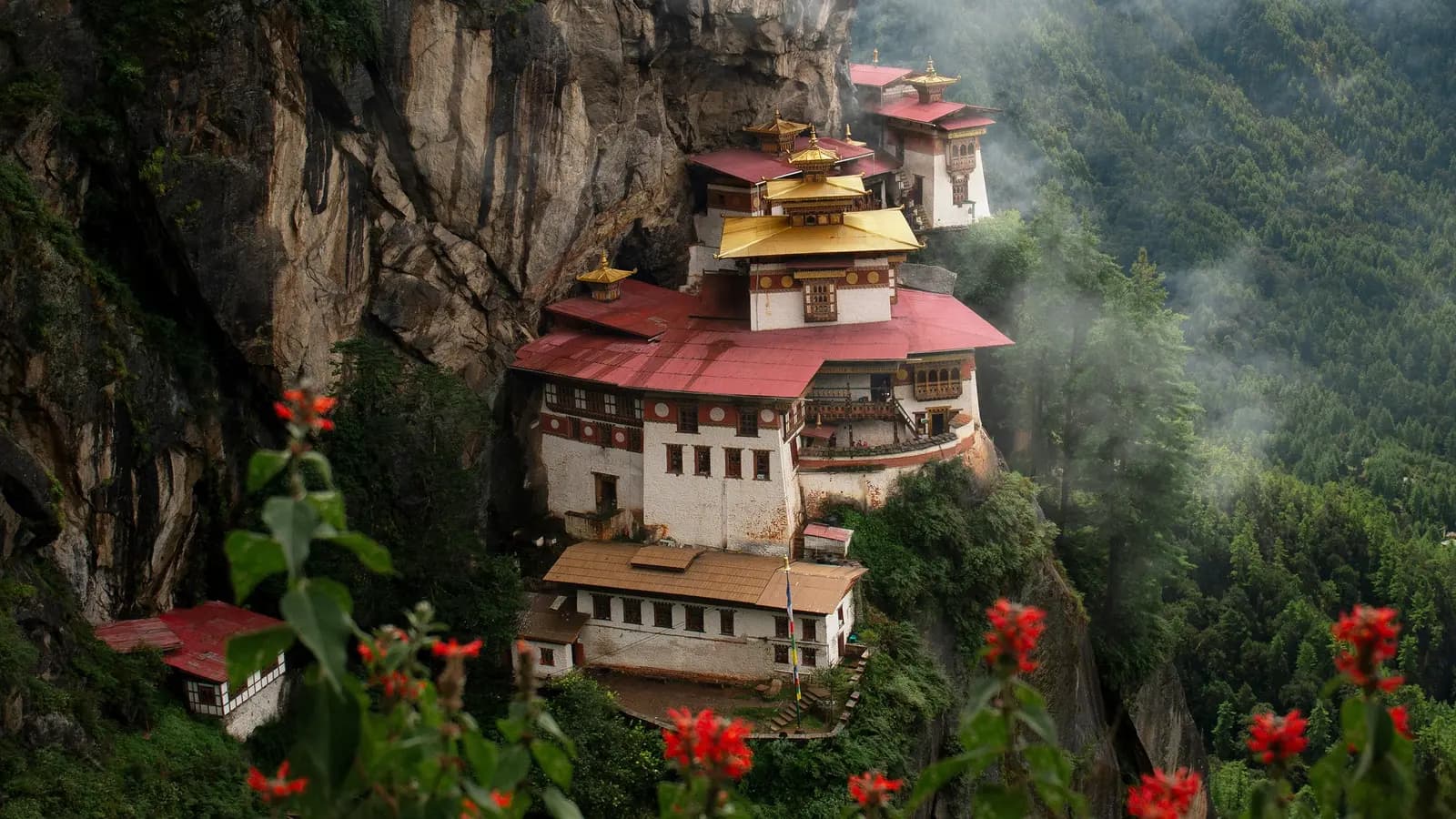
High above the Paro valley in Bhutan, a cluster of white temples clings to a sheer rock face, where a saint is said to have arrived on the back of a flying tigress. The climb to it is the defining walk of any trip to Bhutan.
By Walter Pellow20 October 20264 min read
Bhutan is a small Himalayan kingdom between India and Tibet, and one of the most distinctive countries in Asia. It is a Buddhist kingdom of fortress-monasteries, prayer flags and steep forested valleys. It kept itself largely closed to the outside world until the 1970s, and it still limits tourism deliberately. Of all its sights, one has come to stand for the country more than any other. Paro Taktsang, the Tiger's Nest, is a monastery built on a ledge on a cliff, hundreds of metres above the floor of the Paro valley.
The legend
According to Bhutanese tradition, in the eighth century Guru Rinpoche, also known as Padmasambhava, the great teacher credited with bringing Buddhism to Bhutan and Tibet, flew to this cliff on the back of a tigress. He meditated here in a cave for months, subduing the demons of the region and converting the valley to Buddhism. The cave became one of the most sacred places in the Himalaya, and in the late seventeenth century a monastery was built around it.
In 1998 a fire destroyed much of the monastery. It was rebuilt over the following years, faithfully, to the old design, and it stands today as it has for centuries, a cluster of white buildings with golden roofs pressed against the rock, connected by stairways and bridges across the gully.
The climb
The path to the Tiger's Nest begins in pine forest on the floor of the Paro valley and climbs steadily up the mountainside. It is a good path, and no climbing skill is needed, but it is steep and long. The monastery stands at around three thousand metres, and the climb from the car park takes most people two to three hours. Ponies can be hired for the lower part of the ascent. Prayer flags flutter from the trees, and the path passes prayer wheels turned by streams.
About halfway, a teahouse looks out across the gully to the monastery, and many people stop there for the view. Beyond it, the path climbs to a viewpoint level with the monastery. Then it descends a long stairway into the gully, past a waterfall, before climbing again to the entrance. The first close view of the monastery from the viewpoint, clinging to the rock across the chasm, is one of the great sights of the Himalaya.
Inside, visitors leave their bags and cameras and are shown the temples by their guide. The cave where Guru Rinpoche meditated is opened on certain occasions. Modest dress is required, with long sleeves and long trousers or skirts.
Paro itself is the first place most visitors see in Bhutan. Its airport sits in a narrow valley, and the approach between the mountains is famous. The town is small, with a main street of traditional painted wooden shopfronts. Above it, the great Rinpung Dzong, a fortress-monastery of the seventeenth century, looks over the river, with the national museum in an old watchtower on the hill behind. Nearby, Kyichu Lhakhang, one of the oldest temples in Bhutan, is said to date from the seventh century.
The rest of the trip
The walk is often saved for the end of a trip to Bhutan, when visitors have acclimatised to the altitude. Most visitors to Bhutan travel with a licensed Bhutanese guide, and the climb is done in their company.
G Adventures' Bhutan: The Haa Valley, Himalayan Passes and Tiger's Nest, six nights in spring, includes the Tiger's Nest and Paro. It also takes in Thimphu, the Dochula Pass, Chimi Lhakhang, the Punakha suspension bridge and Punakha Dzong, the Haa Valley and the Chele La Pass, the Kila nunnery and Tara Monastery.
G Adventures' Signature: Bhutan and the High Himalayan Valleys, seven nights in May and September, includes Thimphu, the Dochula Pass, Punakha, the Phobjikha and Gangtey valleys and Paro. G Adventures' Nepal and Bhutan: From the Annapurna Foothills to Tiger's Nest, fourteen nights, combines Kathmandu, the Annapurna foothills, Gurung villages and Chitwan National Park in Nepal with the Haa Valley, Paro, the Tiger's Nest, Thimphu and Punakha.
Start early to avoid the heat and the busiest hours, carry water, and take your time. The altitude makes even a fit walker breathe hard, and there is no prize for speed.
By Walter Pellow, the name Atlas & Passage’s editorial team writes under. Prices and dates in the trips below come from the operators and can change.