Slow travel
Evia by caique, at whatever pace the wind allows
Greece's second-largest island is barely an hour from Athens and almost entirely overlooked, which is exactly why a small wooden boat and a walking itinerary suit it better than a resort ever could.
By Arthur Penhallow26 September 20264 min read
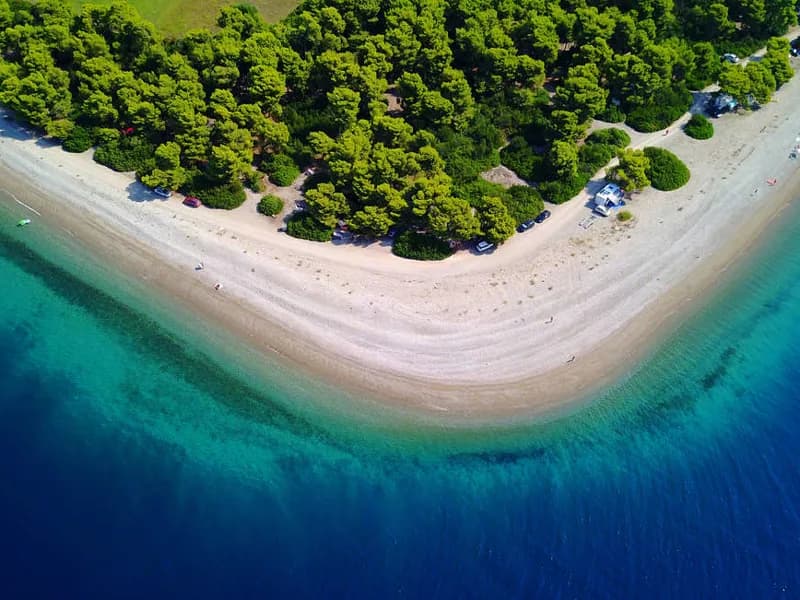
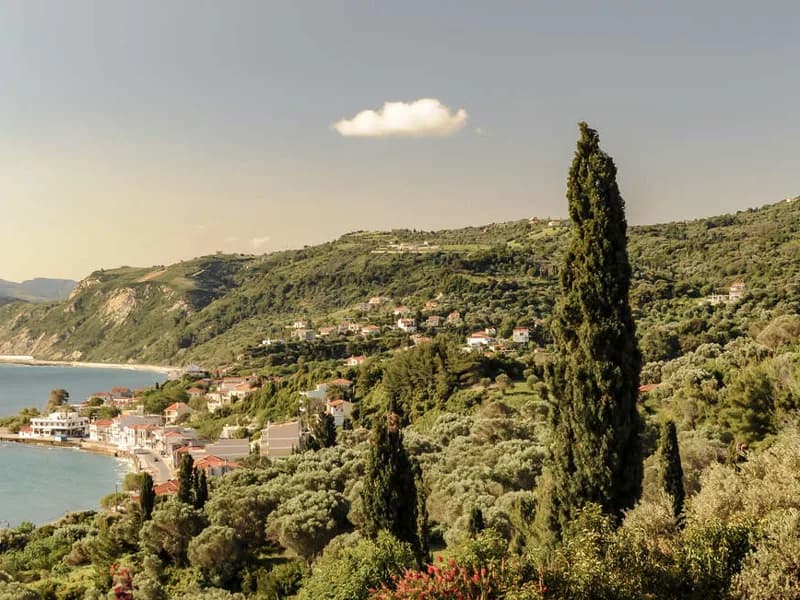
Ask most people to name Greece's second-largest island after Crete and they will guess wrong, usually towards somewhere in the Cyclades. It is Evia, a long, mountainous stretch of land running down the eastern side of the mainland, so close to Athens that a bridge crosses to it rather than a ferry, and so rarely visited by foreign travellers that its coastline has kept a working, unhurried character that busier islands lost decades ago. A trip that moves along it slowly, by caique and on foot, gets a version of Greece that has not been rearranged for anyone's benefit.
A strait that changes its mind
The narrowest crossing to Evia is at Chalkida, where the mainland and the island pinch together into the Evripos Strait, barely wide enough for a bridge, and famous since antiquity for a genuinely strange piece of hydrography: the current through the strait reverses direction several times a day, at intervals that do not correspond neatly to the usual tidal patterns of the wider sea. Ancient observers noticed it and were puzzled by it, and modern oceanographers, working with rather more instruments, still find it an unusually complicated case study. It is a small thing to see from a bridge, and a genuinely odd one.
Small boats and a working coast
South of Chalkida, the coast opens out into bays and small harbour towns rarely troubled by anything larger than a fishing boat or a traditional caique, the wooden sailing vessel that has carried people and goods around the Greek islands for generations. A trip built around one moves at whatever pace the wind and the coastline allow, calling at villages like Marmari and Nea Styra, and setting travellers ashore to walk sections of the coast path between them rather than watching it all go by from a deck.
Its coastline has kept a working, unhurried character that busier islands lost decades ago.
Karystos, near the island's southern tip, sits below Mount Ohi, Evia's highest peak, and makes an easy base for a day among its foothills. Above the town, the ruins of the Venetian-built Castello Rosso, the Red Castle, look back down over the strait between Evia and the mainland, a reminder that this quiet coast had its share of contested history too.
The valley below Mount Ohi
In the Valley of Styra, on the mountain's lower slopes, walking paths pass a scatter of odd stone structures known locally as the Dragon Houses: single-room buildings of massive, precisely fitted slabs, built without mortar, whose original purpose nobody has fully explained. Theories range from ancient sanctuaries to shepherds' shelters built for a much harsher climate than the coast below, and the uncertainty is, if anything, part of the appeal. The paths through the valley climb gently at first, through pine forest and small farming hamlets that see considerably more goats than visitors, before the ground steepens towards the summit itself, which is left as an option for anyone with the legs and the weather for it, rather than a fixed stop on the itinerary.
Eretria, and the classical city underfoot
Further north, Eretria was once a genuine rival to Athens, a classical Greek city-state with its own fleet and its own role in the wars against Persia, and the archaeological remains scattered through the modern town, a theatre, a sanctuary, fragments of the old walls, are handled with none of the crowd management that surrounds Athens's more famous sites. It is possible to walk through two and a half thousand years of history here without another visitor in sight, which says as much about how overlooked Evia is as it does about the ruins themselves.
Why the slow version works here
A route that hugs this coast rather than crossing open water in long overnight runs is, frankly, a better fit for Evia than a conventional cruise would be. The island rewards stopping rather than passing: a village harbour worth an evening, a gorge or a mountain path worth a morning, a strait worth stopping the car for even though nothing about it looks, at first glance, worth stopping for. None of it announces itself the way Santorini's caldera or Delphi's mountainside does. It simply sits there, close to Athens and almost entirely spared the attention, waiting for a slower kind of itinerary to notice it.
By Arthur Penhallow, the name Atlas & Passage’s editorial team writes under. Prices and dates in the trips below come from the operators and can change.