History
Kolkata, the old capital of British India
For most of the British Raj, Calcutta was its capital, and the city still wears the clothes of that era: a white marble memorial, colonnaded offices, a great iron bridge. It is also a bookish, argumentative and artistic city, and very much alive.
By Walter Pellow2 November 20263 min read
Kolkata grew out of a cluster of villages on the east bank of the Hooghly river. In 1690 an agent of the English East India Company, Job Charnock, landed there to set up a trading post, and from that unpromising, marshy start the city of Calcutta grew into the commercial and political capital of British India. It is a matter of local pride, and local argument, whether Charnock should be called its founder; the villages, as Bengalis point out, were there before him.
By the nineteenth century Calcutta was a great imperial city, with palaces, offices, churches and clubs along its riverfront and around its great open park, the Maidan. It was the capital of British India until 1911, when the government announced that the capital would move to Delhi, in part because Bengal had become a centre of the movement for independence.
The imperial city
The grand monument of that era is the Victoria Memorial, a great domed hall of white marble set in gardens at the edge of the Maidan, built between 1906 and 1921 in memory of Queen Victoria. It is now a museum of the city's history and of the Raj, with paintings, documents and a gallery on Calcutta itself. In the early evening, as the light softens and the families come out to stroll in its gardens, it is a fine place to be.
Around the Maidan, and in the old commercial district around BBD Bagh, are the colonial buildings: the red-brick Writers' Building, where the East India Company's clerks once worked; the High Court; St Paul's Cathedral; and street after street of colonnaded banks and offices, some restored, some crumbling magnificently. In the old South Park Street Cemetery, the tombs and obelisks of the early British residents stand among the trees.
The river and the bridge
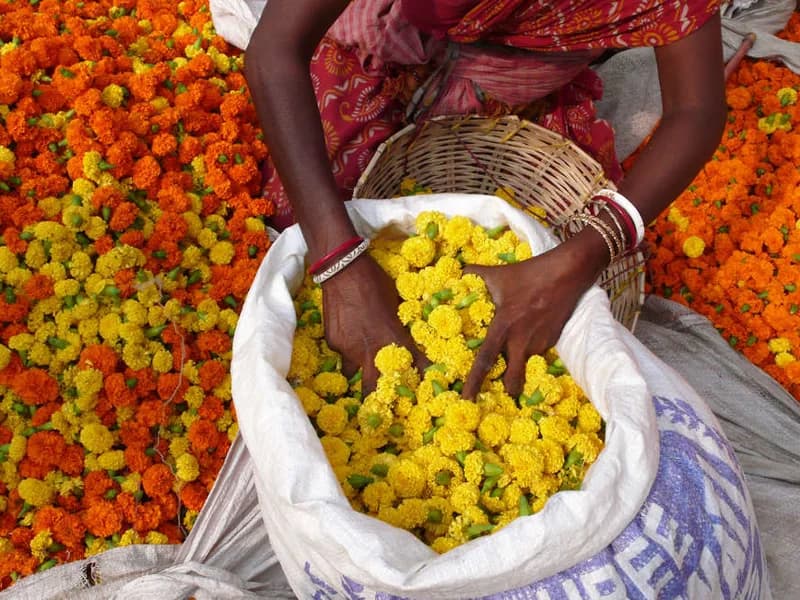
Calcutta was a river city first, and the Hooghly, a distributary of the Ganges, is still its heart. Its great landmark is the Howrah Bridge, a vast cantilever of steel opened in 1943, which carries a ceaseless flow of people, cars, buses, handcarts and bicycles between Kolkata and Howrah railway station on the far bank. Beneath it, the flower market at Mullick Ghat fills the riverbank at dawn with mountains of marigolds.
The ghats along the river, where people bathe, pray and perform ceremonies, are the best place to watch the city's life go by, and a ferry across the river is the best way to see the bridge.
The villages, as Bengalis point out, were there before him.
The city of letters
Kolkata is more than its imperial past. It has long been the cultural capital of Bengal, a city of poets, writers, film-makers, scientists and talkers. Rabindranath Tagore, who in 1913 became the first non-European to win the Nobel Prize in Literature, was born here, and his family house is now a museum. The film director Satyajit Ray worked here. College Street, near the university, is lined with bookshops and book stalls, and the Indian Coffee House above them has been a meeting place for argument and gossip for generations.
The city's festivals are famous, above all Durga Puja in the autumn, when the whole city is decorated and elaborate temporary shrines, the pandals, are built in every neighbourhood. And its food, from fish curries to the sweets of Bengal, is a reason to come in its own right.
Tours that start in Kolkata
Explore's fourteen-night Kolkata to Amritsar by rail begins here and crosses northern India by train: to Bodh Gaya, Varanasi and Sarnath, Agra, Delhi, then up the mountain railway from Kalka to Shimla, and on by way of Ambala to Amritsar. It departs in February, March, October, November and December.
Explore's twenty-night Discover Darjeeling and Bhutan, departing in October, also begins in Kolkata, with the mangrove forests of the Sundarbans, before heading north to Darjeeling, Pelling, Gangtok and Kalimpong, then into Bhutan by way of Phuentsholing to Thimphu, Punakha and Paro, and on to Kathmandu.
The cool season, from about November to February, is the most comfortable time in Kolkata. The hot season from March to May is fierce, and the monsoon from June to September is very wet. October brings Durga Puja, which is an extraordinary time to be in the city, if a crowded one. Give it more than a night on the way somewhere else: Kolkata is a city that reveals itself slowly, over long walks, long lunches and longer conversations.
By Walter Pellow, the name Atlas & Passage’s editorial team writes under. Prices and dates in the trips below come from the operators and can change.