Cruise
Norway by sea, the old way, from a British port
The Vikings came the other way. Crossing the North Sea from Newcastle or Tilbury is still the most natural approach to the fjords, and it spares you the airport.
By Arthur Penhallow26 September 20264 min read
For about three centuries, the traffic across the North Sea ran mostly one way. The longships that appeared off Lindisfarne in 793 had come from the fjords, and for a long while afterwards the Norwegian coast was where trouble for the British Isles began. It seems only fair that the modern crossing runs the other way, and that it does so at a pace the Vikings would have recognised: a day or so at sea, then a grey line on the horizon that slowly resolves into mountains.
Flying to Bergen takes under two hours. Sailing from Newcastle or Tilbury takes considerably longer, and that is rather the point. You arrive in Norway the way Norway is meant to be arrived at, from the water, with the coast ahead of you rather than beneath you, and without having had to surrender your shoes at an airport.
A coast that goes a surprisingly long way inland
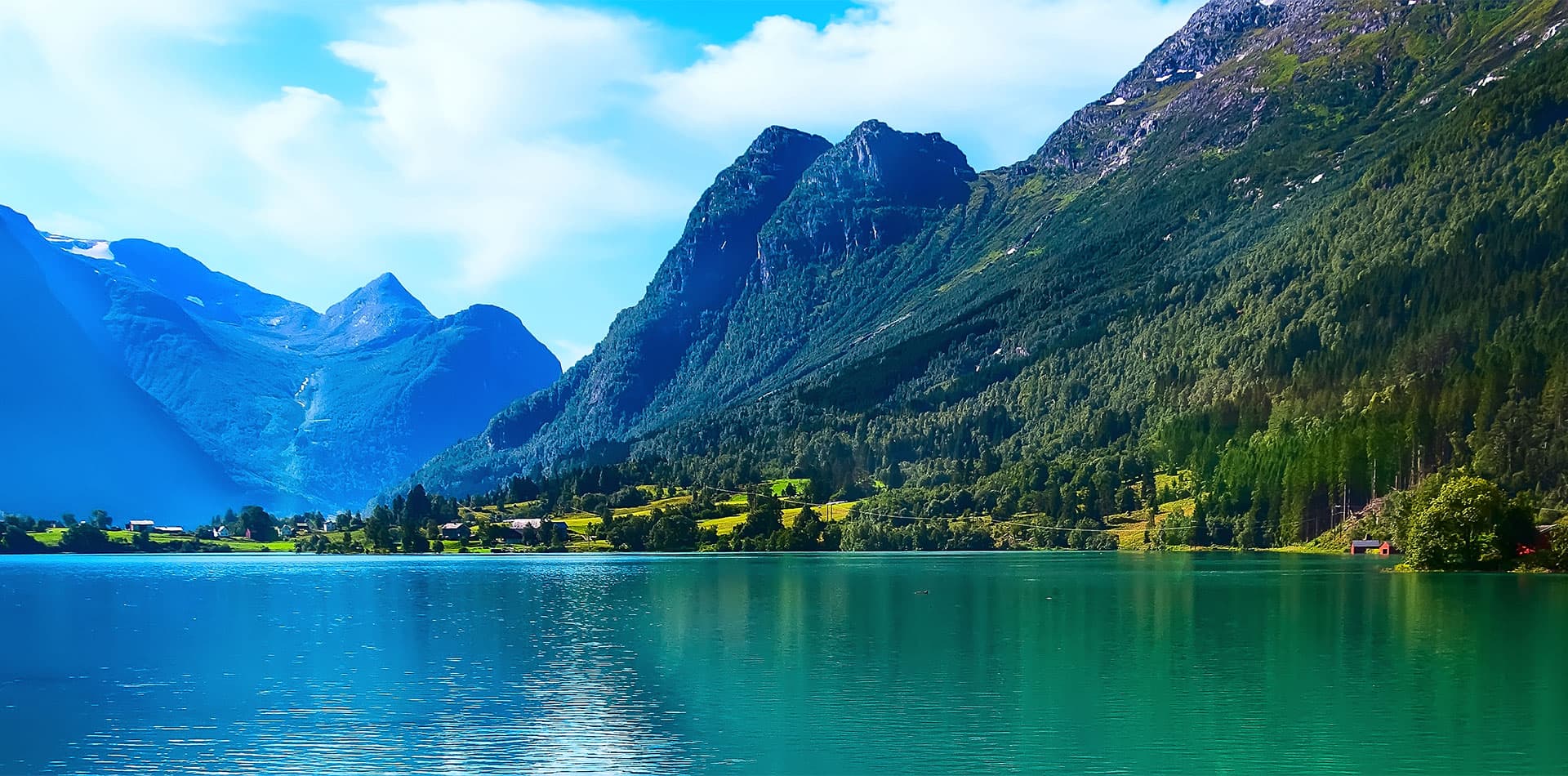
The fjords are drowned valleys, carved by glaciers and then flooded by the sea when the ice retreated. What this means in practice is that the sea goes a very long way inland. The Sognefjord, the longest and deepest in Norway, runs for more than two hundred kilometres from the coast, and its walls fall far below the waterline as steeply as they rise above it. A ship sailing up it is not, in any meaningful sense, at the seaside. It is in the mountains, afloat.
This is why the view from a deck is different from the view from a road. The road clings to one side and keeps disappearing into tunnels; the ship sits in the middle, with both walls in sight, and the waterfalls arrive one after another like a procession. In late spring, when the snow is melting, there are rather more of them than the maps admit.
The ship sits in the middle, with both walls in sight, and the waterfalls arrive one after another like a procession.
Hardanger in blossom, Bergen in the rain
The Hardangerfjord is the gentler cousin: orchards on the lower slopes, small white churches, farms that look as if they were arranged for a jigsaw. It is best in May, when the fruit trees flower and the slopes above them still carry snow, a combination that seems faintly implausible until you see it.
Bergen, where many itineraries call, was for centuries one of the great ports of the Hanseatic League, the merchant network that ran much of northern Europe's trade in dried fish, grain and timber. The row of timber warehouses on the harbour, Bryggen, is on UNESCO's World Heritage List, and it has the slightly tilted look of buildings that have been rebuilt more than once after fires and have never entirely settled. Bergen is also famous for its rain, which it produces with great reliability, and which the locals discuss with the weary pride other cities reserve for their football teams. Bring a coat, and go anyway.
The railway that falls down a mountain
From Flåm, at the head of the Aurlandsfjord, a branch line climbs to Myrdal on the mountain plateau. It rises roughly 860 metres in about twenty kilometres, which makes it one of the steepest standard-gauge railways in the world, and it took the best part of two decades to build, much of it by hand, through twenty tunnels. It opened in the early 1940s, and it has been astonishing its passengers ever since, not least at the Kjosfossen waterfall, where the train stops so that everyone can get out and photograph the same thing.
Several sailings call at Flåm precisely so that passengers can ride it. The line is at its most dramatic in spring and autumn, and in winter, when the snow is on the ground, it is a different and quieter experience altogether.
When to go, and how long for
There is no bad month for the fjords, only different ones. May and early June bring blossom, meltwater and long evenings; midsummer brings light that barely leaves the sky; September brings autumn colour and emptier quaysides. Winter sailings trade the waterfalls for snow and, further north, the chance of the northern lights, which is a chance and not a promise, whatever anyone tells you.
A short sailing of five nights or so is enough to see a fjord or two and decide whether you like this sort of thing. A week allows for Bergen, the railway and a slower pace. Beyond that, itineraries begin to head north towards the Arctic, which is another article, and another kind of trip.
By Arthur Penhallow, the name Atlas & Passage’s editorial team writes under. Prices and dates in the trips below come from the operators and can change.